
Hostile Humor as Contempt, Withholding, and Identity Branding
A birthday artifact by Kyle Morgan, known on Reddit in the Buddhism community as “Old Sick Dead,” using playful design to deliver contempt, replace care with provocation, and enclose identity inside someone else’s mood.
A birthday artifact that uses playful design to deliver contempt, replace care with provocation, and enclose identity inside someone else’s mood.
Content note: This entry discusses coercive dynamics, contempt, and emotional manipulation.
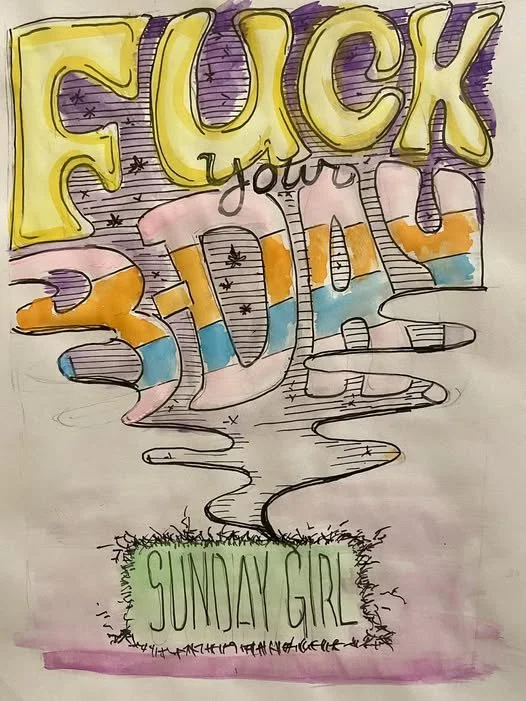
This was the first thing I saw when I woke up on my birthday. Not a small gesture of care. Not a note meant to soften the day. This was presented as the gift.
On the page, the message is direct. “F*CK” is drawn in the largest letters, bright and ballooned, occupying the top of the composition like a headline. The word “your” is smaller and cursive, tucked beneath the profanity, stylized in a way that keeps the insult visually “playful” while still aimed. “BDAY” is also oversized, rendered in cheerful stripes that resemble candy-color signage. Beneath it, “SUNDAY GIRL” is placed inside a pale green box with a scratchy border, like a stamp. A drippy, smoky shape funnels the top message down into the boxed name, linking dominance above to containment below.
A birthday gift is supposed to be simple. Not expensive. Not performative. Just unmistakably oriented toward care, something that says, I see you. I thought of you. I want your day to feel lighter.
This piece is oriented toward something else.
Contempt disguised as “play”
There is a difference between anger and contempt. Anger can exist alongside respect. Contempt is the downward gaze, the posture of superiority that frames another person as ridiculous, lesser, or undeserving of gentleness. It often appears as mockery, profanity, sarcasm, condescension, and jokes that function as punishment. The mechanism is predictable. The cut lands, then the target is blamed for feeling it.
The design matters because the bright, celebratory style creates plausible deniability. When hostility is wrapped in fun visuals, the receiver is pushed into a double bind.
React, and you are labeled “too sensitive.”
Do not react, and you learn to distrust your own internal signal.
In that structure, clarity is not allowed. Confusion becomes the price of staying connected.
This is not only emotional. It is physiological. Mixed signals, bright color paired with aggression, train the body toward vigilance. The nervous system learns unpredictability. Is this affection or threat. Is this safe or a trap. Over time, that uncertainty becomes a baseline. You start scanning tone, forecasting mood shifts, editing yourself for safety, shrinking your needs because the environment has taught you that stability depends on how well you manage someone else’s volatility.
Withholding repackaged as a gift
A second maneuver operates here. Withholding reframed as humor. This was not a card attached to care. This was the care.
When ordinary generosity is withheld and replaced with provocation, the recipient is expected to supply what is missing. Reinterpret it generously, regulate themselves alone, and perform gratitude anyway. The recipient becomes the translator, converting sting into “edgy affection” and absence into meaning.
That translation is labor. It accumulates. Over time, it trains a person to accept less while working harder to keep the emotional temperature stable. It trains hyper-attunement, the constant reading of micro-signals, the adjusting of expression, the pre-emptive softening of truth.
And when steadiness is rare, attention can start to feel like relief. Relief can resemble closeness because the body is briefly exiting threat. But relief is not the same as being cherished. When care is unpredictable, crumbs can start to feel like jackpots, not because the receiver is naive, but because the nervous system is trying to survive uncertainty by clinging to whatever moment feels like oxygen.
Identity treated as a prop
Then there is the label. “SUNDAY GIRL.” It is boxed and bordered like a stamp. That matters, because it was not an empty nickname to me. It was a name I authored first and carried forward in my life. In a healthy dynamic, a person’s name is handled with tenderness. It is not used as a design element inside someone else’s provocation.
A stamp is not intimacy. A stamp is a claim. It implies possession, classification, enclosure.
Placed beneath an aggressive headline, the visual message becomes clearer. My name sits downstream from his tone. His emotional weather comes first. My identity is packaged inside it.
A pattern, not a diagnosis
I am not writing this as a clinical diagnosis. I am naming a pattern.
When these behaviors repeat, hostility framed as humor, care replaced by provocation, identity treated as something to label and contain, and accountability treated as optional, the relationship stops functioning as a bond and starts functioning as a mechanism.
Birthdays make this stark because birthdays are not complicated. They are a small test of attention. You do not need grand gestures. You need consideration. You need the willingness to center someone else for a day without turning the moment into a performance of dominance.
Real care does not require translation. It does not arrive with a sting and demand gratitude anyway. It does not treat attention as a scarce resource to ration. It does not confuse domination with devotion.
The opposite of distortion is simple. Reality, steadiness, and care.

Curated Persona, Private Record
Two portraits from the same hand, one rendered with tenderness and one with harsh reduction, showing how the public persona “Old Sick Dead” can be curated and circulated while the private record and lived impact tell a different story.
Two portraits from the same hand
Content warning: domestic abuse, strangulation.
During the period my children and I were dealing with domestic abuse and its aftermath, a Portland based DJ and “producer” who goes by Xavia Purp became involved by posting bail for my ex of 20 years, Kyle Evan Morgan (44), also known online as Old Sick Dead.
Kyle has publicly presented himself as someone who shares Buddhist teachings through his art. In his criminal case, he was charged with multiple felony counts related to abuse, including strangulation. A CPS investigation also resulted in founded findings of abuse involving our children.
I am writing about this because public persona can be curated while the private record tells the truth.
What these images show, and why I am documenting them
I am sharing two drawings created by Kyle.
In the first image, the subject is rendered with softness and attention. The lines are careful. The face is treated with dimensionality and tenderness. The overall effect is elevation. It reads like devotion, or at least idealization. I cannot verify the identity of the person depicted, and I am not claiming certainty. I can only name what I observed in context: during this period, he repeatedly sketched the same woman in a consistently flattering light, and he had suggestive photos of a woman on his phone.
In the second image, the style changes. The strokes are heavier. The face is captured in a harsher register. The linework is aggressive and compressed, as if the goal is not to understand the subject, but to reduce her.
I believe the second image reflects how he chose to capture me.
Even if a viewer knows nothing about the backstory, the contrast communicates something legible: one subject is treated as worthy of gentleness, and the other is treated as disposable.
That difference matters. Not because art is evidence of a crime by itself, but because the way someone repeatedly frames people can mirror the roles they assign them. Idealization for one. Devaluation for another. In relational harm, this pattern is not rare. It is one of the ways control stabilizes itself. Someone is lifted. Someone is diminished. The hierarchy becomes the story.
Why “public teachings” do not neutralize private harm
I have learned, painfully, that spiritual language and public virtue do not protect families. A public image can be sincere, polished, persuasive, and still function as cover. That is not an attack on a tradition. It is a warning about human behavior.
There is a particular kind of confusion that happens when someone who harms others also performs insight. It creates an internal contradiction in the observer, especially for survivors. The mind searches for reconciliation. The body stays alert. The nervous system tries to solve the puzzle because unsolved puzzles feel unsafe.
But the clearest measure is not the persona. It is the impact.
A teaching voice does not erase coercion. A spiritual aesthetic does not cancel violence. Art that gestures toward compassion does not outweigh what happened behind closed doors.
Why I am naming the bail involvement
I am naming the bail involvement because it is part of the ecosystem around harm. Abuse rarely survives on one person’s actions alone. It survives through enabling, minimization, and the comfort of “he does not seem like that.” When support is offered to someone facing serious allegations, the support often functions as a statement, whether intended or not. It can reinforce the public image. It can undermine the credibility of victims. It can increase pressure on survivors to stay quiet.
I am documenting this to keep the record coherent. I am not asking anyone to take action.
Boundaries and reader ethics
Please do not contact, harass, threaten, or dox anyone mentioned here. This is documentation, not a call to mobilize. If you are reading this and feel activated, pause. Do not outsource your nervous system to the internet. Do not turn my record into a pile-on.
My purpose is clarity.
A person can build a public identity that looks enlightened, creative, and safe. The private record can still tell a different story. When that happens, the record deserves to be named, preserved, and read without fantasy.

Portrait sketch associated with the name “Xavia Purp” in my records.

Portrait of me, drawn by Kyle Morgan (also known online as “Old Sick Dead”).