
Curated Persona, Private Record
Artifact Analysis: Two Portraits Attributed to Kyle Morgan
Content warning: Domestic abuse and strangulation.
This article examines two portraits that I attribute to Kyle Evan Morgan, who has also used the online name “Old Sick Dead.” It explains what I personally observed, how I understand the images within the larger history of our relationship, and the limits of what the artwork can establish.
The images are not presented as proof of a crime, an affair, a person’s identity, or the artist’s intentions. They are artifacts from a much larger record.
During the period when my children and I were experiencing domestic abuse and its aftermath, a person publicly associated with the names “Xavia Purp” and “Xavia Phoenix” became connected to Kyle’s criminal case through release-related arrangements, according to records and communications I reviewed.
Kyle was later charged with multiple felony offenses, including strangulation. Those criminal charges remain pending and are allegations unless and until proven in court. A separate CPS investigation resulted in founded findings concerning harm to our children. The criminal case and CPS records are documented elsewhere in this archive.
I am writing about these portraits because public personas can be carefully curated while private conduct tells a different story.
What the Images Show
According to my firsthand knowledge and records, Kyle created both drawings.
The first is a pencil drawing containing two overlapping faces. I associate this drawing with the name “Xavia Purp” because of the context in which I discovered and documented it. However, I cannot independently verify the identities of the people depicted.
During this period, I observed Kyle repeatedly sketching what appeared to be the same woman’s face. When I asked who she was, he told me that he was practicing facial features. I later discovered photographs on his device that changed how I understood those repeated drawings.
In the first image, I see careful lines, dimensionality, and softness. The face appears studied and elevated. To me, the drawing conveys tenderness or idealization.
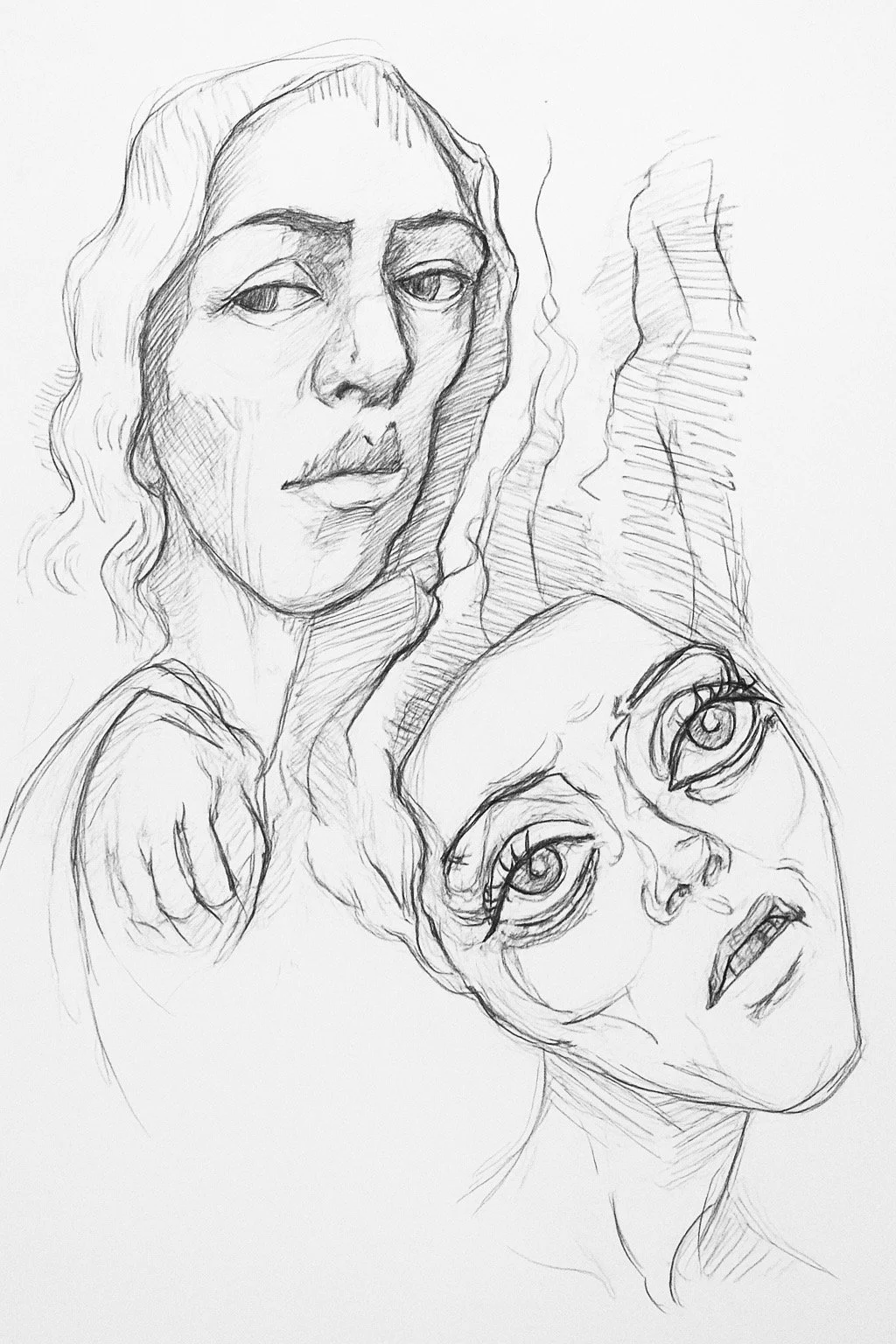
Pencil Portrait Associated with the Name “Xavia Purp”
Pencil drawing attributed to Kyle Morgan and associated in my records with the name “Xavia Purp.” The drawing contains two overlapping faces. I have not independently verified the identities of the people depicted.
The second image is a high-contrast ink portrait that I identify as a drawing of me. Its visual treatment is markedly different. I experience the strokes as heavier, harsher, and more compressed.
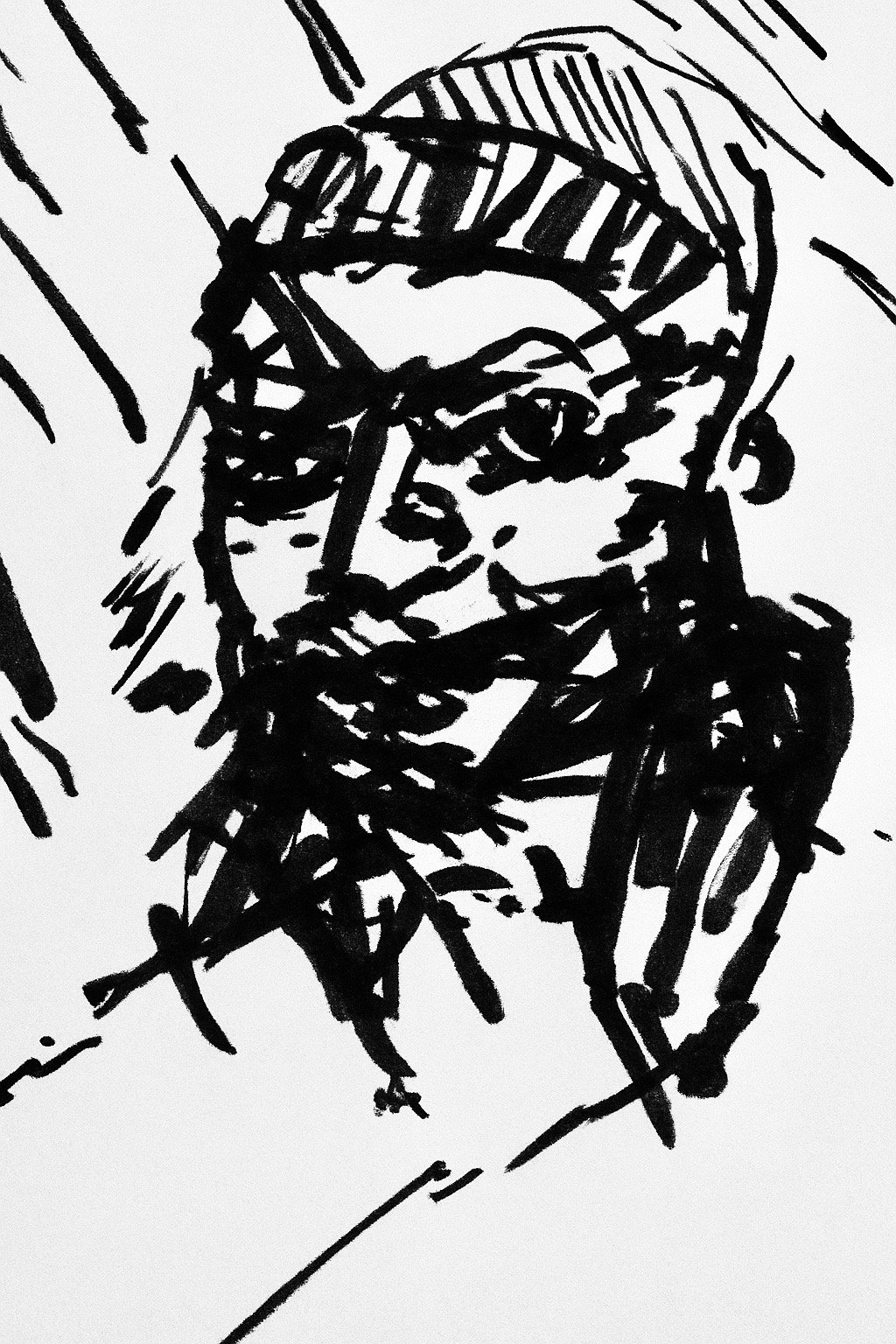
Portrait of Rebekah Morgan
Ink portrait of Rebekah Morgan, drawn by Kyle Morgan, according to my identification and records.
My interpretation is necessarily personal. Different materials, poses, techniques, and artistic purposes can produce very different effects. The images alone cannot establish Kyle’s motives.
Within the broader history of our relationship, however, the contrast resonated with a pattern I experienced repeatedly: idealization directed outward and devaluation directed toward me.
One subject appears rendered with gentleness. The other appears rendered in a harsher and more distorted register.
That contrast matters to me because art does not exist outside the relationships in which it is created. The ways people are represented can sometimes reflect the roles assigned to them. One person may be elevated while another is diminished. Over time, that hierarchy can become part of the larger architecture of relational harm.
The portraits do not prove that pattern by themselves. They document one part of how I experienced it.
Public Teachings Do Not Neutralize Private Harm
Kyle publicly presented himself as an artist who incorporated Buddhist ideas and teachings into his work.
I learned painfully that spiritual language and public virtue do not protect a family from private harm. A public identity can appear thoughtful, creative, and compassionate while concealing conduct that produces fear and instability at home.
There is a particular kind of confusion that occurs when someone who causes harm also performs insight. The observer searches for a way to reconcile the contradiction. Survivors may question their own perceptions because the person they know privately appears so different from the person everyone else sees.
The clearest measure is not the persona. It is the impact.
A teaching voice does not erase coercion.
A spiritual aesthetic does not cancel violence.
Art that gestures toward compassion does not outweigh conduct behind closed doors.
Why I Am Documenting the Release-Related Connection
I am identifying the release-related connection because it explains why these names and images appear within the same archive. I am not claiming that another person caused Kyle’s alleged conduct or is legally responsible for it.
Supporting a person accused of a crime does not, by itself, establish knowledge, endorsement, or complicity. It does, however, become relevant context when that person later appears in communications, photographs, records, or other parts of the chronology.
Abuse does not occur in a social vacuum. Public disbelief, minimization, and unquestioning support can affect survivors even when the people providing that support do not understand the entire situation.
I am preserving the connection as part of the record. I am not asking readers to contact anyone or take action.
Evidence and Limitations
For clarity:
I attribute both drawings to Kyle based on my firsthand knowledge and records.
I identify the second drawing as a portrait of me.
I associate the first drawing with the name “Xavia Purp,” but I cannot independently verify the identities of the people depicted.
My discussion of the drawings is personal interpretation, not expert art analysis or proof of motive.
Kyle’s criminal charges remain pending and should not be described as convictions.
CPS findings arise from a separate administrative process and are not criminal convictions.
The release-related connection should not be described as “posting bail” unless a court or financial record specifically establishes that fact.
Reader Boundaries
Please do not contact, harass, threaten, impersonate, or attempt to identify the private information of anyone mentioned here.
This is documentation, not a call to mobilize.
If this material activates you, pause before responding. Do not turn my record into a pile-on. Do not outsource your nervous system to the internet.
My purpose is clarity.
A person can construct a public identity that appears enlightened, creative, and safe while the private record tells a profoundly different story. When that happens, the record deserves to be preserved, examined carefully, and read without fantasy.