
Hostile Humor as Contempt, Withholding, and Identity Branding
Artifact Analysis: A Birthday Image Given to Me by Kyle Morgan
Content note: This entry discusses contempt, coercive dynamics, emotional manipulation, and the effects of unpredictable care.
This article examines a birthday image Kyle Morgan gave me. It describes what is visible in the artifact, how I experienced it, and why it became meaningful within the larger pattern of our relationship.
The artwork alone cannot prove Kyle’s intent or establish a pattern of abuse. My interpretation comes from the artifact’s language, composition, the circumstances in which it was given to me, and my firsthand experience of the relationship.
At the same time he gave me this, Kyle was cultivating the moniker “Old Sick Dead” behind the scenes as part of his self-branding, even though that name is not written on this particular artifact.
The First Thing I Saw on My Birthday
This was the first thing I saw when I woke up on my birthday.
It was not attached to another gift or accompanied by a caring note. This was presented as the gift.
I did not need something expensive or elaborate. I wanted the simple consideration that makes a birthday gesture recognizable as care: I see you. I thought about you. I want your day to feel lighter.
Instead, the first message directed toward me was profanity.
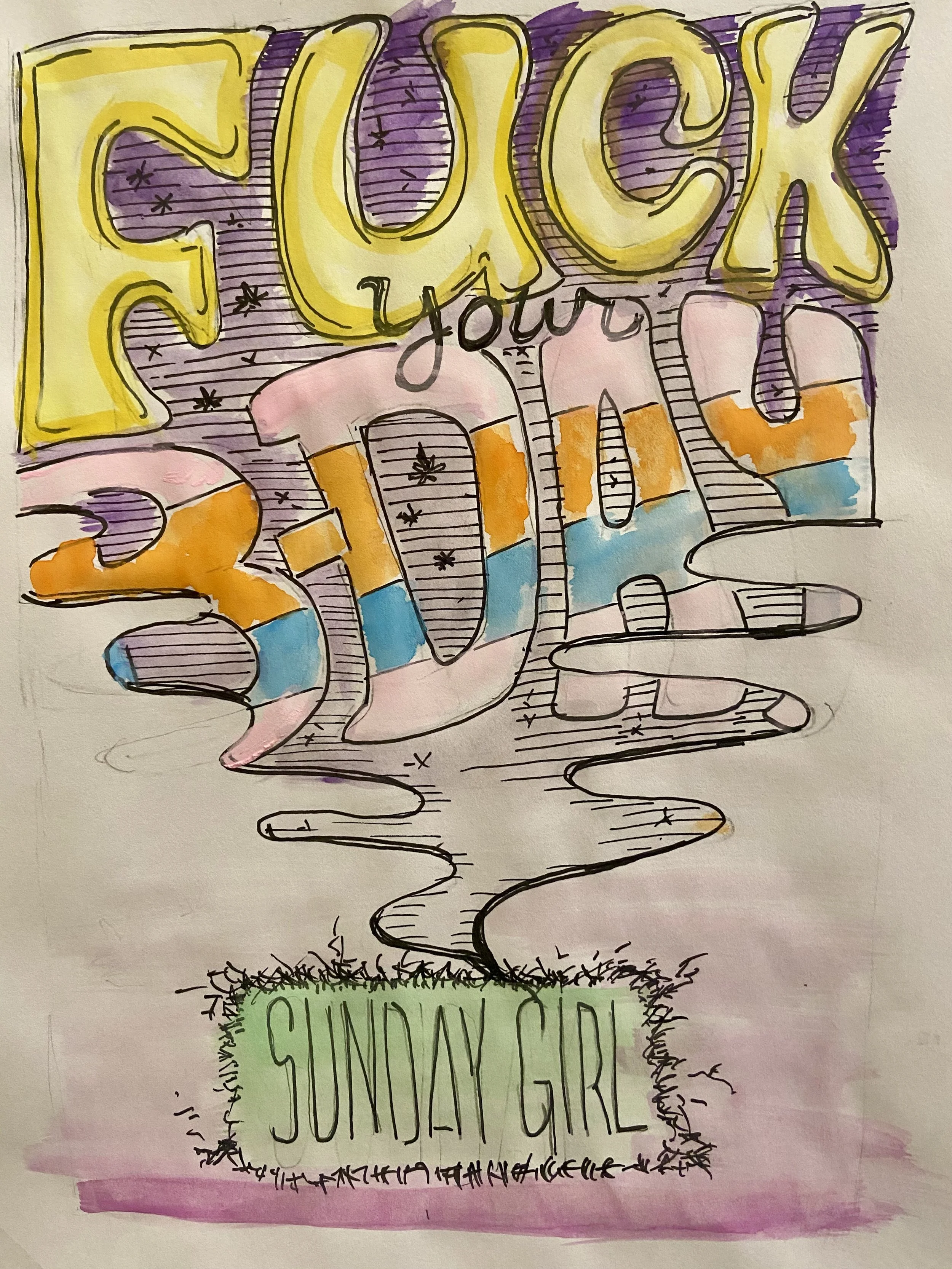
Birthday Artwork Given to Rebekah Morgan
Artwork given to me by Kyle Morgan as a birthday gift. The image prominently displays the phrase “FCK your BDAY” above the boxed name “SUNDAY GIRL.”*
What the Artifact Shows
The word “F*CK” appears in the largest letters, bright and ballooned across the top of the composition. Beneath it, the word “your” appears smaller and in cursive. “BDAY” is also oversized and rendered in cheerful, candy-colored stripes.
Below the main message, “SUNDAY GIRL” appears inside a pale green box with a rough border. A dark, dripping shape visually connects the profanity above to the boxed name below.
The design combines celebratory colors with an aggressive message. That contrast is central to how I experienced the artifact. The visual language says birthday celebration, while the written language delivers hostility.
To another viewer, the image might appear irreverent or playful. To me, within the context of the relationship, it felt contemptuous.
Contempt Disguised as Play
I use the word contempt behaviorally, not diagnostically.
Anger communicates that something is wrong. Contempt positions another person as ridiculous, inferior, or undeserving of gentleness. It can appear through mockery, profanity, sarcasm, condescension, or jokes that punish the recipient while allowing the speaker to deny seriousness.
The bright design gives the hostility plausible deniability. Because the message is visually playful, the recipient can be placed in a double bind.
React to the insult, and you risk being called too sensitive.
Do not react, and you suppress your own internal response to preserve the peace.
The problem is not humor itself. Humor between people who trust one another can be intimate and affectionate. The relevant question is whether both people experience the joke as connection, or whether one person absorbs the injury while the other controls what the injury is allowed to mean.
In my relationship, I often felt required to reinterpret hostility as humor and then regulate my response alone.
Withholding Repackaged as a Gift
There was another dynamic operating here: the replacement of care with provocation.
This was not a provocative card attached to a thoughtful gesture. The provocation replaced the gesture.
That left me responsible for supplying what was missing. I was expected to translate the sting into edgy affection, assign generosity to the absence of care, and perform gratitude anyway.
That kind of translation is emotional labor.
When it occurs repeatedly, a person may begin monitoring tone, expressions, and small changes in mood. They may soften their reactions, minimize their needs, and search for the interpretation least likely to create conflict.
Repeated mixed signals can also contribute to vigilance. The question is no longer simply, “What does this mean?” It becomes, “Is this affection or punishment? Am I safe to respond honestly? What reaction will keep the situation stable?”
When steadiness is rare, ordinary attention can feel like relief. Relief can resemble closeness because the body is briefly exiting uncertainty. But relief from tension is not the same as being cherished.
My Name Inside His Message
The words “SUNDAY GIRL” carried personal meaning for me. This was not an empty nickname created for the artwork. It was a name I had authored and carried forward in my life.
In a healthy relationship, I believe a person’s chosen name should be handled with tenderness and respect. Here, my name became part of someone else’s provocative design.
Visually, it is boxed, bordered, and placed beneath the dominant message.
A box can simply be a design element. In my reading of this artifact, however, it felt like classification and enclosure. His tone occupied the largest part of the image. My identity appeared beneath it, framed inside the emotional atmosphere he created.
I do not claim that the composition proves possession or conscious intent. I am documenting how the visual hierarchy affected me and why it later became significant.
An Artifact Within a Larger Pattern
I am not presenting this image as proof of abuse by itself. I am preserving it as one artifact within a much larger record.
A single hostile joke may be thoughtless. A repeated structure is different.
When hostility is routinely framed as humor, care is replaced by provocation, the recipient must translate injury into affection, and accountability disappears behind “just joking,” the relationship can stop feeling emotionally mutual.
The artifact mattered because it reflected a pattern I already knew:
His emotional weather came first.
My response had to adjust around it.
His intentions defined what happened.
My experience was treated as negotiable.
That is why the image stayed with me. It was not merely the profanity. It was the expectation that I receive contempt as celebration.
What Care Does Differently
A birthday does not require a grand performance. It requires consideration.
Real care does not demand that the recipient ignore a sting and display gratitude anyway. It does not make attention so scarce that ordinary decency feels extraordinary. It does not require one person to translate hostility into devotion to preserve the relationship.
Care can be playful without being punishing.
Humor can be irreverent without making someone feel small.
Affection does not require confusion.
The opposite of distortion is simpler than the distortion itself: reality, steadiness, mutuality, and care.
Evidence and Limitations
For clarity:
Kyle Morgan gave me this artifact as my birthday gift.
The words and visual elements described above are visible in the artifact.
“Sunday Girl” was a name I had previously authored and used.
“Old Sick Dead” does not appear on this particular artifact.
My discussion of the composition and its emotional meaning is personal interpretation.
The artifact alone cannot establish Kyle’s intentions or prove a broader pattern of conduct.
I am publishing it as one dated artifact within my larger firsthand record.
This archive does not ask one image to prove an entire relationship. It preserves the image, the circumstances in which I received it, and the meaning it acquired when placed beside the rest of the record.