
The Persona Begins: Death Branded as Spiritual Identity
Old Sick Dead Art Archive, Artifact No. 1
Within this archive, the first artwork establishes death, suffering, and spiritual authority as the foundation of Kyle Morgan’s developing Old Sick Dead identity. Read beside years of contemporaneous communications documenting fear, silencing, and deliberate emotional injury, the skull becomes more than a Buddhist meditation on mortality.
Content note: This entry discusses psychological abuse, spiritual abuse, coercive control, domestic violence, strangulation, grief, death imagery, abusive and profane language, sexual accusations, and thoughts of self-harm.
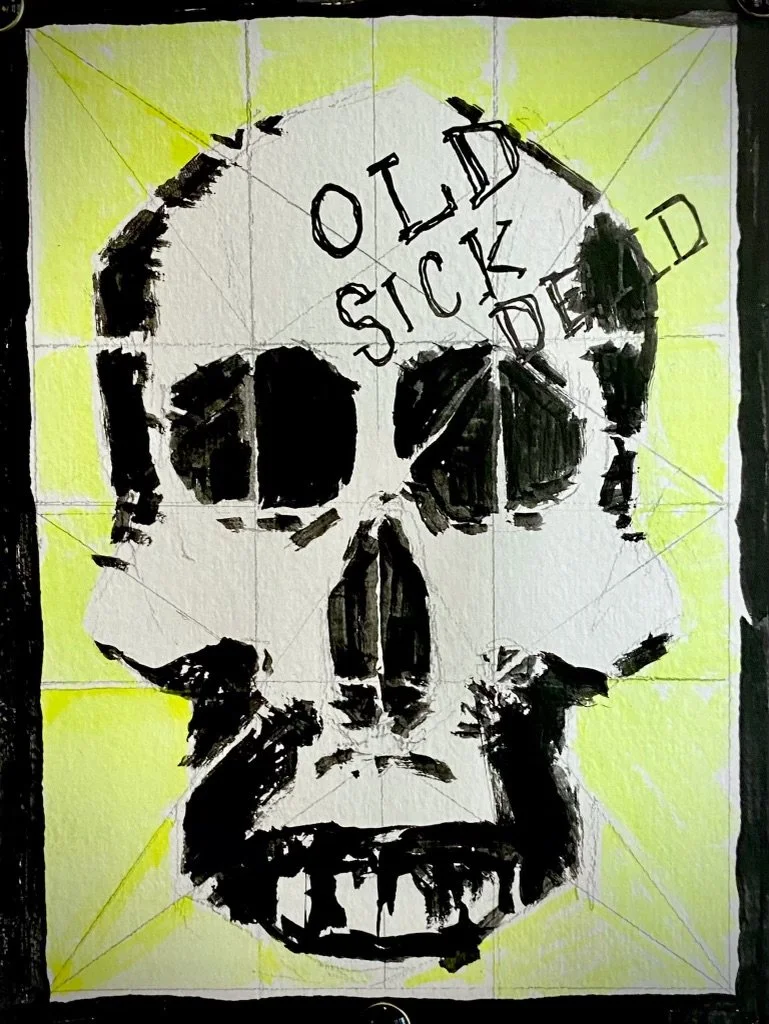
Old Sick Dead Skull, Artwork No. 1.
This is the first artwork in the numbered collection Kyle Morgan sent me for help organizing and promoting his work. “OLD SICK DEAD” is written directly across the skull. The original photograph was captured on September 2, 2021.
The Artifact
This is Artwork No. 1 in a numbered collection of 123 works Kyle Morgan sent to me in what he represented as their order of creation, from his earliest work to his most current work at the time.
The preserved filename is:
1 skull.jpeg
The image shows a frontal skull rendered in black and white against a fluorescent yellow-green background. Fine lines radiate outward from the skull, giving the composition the appearance of illumination, projection, or a constructed aura.
The words “OLD SICK DEAD” are written directly across the skull’s forehead.
They do not appear beneath the image as an ordinary title or outside the figure as an explanatory label. The identity is inscribed onto the dead body itself.
Black ink fills the eye sockets, nasal cavity, cheek structure, and jaw. Dark marks descend from the mouth and teeth, creating an appearance of decay, dripping, injury, or speech emerging from a deadened mouth.
Documented Date and Metadata
The original JPEG preserves the following metadata:
Photograph date: September 2, 2021
Time: 12:58:21 p.m. Pacific
Camera: Apple iPhone 11
Software: iOS 14.7.1
Dimensions: 769 × 1024 pixels
Original numbered filename: 1 skull.jpeg
The Public Meaning
Kyle later publicly described the old, the sick, and the dead as Buddhist messengers that prompted the Buddha’s spiritual journey.
Within that public explanation, the skull can be presented as a meditation on mortality, impermanence, sickness, aging, suffering, and death.
That interpretation is not inherently abusive.
But this artwork was not created in a historical vacuum or received by an anonymous viewer. It entered a relationship with a long, documented history.
The private context changes what the image communicated to me.
What Was Happening in My Life
By September 2021, death was not an abstract spiritual concept in my life.
My mother died on March 27, 2021. Her death left me without meaningful family support and intensified my isolation inside the relationship.
I have reported that, on May 18, 2021, Kyle assaulted and strangled me in our home. I later documented the incident, the marks on my body, the physical symptoms that followed, and the fact that our children witnessed it.
Less than four months later, the first image in the numbered collection was photographed: a skull marked “OLD SICK DEAD.”
The following day, September 3, 2021, a portrait of me was photographed and marked with the same words.
The sequence matters:
A skull marked “OLD SICK DEAD.”
A portrait of me marked “OLD SICK DEAD.”
The first image establishes the identity and its symbolic language.
The second places me beside that identity.
The Emails and Written Record
The skull cannot be interpreted as though it appeared inside a neutral relationship. For more than a decade before this photograph was taken, I had been documenting fear, psychological destabilization, threatened abandonment, and the weaponization of my vulnerability.
January 29, 2009
In a long communication letter to Kyle, I described increasingly frequent conflicts, anxiety, self-doubt, and the effect our communication was having on my mental health.
I explained that rhetorical questioning could be used against me “as a weapon.” I described intensified self-criticism and self-hate. I asked for counseling, communication, and collaborative problem-solving.
I was not writing after the relationship ended.
I was documenting the psychological damage while I was still trying to preserve the relationship.
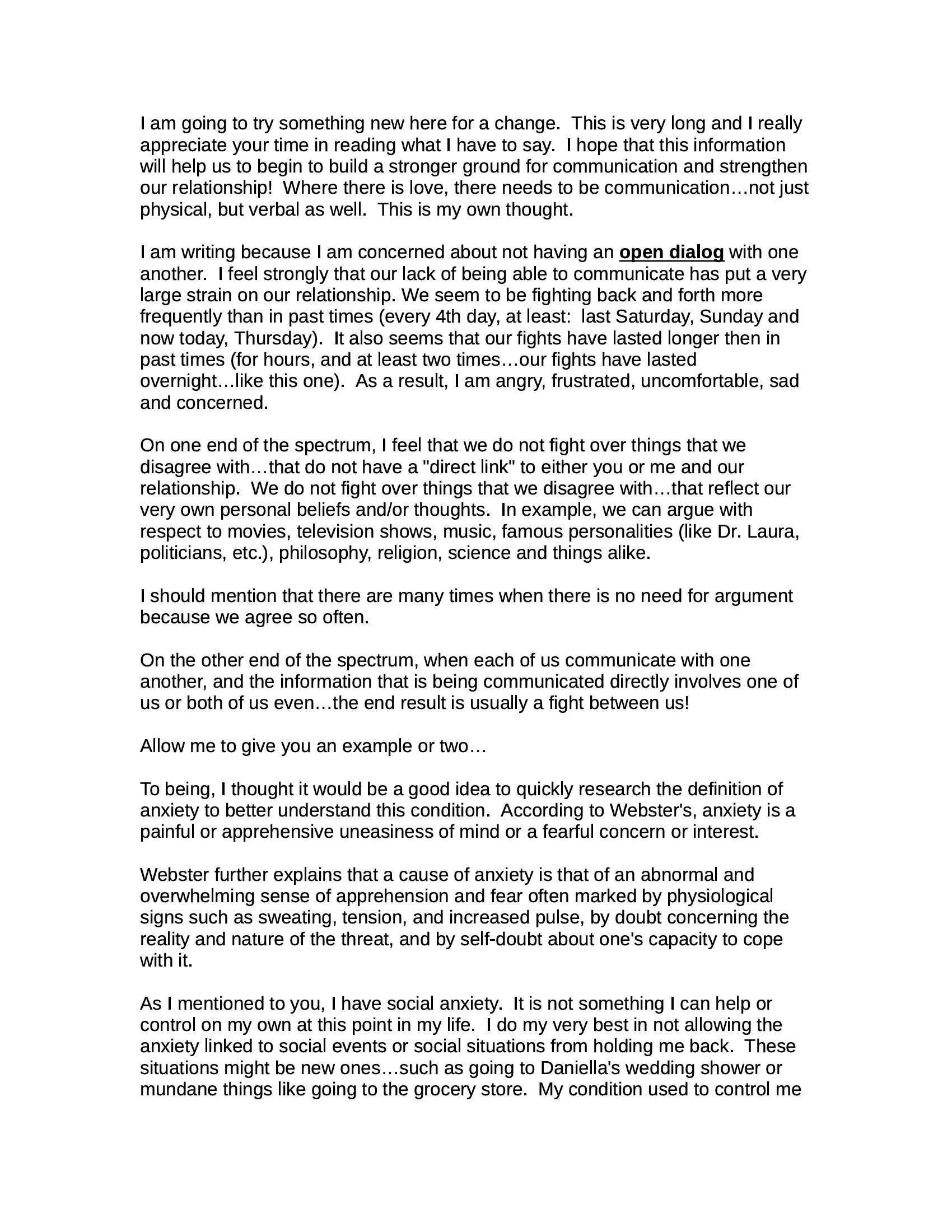
A Very Long Letter, January 29, 2009 — Page 1 of 6. I introduce my concerns about our increasingly frequent conflicts, explain that I am writing because spoken conversations were becoming unproductive, and ask Kyle to read the letter with empathy and openness.
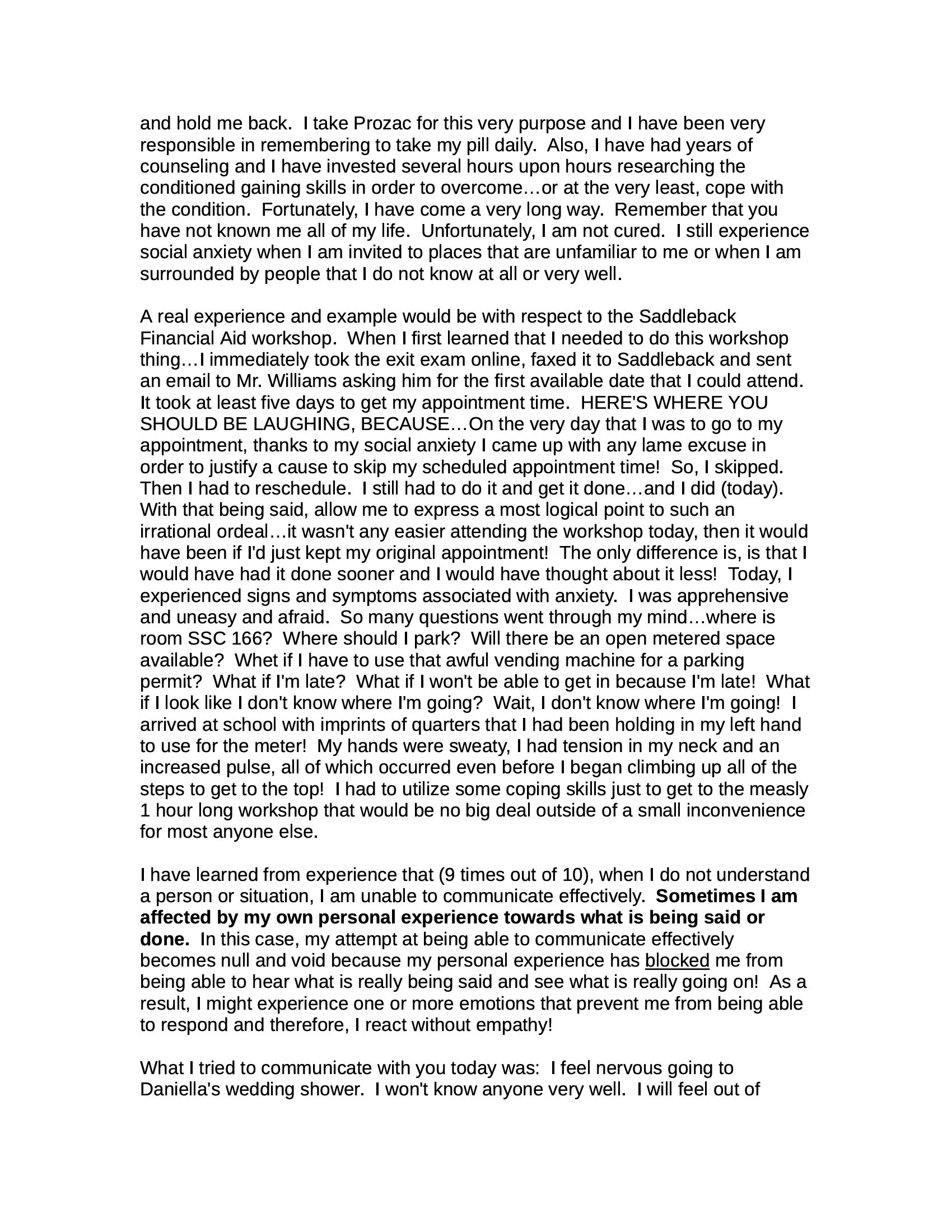
A Very Long Letter, January 29, 2009 — Page 2 of 6. I describe the physical symptoms of my anxiety, my efforts to manage it, and my concerns about attending Daniella’s wedding shower.
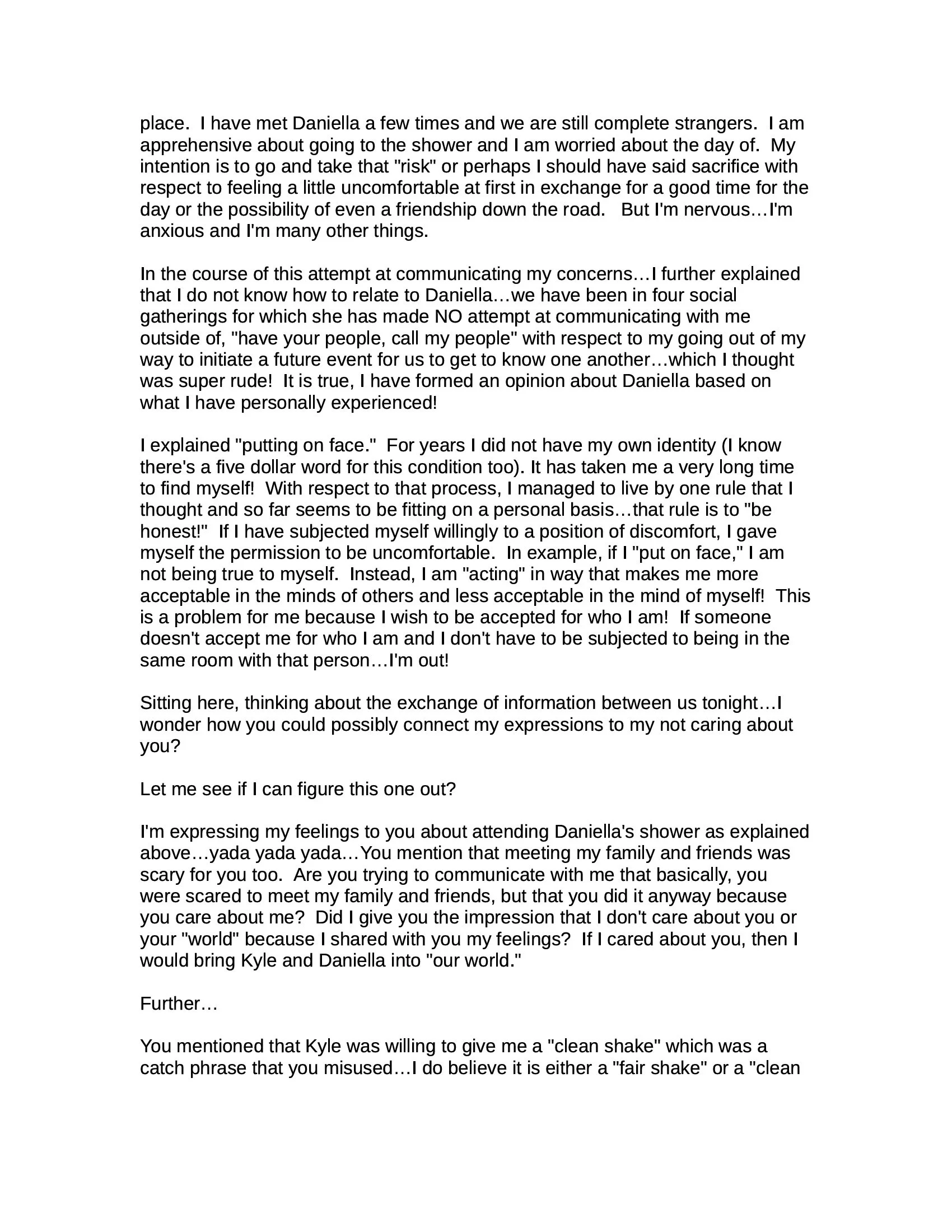
A Very Long Letter, January 29, 2009 — Page 3 of 6. I explain my discomfort around Daniella, my desire to be honest about my feelings, and concerns about information about our relationship being shared with Kyle and Daniella.
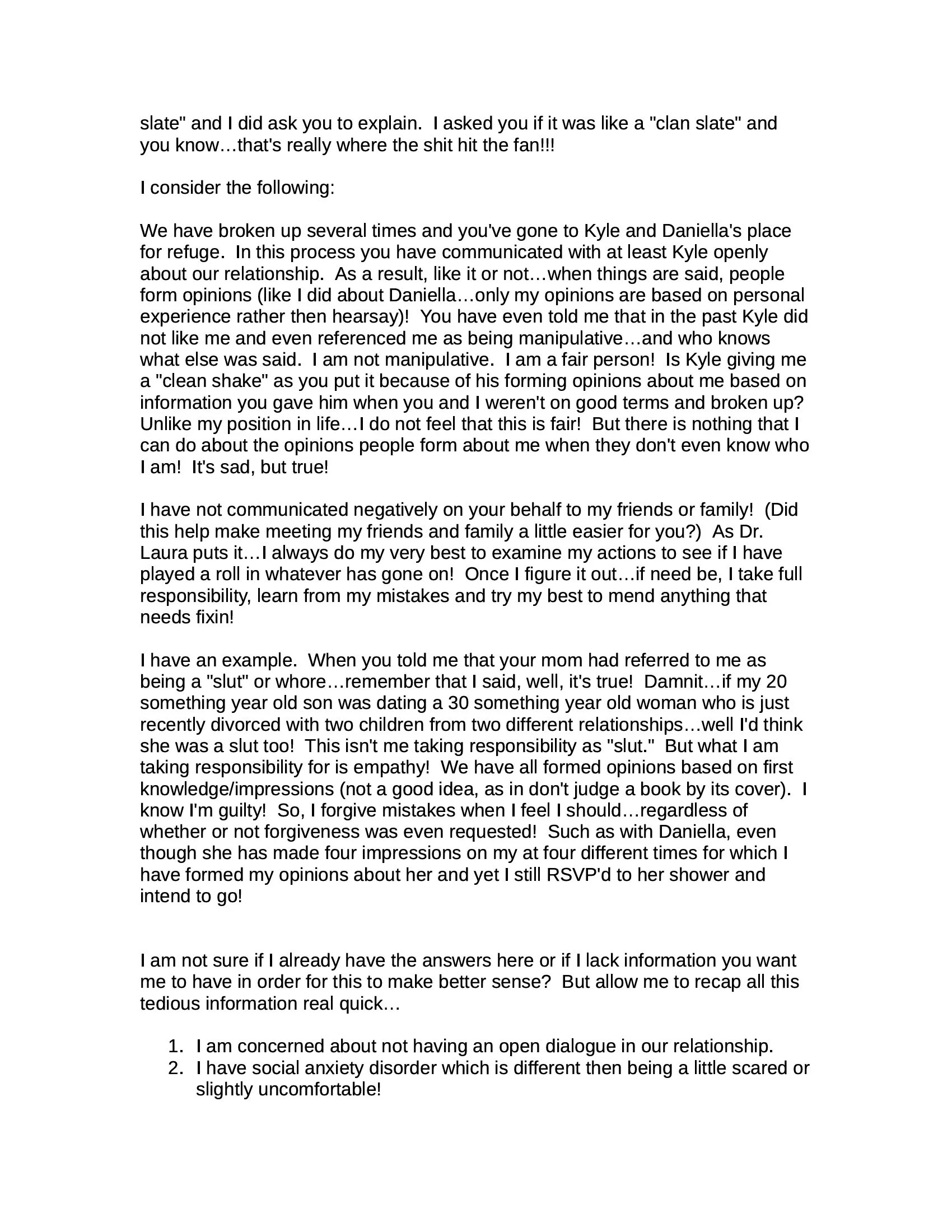
A Very Long Letter, January 29, 2009 — Page 4 of 6. I discuss prior breakups, information about our relationship being shared with others, and my attempt to understand the conflict through empathy and personal responsibility.
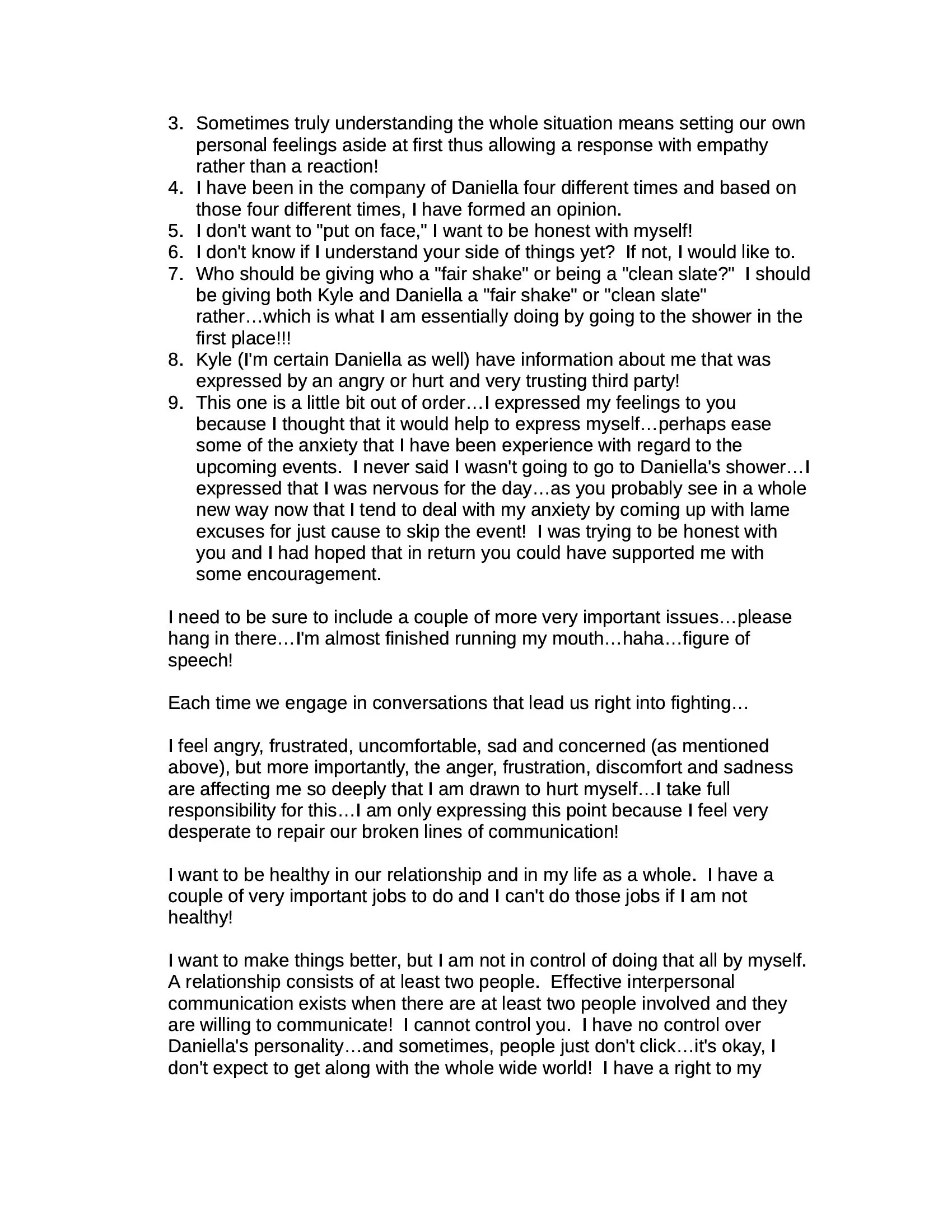
A Very Long Letter, January 29, 2009 — Page 5 of 6. I describe how recurring conflict was affecting me emotionally, including thoughts of self-harm, while emphasizing my desire to repair communication and have a healthy relationship.
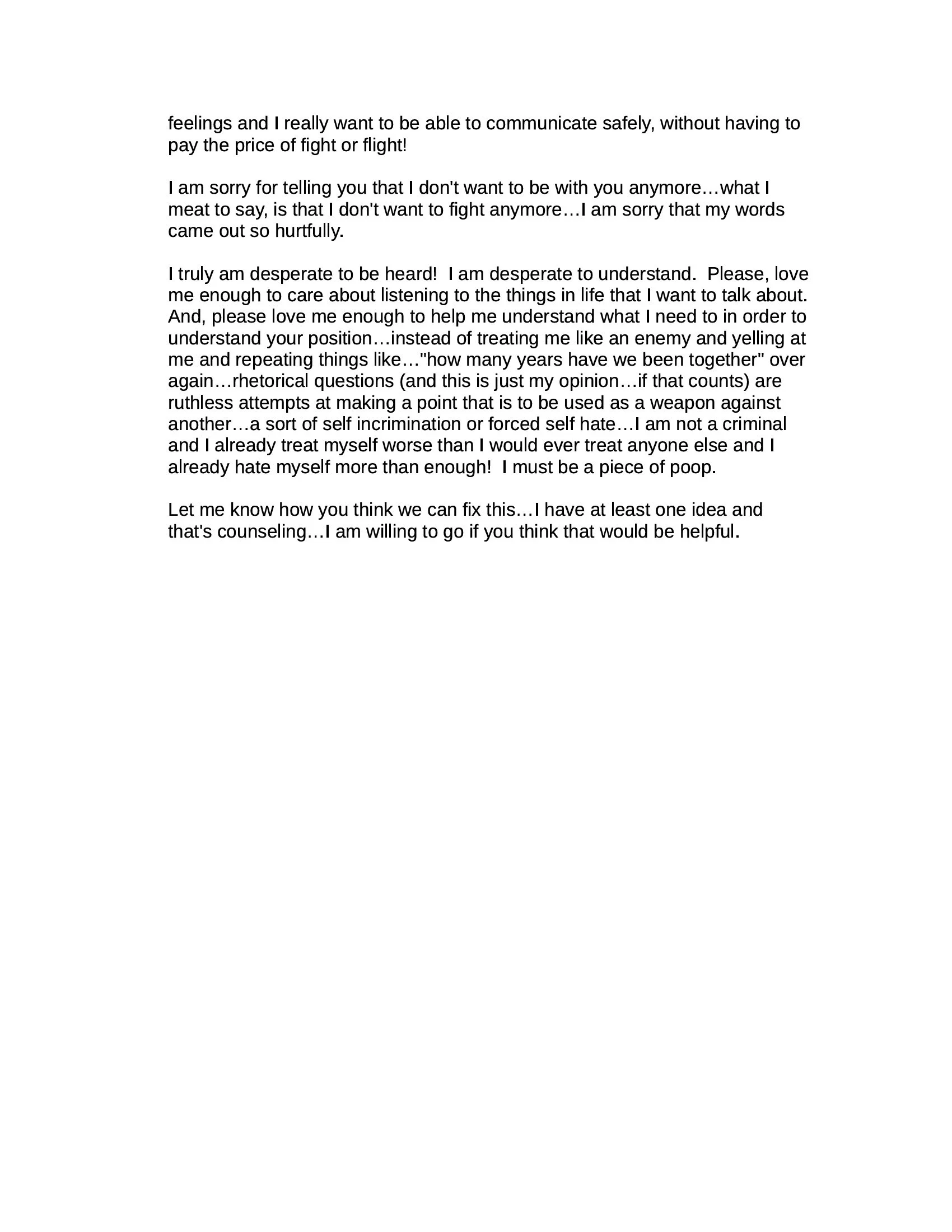
A Very Long Letter, January 29, 2009 — Page 6 of 6. The letter concludes with an apology for saying I did not want the relationship, a plea to be heard without fighting, and my suggestion that we seek counseling.
April 28, 2016
The April 28, 2016 Apple Messages/iChat record preserves approximately seven hours of communication between Kyle and me, beginning at 7:43 a.m. and continuing through 3:08 p.m.
The complete record spans thirteen redacted transcript pages.
During the exchange, Kyle wrote:
“Fuck you”
And:
“Do me a favor and look for a job you fucking bitch”
I responded:
“Thanks for all of your emotional abuse”
Later, when he questioned my medication and behavior, I wrote:
“Please refrain from asking me questions.”
“I don't want to talk about myself because you use it as a weapon against me.”
As the exchange continued, I wrote:
“You scare me.”
“You use my honesty as a weapon against me.”
“That's why I left.”
“Cause you scare me.”
“And I will shut down...that is what you have been trying to get me to do all morning.”
I repeatedly described not feeling emotionally or mentally safe enough to discuss my pain with him.
I eventually wrote:
“I really am at a loss. I really need to be able to talk with you about my hurts and resentments...and I am afraid I can't.”
And:
“Yeah I'm just not in a place mentally where I feel safe talking to you about my hurts and resentments.”
I suggested counseling and continued trying to find a way to repair the relationship.
After reading what I had written, Kyle eventually responded:
“I see and understand what you are saying. You are not wrong.”
He then wrote:
“There are things I could and should work on”
And:
“I am sorry for trying to hurt you with my ugly insults and language”
He also said:
“I will make sure that I resolve those things and treat you better”
That acknowledgment is essential.
It is not only my later interpretation that his language caused emotional injury. In the contemporaneous exchange itself, Kyle explicitly described his own conduct as “trying to hurt” me with his insults and language.
The thirteen pages below preserve the exchange in sequence.
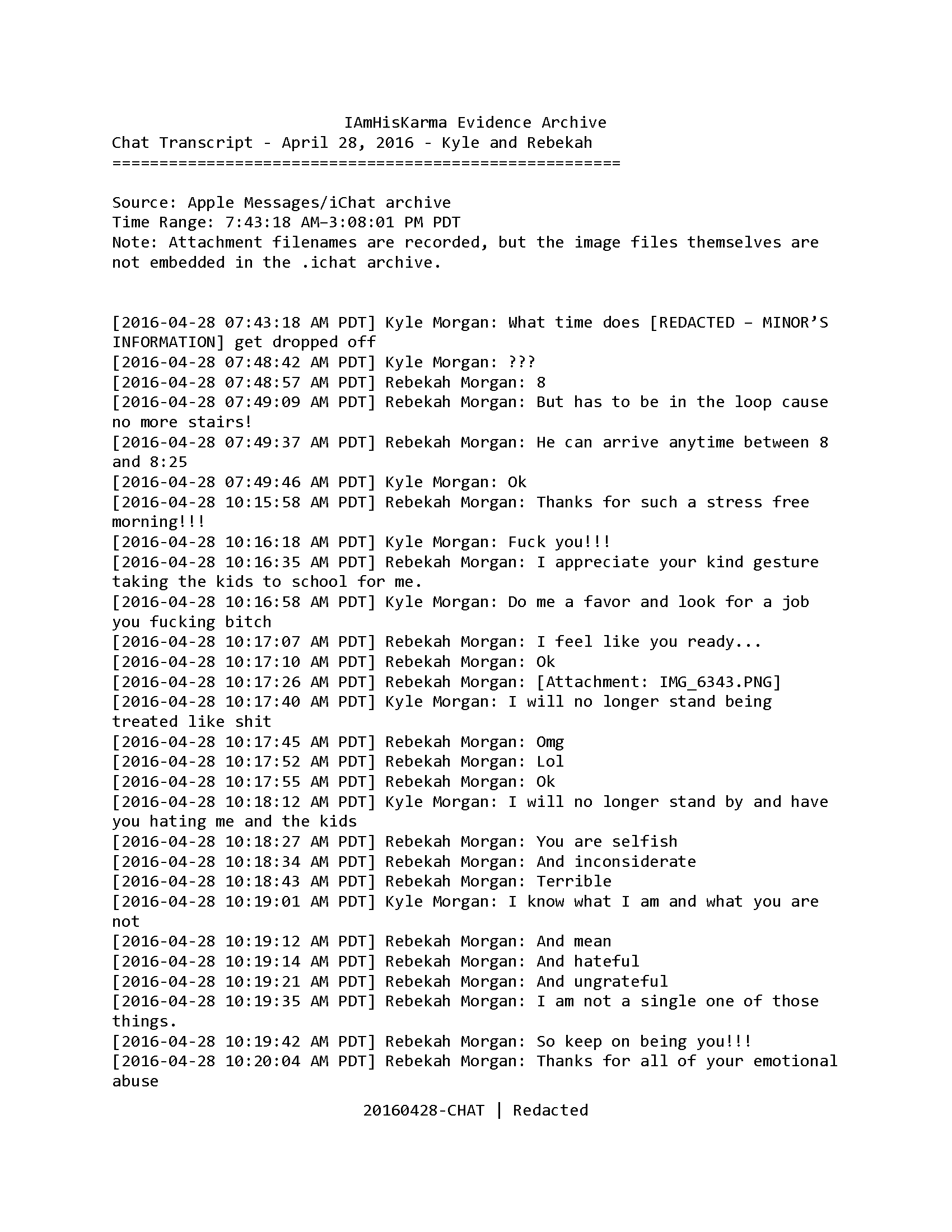
April 28, 2016 — Page 1 of 13. The exchange begins with routine discussion about a child and school. Later that morning, Kyle directs profanity at me and tells me to “look for a job you fucking bitch.” I respond by identifying his behavior as emotional abuse.
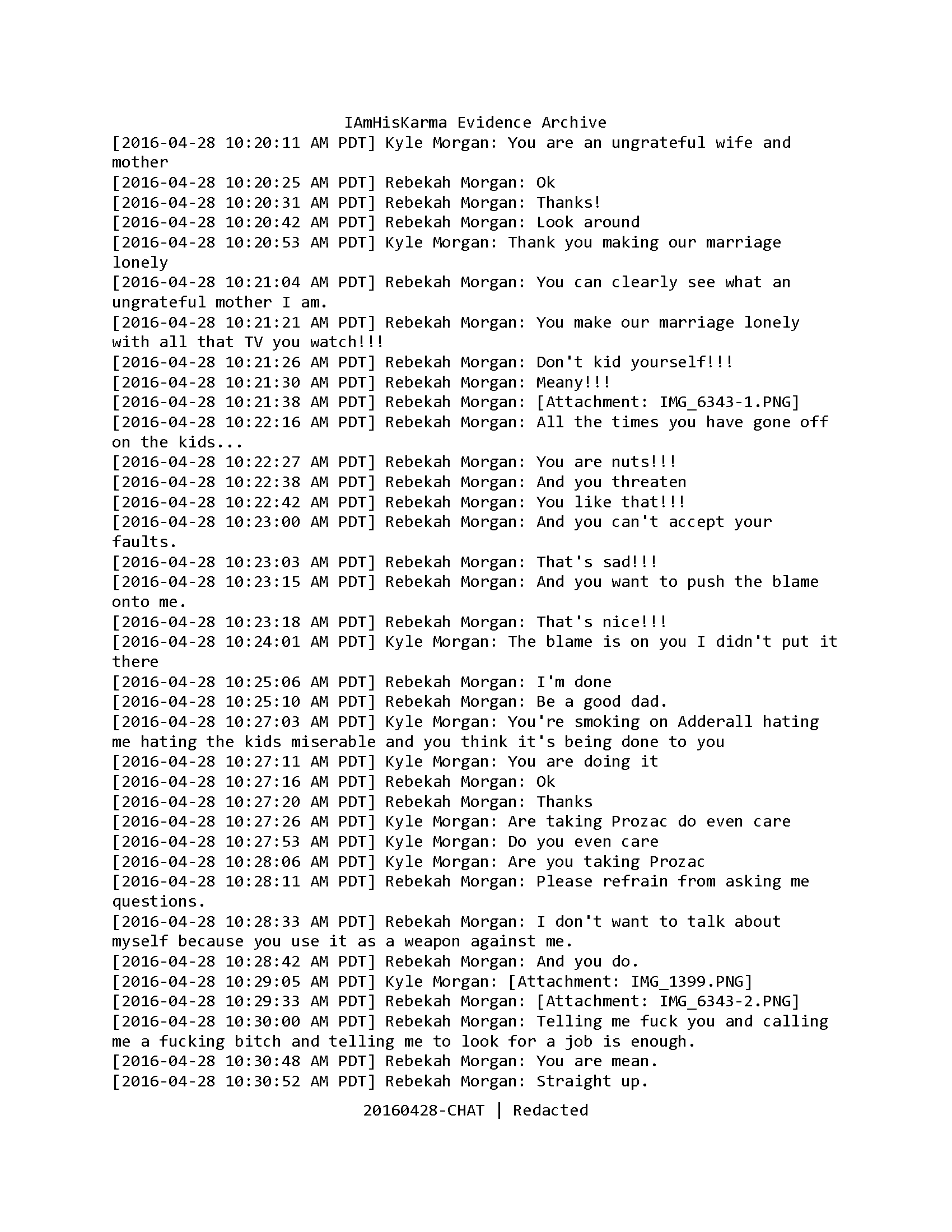
April 28, 2016 — Page 2 of 13. Kyle calls me an “ungrateful wife and mother,” blames me for the state of the marriage, questions whether I am taking Prozac, and refers to Adderall and cannabis. I ask him to stop questioning me and write, “I don't want to talk about myself because you use it as a weapon against me.”
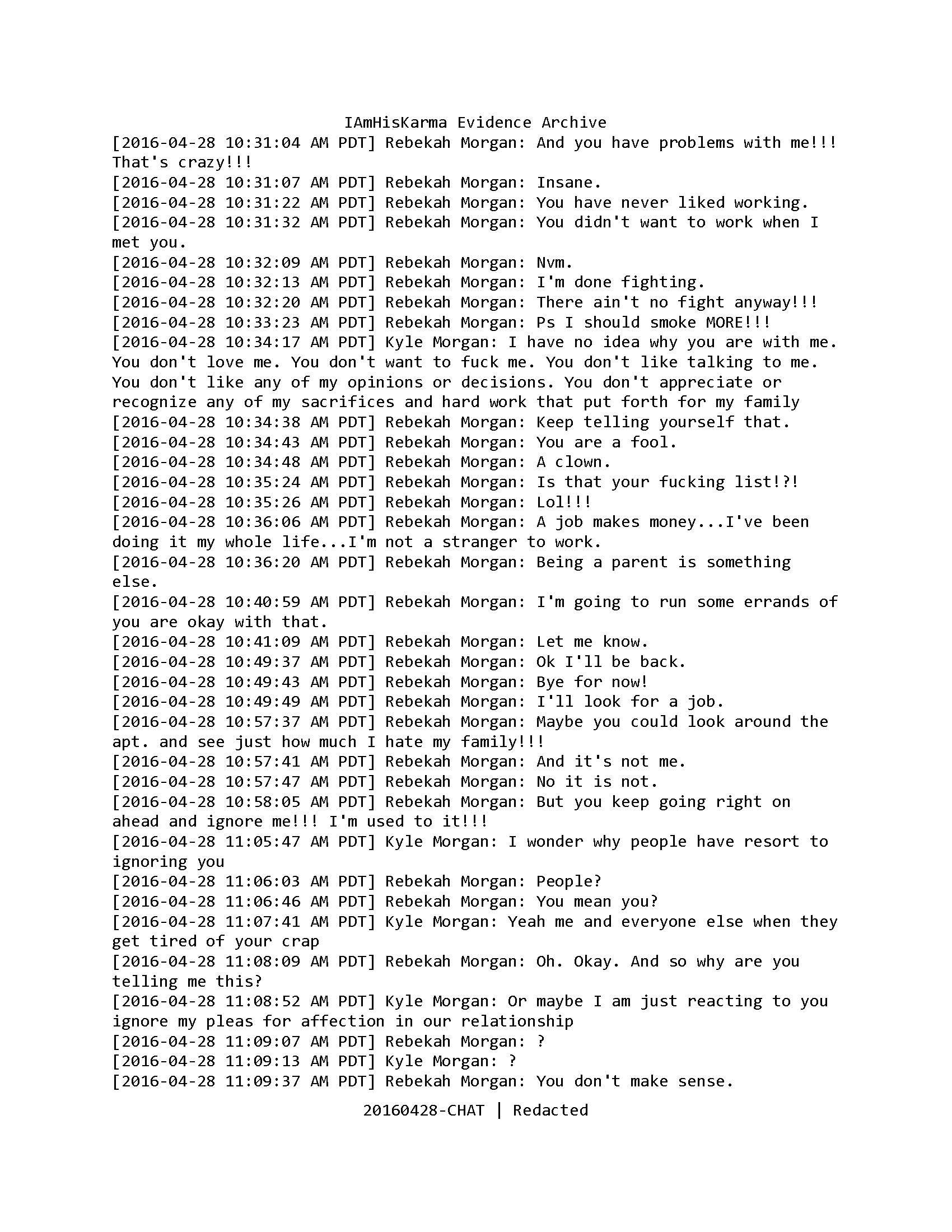
April 28, 2016 — Page 3 of 13. The argument continues around work, parenting, affection, appreciation, and responsibility. I say that I am done fighting while Kyle describes feeling unloved and unappreciated.
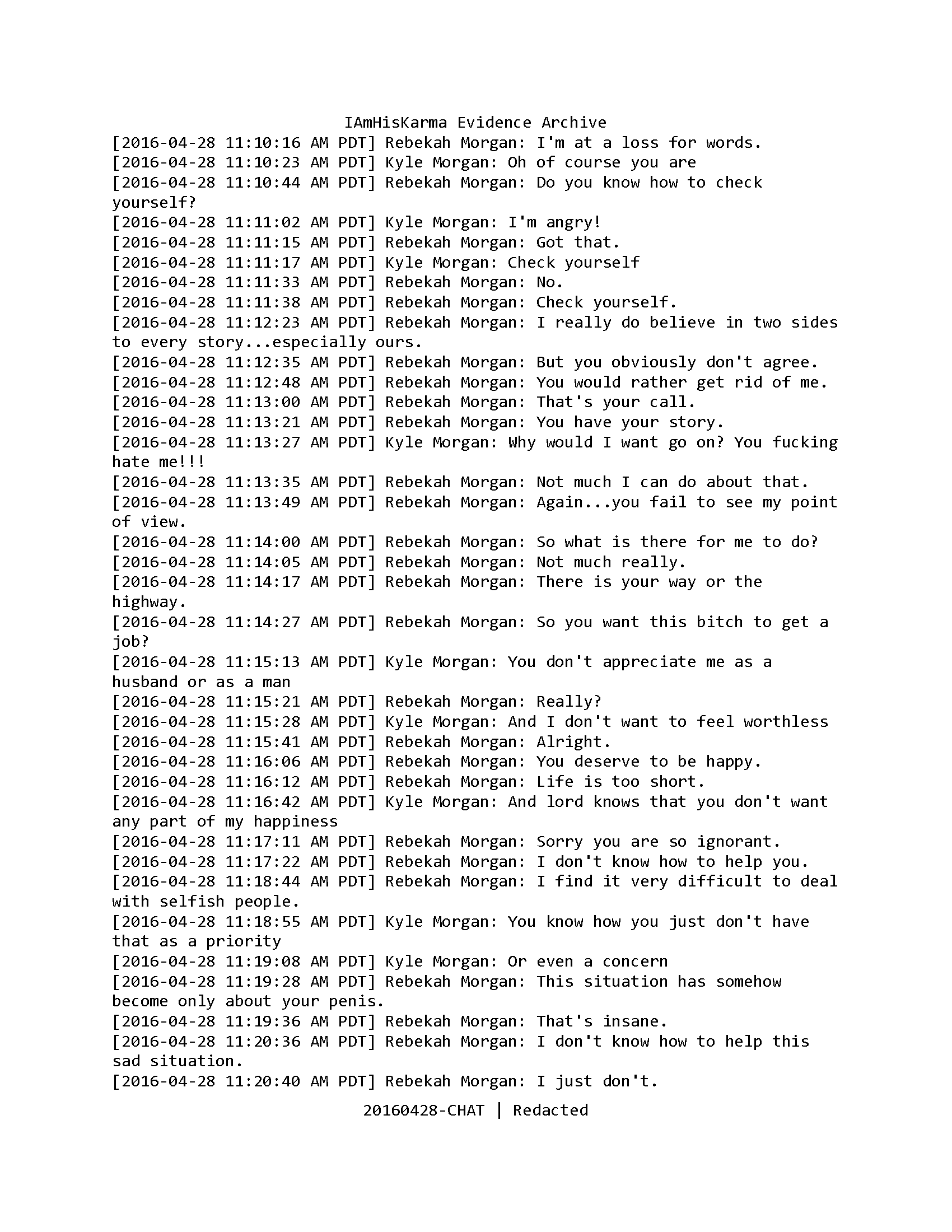
April 28, 2016 — Page 4 of 13. I try to explain that there are two sides to the conflict and describe feeling unable to make Kyle understand my perspective. The exchange turns to his feelings of worthlessness, happiness, affection, and sexual frustration.
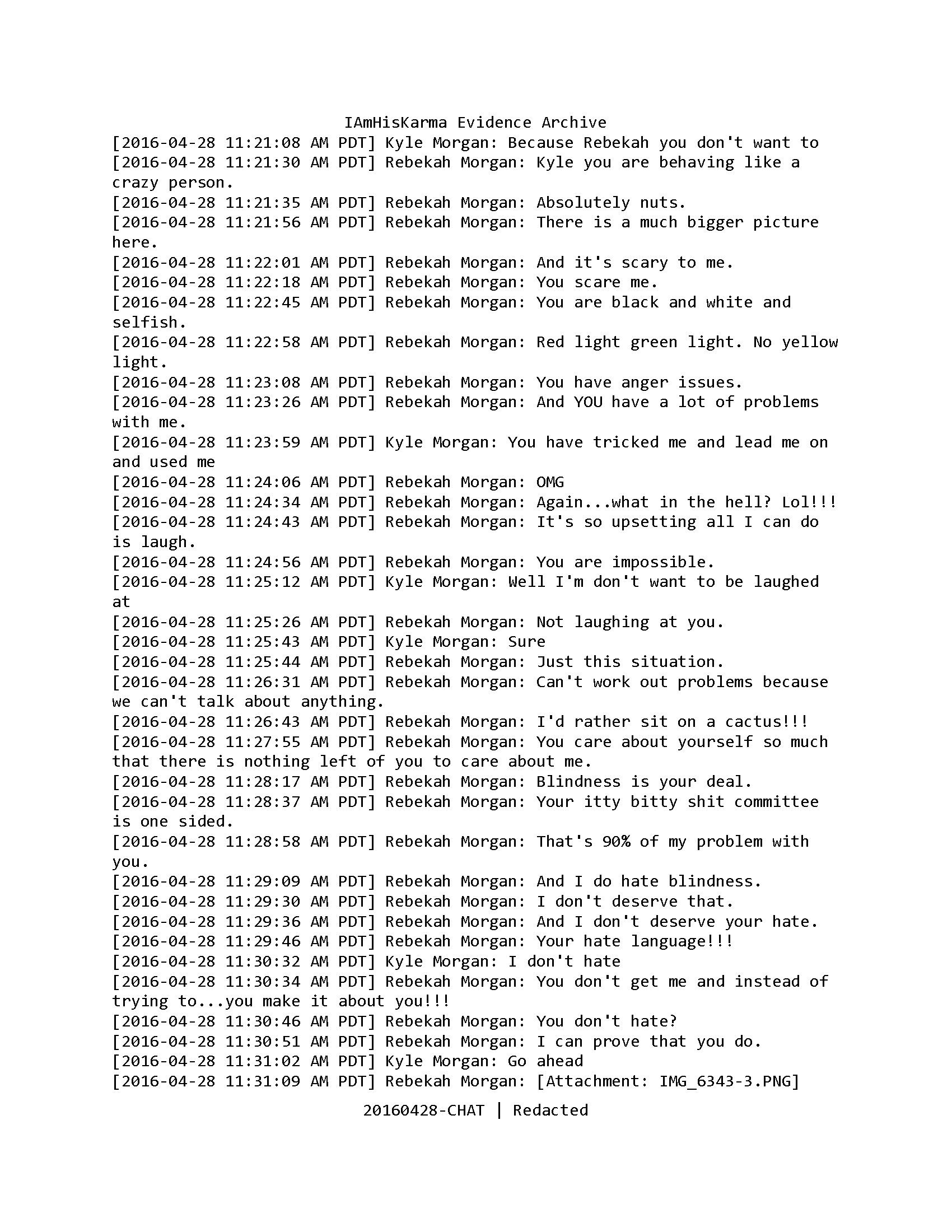
April 28, 2016 — Page 5 of 13. I tell Kyle that the larger situation is frightening to me and write, “You scare me.” I describe his anger and “hate language” and say that we cannot work through problems because we cannot safely talk about them.
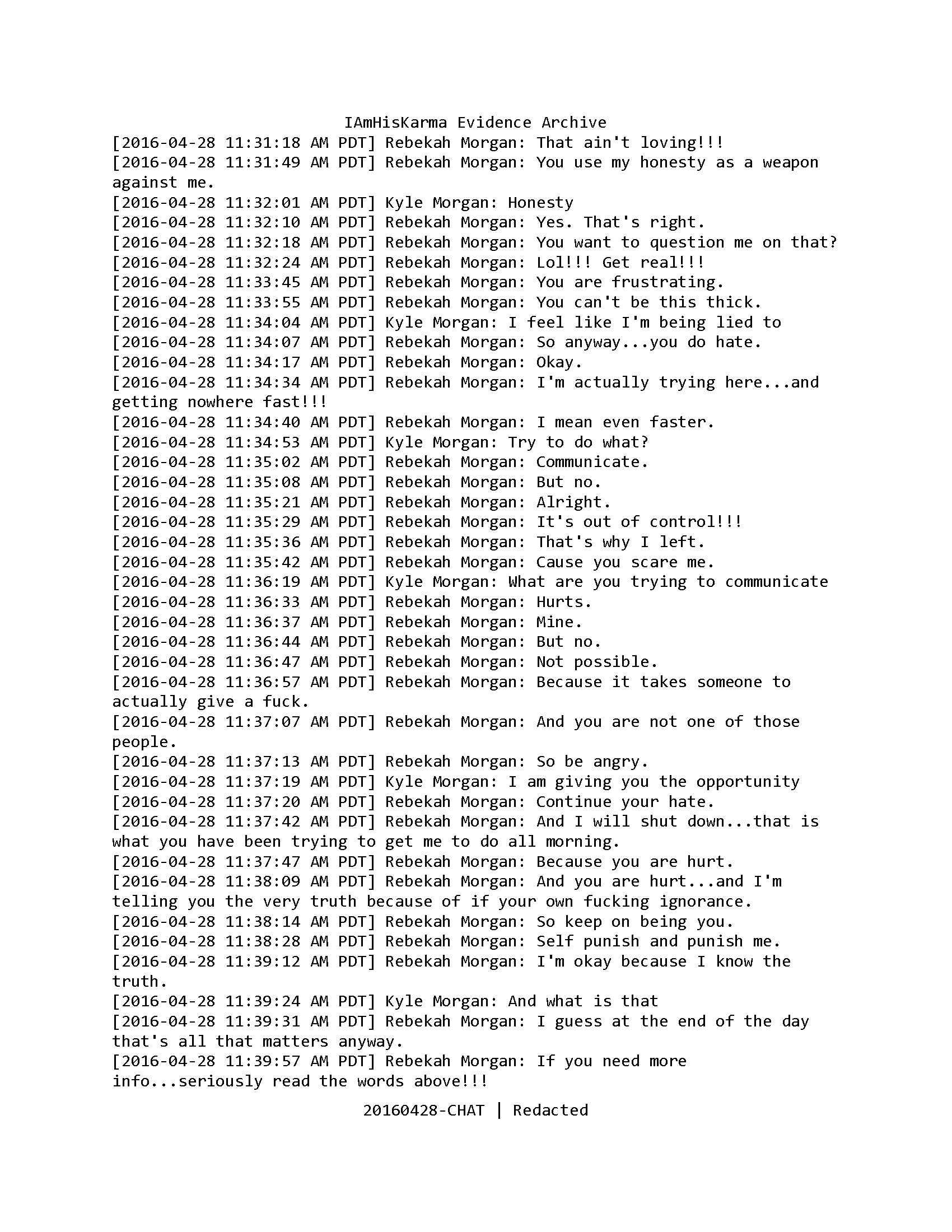
April 28, 2016 — Page 6 of 13. I write, “You use my honesty as a weapon against me,” explain that I am trying to communicate my hurts, and state, “That's why I left. Cause you scare me.” I also describe shutting down in response to the conflict.
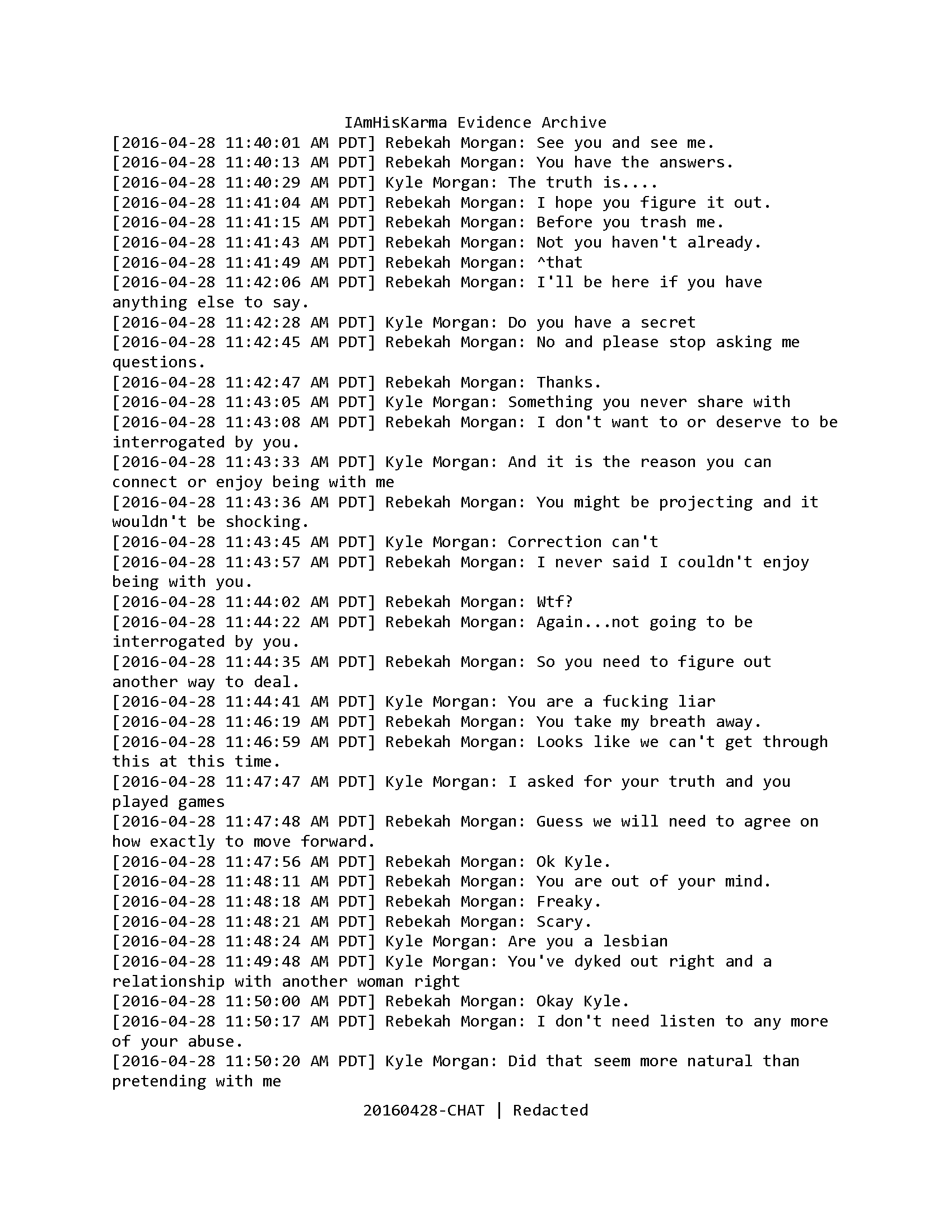
April 28, 2016 — Page 7 of 13. Kyle continues questioning me about secrets, intimacy, and sexuality after I repeatedly ask not to be interrogated. He calls me a “fucking liar” and questions whether I am a lesbian. I describe the interaction as frightening and abusive.
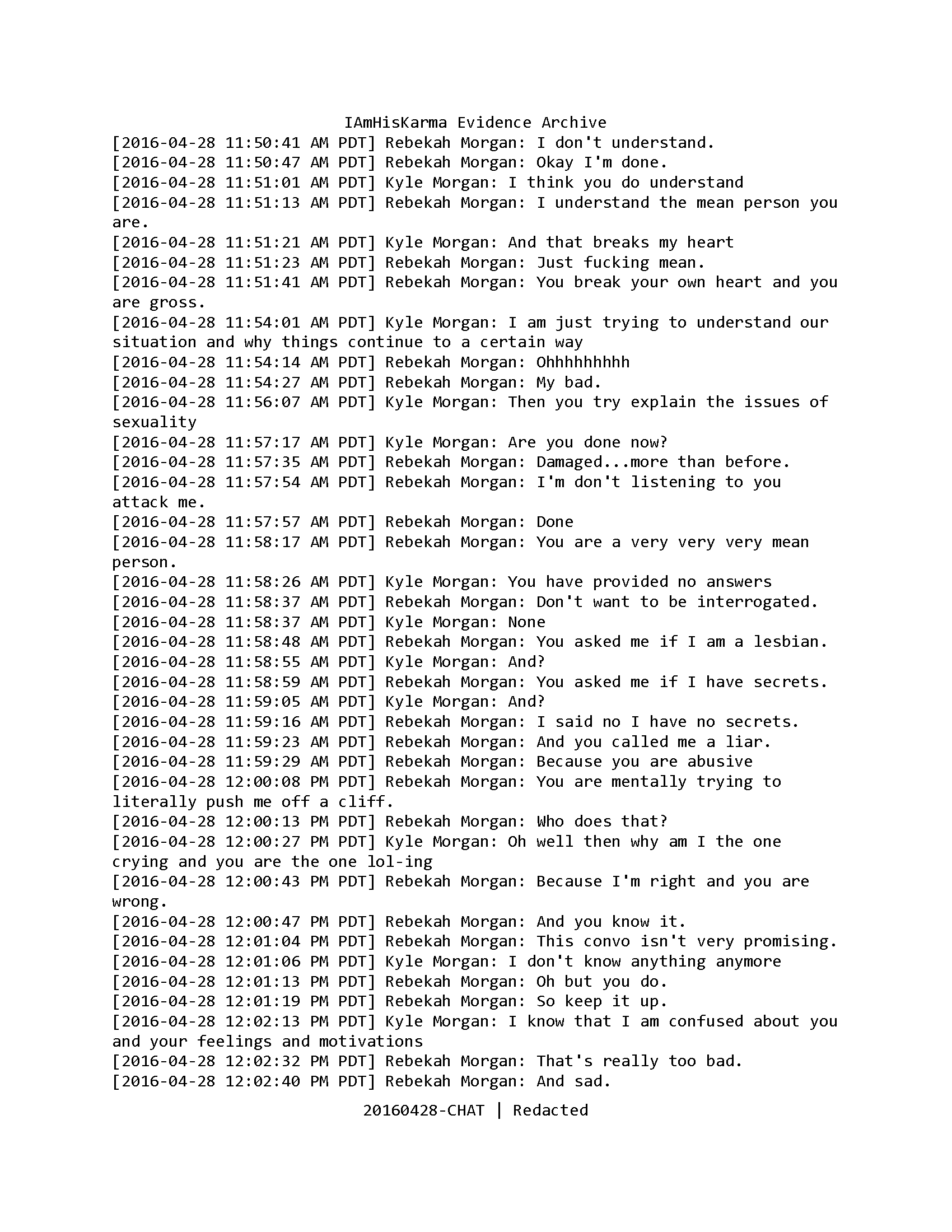
April 28, 2016 — Page 8 of 13. I say that I am done listening to attacks, describe myself as more damaged by the conversation, and again object to being interrogated. I tell Kyle that he is “mentally trying to literally push me off a cliff.”
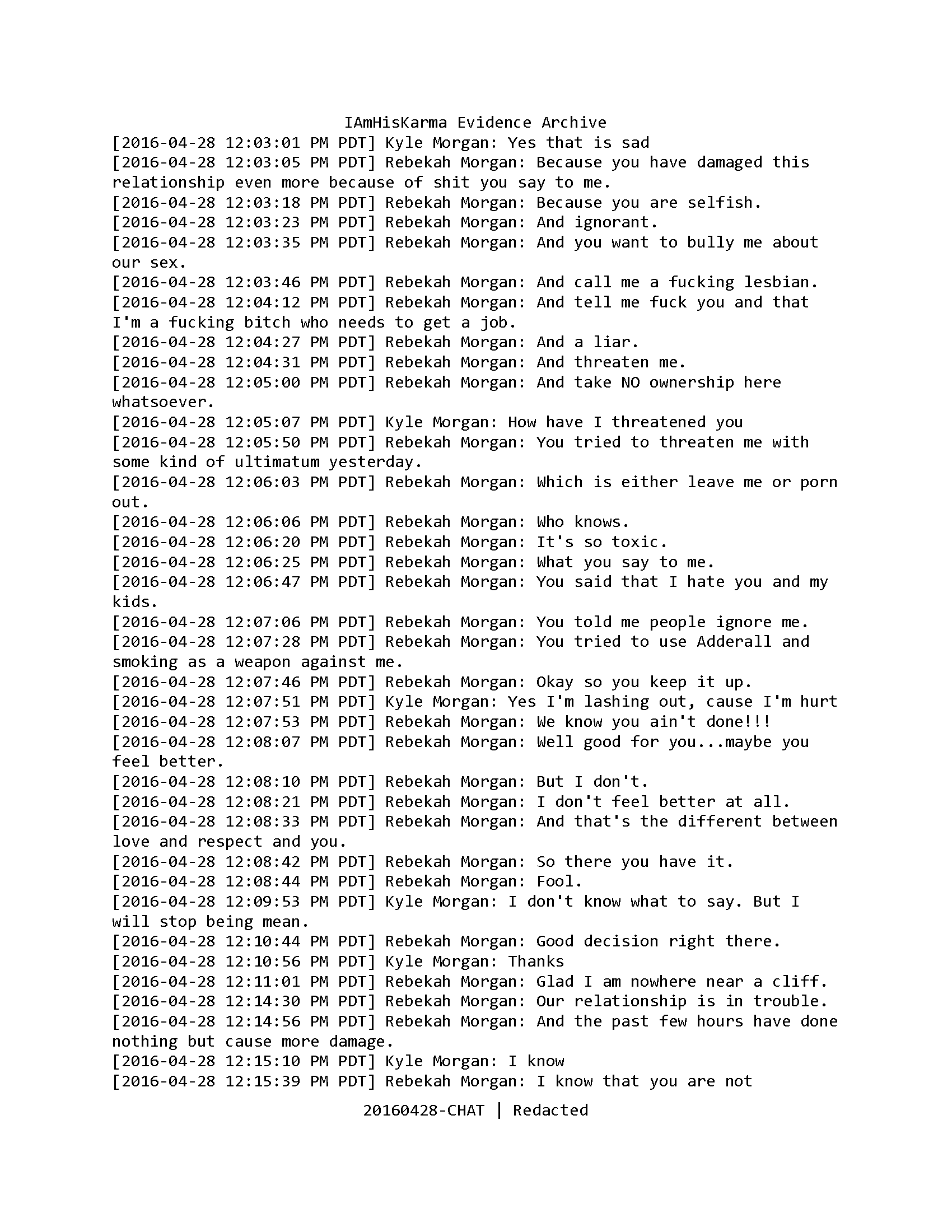
April 28, 2016 — Page 9 of 13. I list the conduct that had hurt me that morning, including insults, sexual accusations, threats, attacks involving medication, and statements about my parenting. Kyle responds, “Yes I'm lashing out, cause I'm hurt,” and later says, “I will stop being mean.”
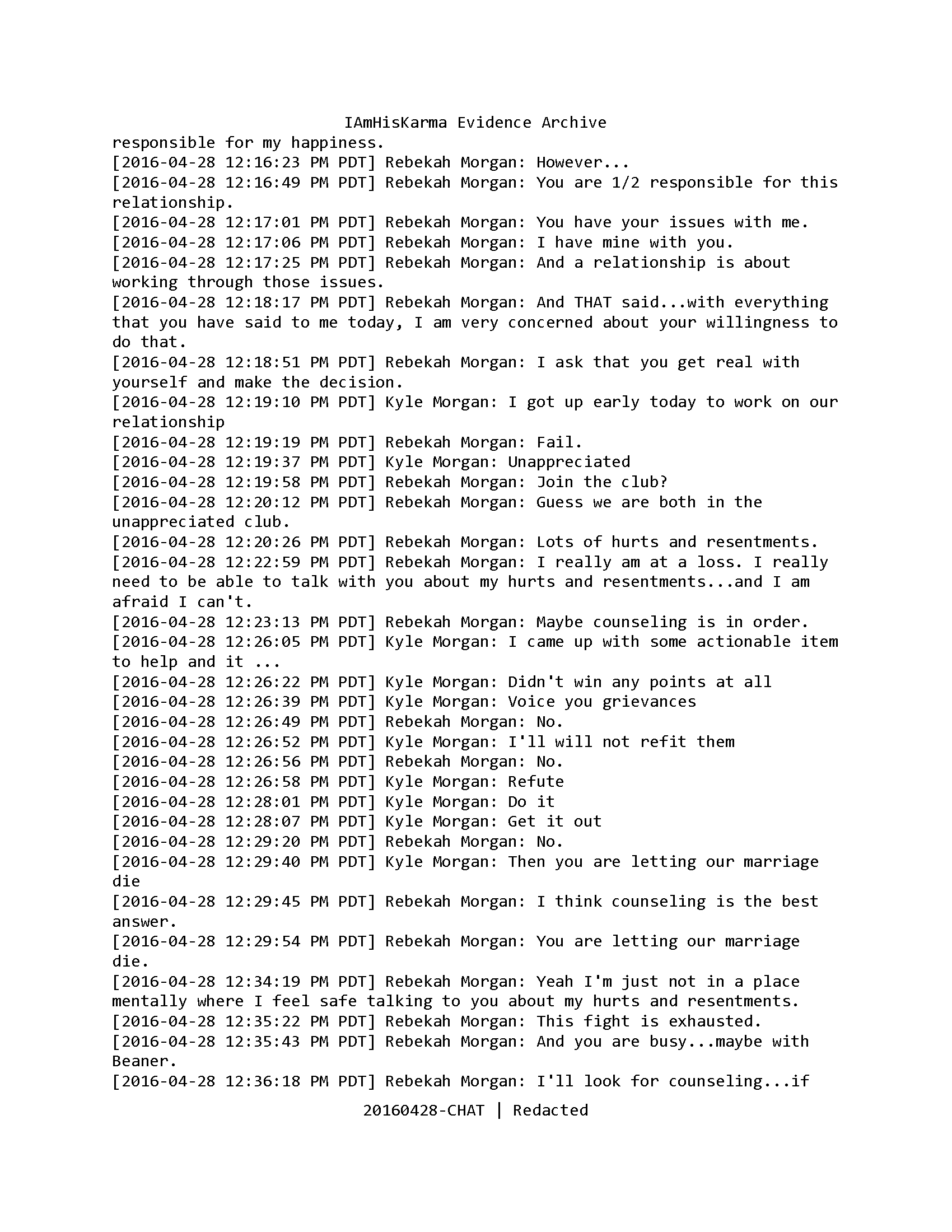
April 28, 2016 — Page 10 of 13. I tell Kyle that our relationship is in trouble and that I need to discuss my hurts and resentments but am afraid I cannot. I suggest counseling. When he urges me to voice my grievances, I decline and explain that I do not feel mentally safe doing so.
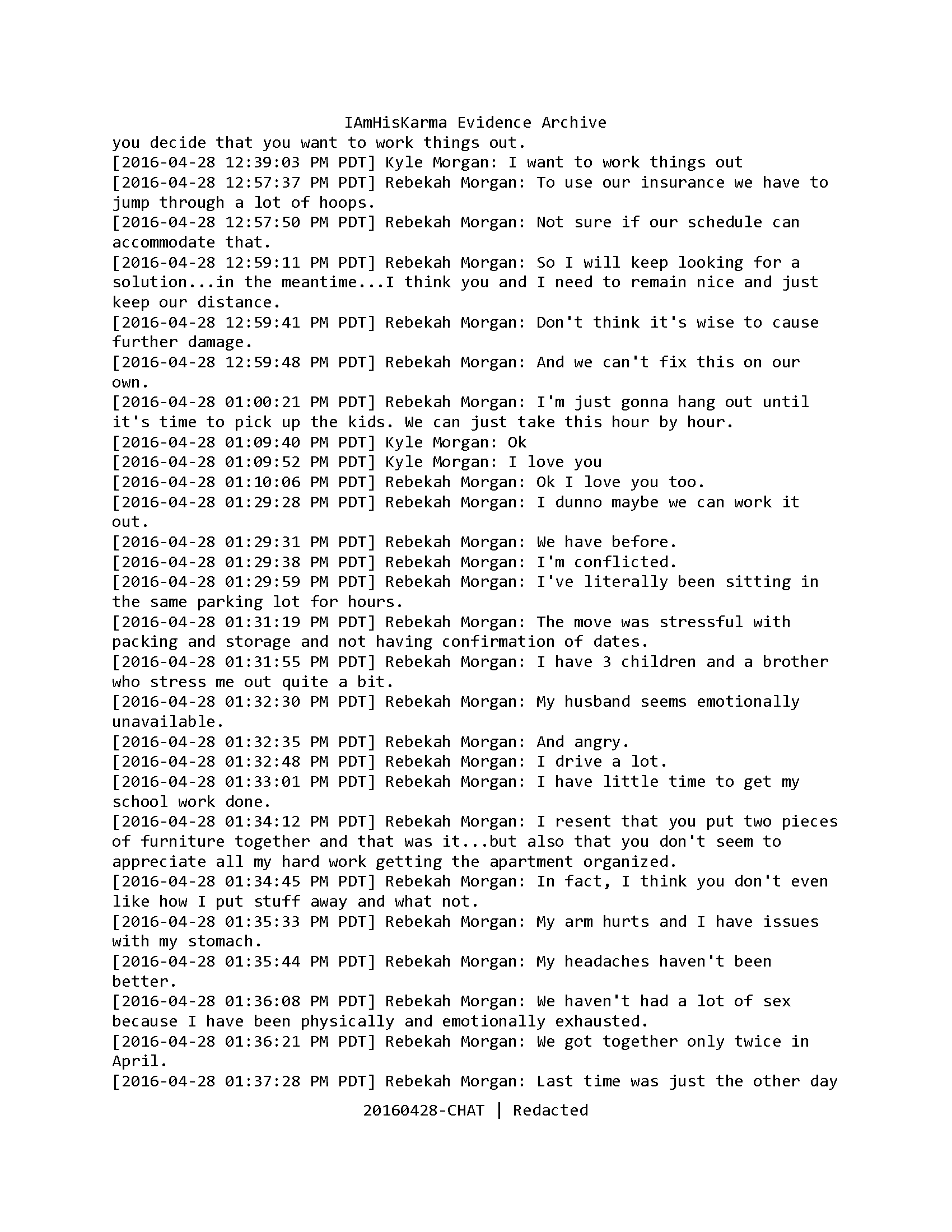
April 28, 2016 — Page 11 of 13. I continue looking for counseling and suggest that we remain kind and keep some distance because we cannot fix the situation on our own. Later, I describe feeling conflicted, emotionally exhausted, overworked, and unappreciated.
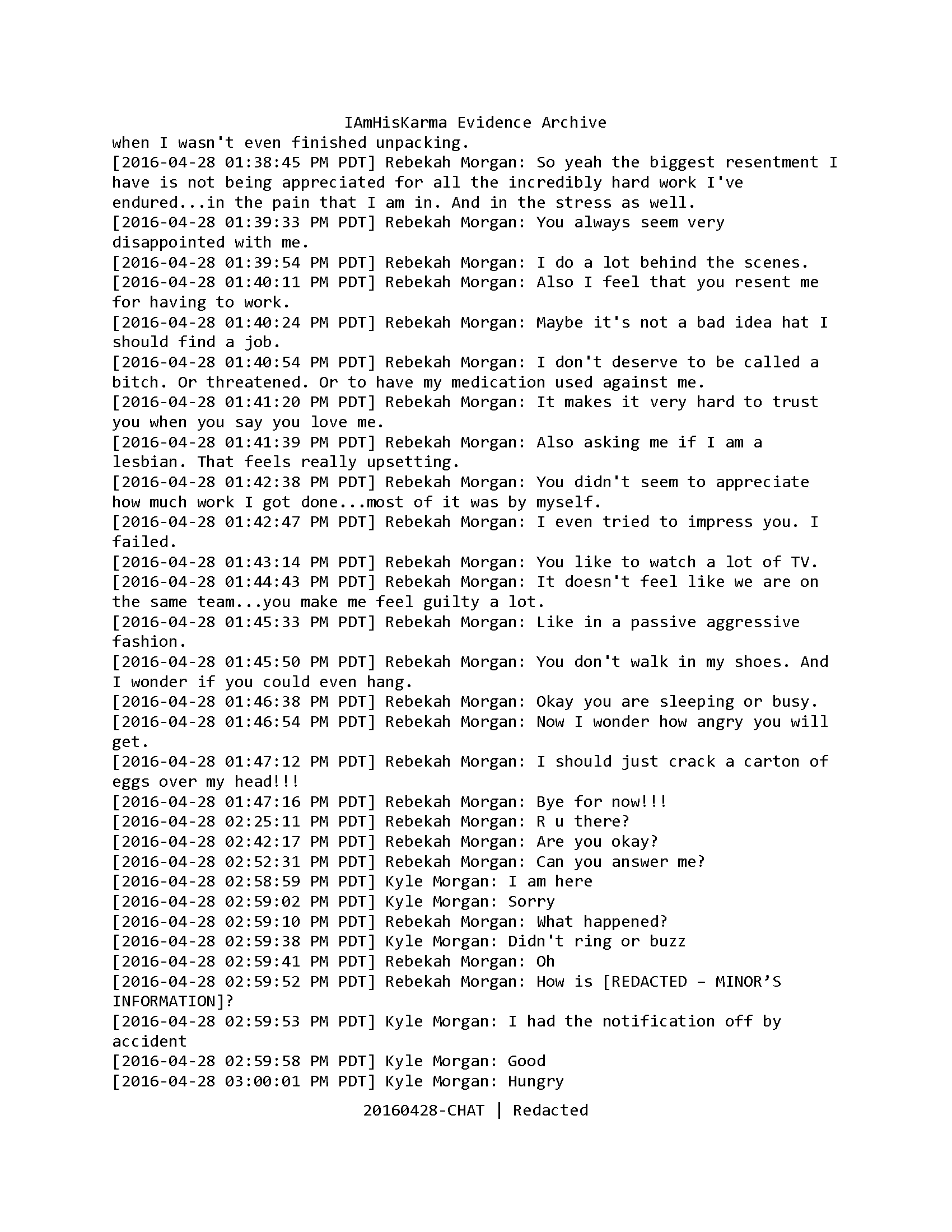
April 28, 2016 — Page 12 of 13. I describe resentment about unrecognized labor and say, “I don't deserve to be called a bitch. Or threatened. Or to have my medication used against me.” I explain that this makes it difficult to trust expressions of love and describe feeling guilty, exhausted, and apprehensive about his anger.
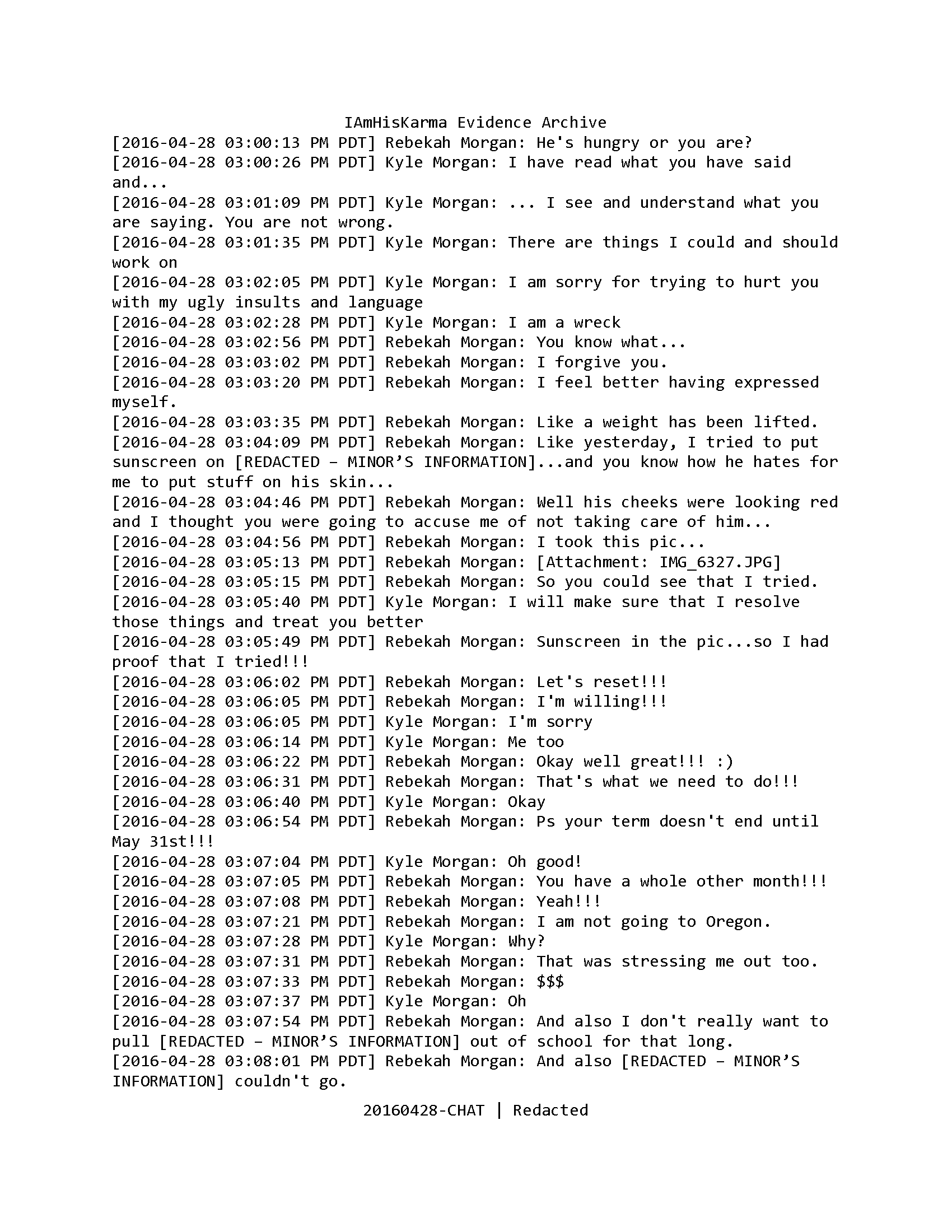
April 28, 2016 — Page 13 of 13. After reading what I wrote, Kyle responds, “You are not wrong,” acknowledges that there are things he should work on, and writes, “I am sorry for trying to hurt you with my ugly insults and language.” He later says he will resolve those issues and treat me better. I forgive him and agree to try to reset the relationship.
May 28, 2017
The fear documented in the 2016 messages did not end with that exchange. The following year, I recorded another incident in a contemporaneous journal entry.
In the May 28, 2017 entry, I wrote that Kyle had flipped a table and chairs while our children cried. I documented my fear, anger, exhaustion, and the effect of the incident on our household.
This entry matters because it shows that my descriptions of fear and instability were not created retrospectively after the relationship ended. I was recording these experiences privately, as they occurred, while I was still inside the relationship and attempting to preserve our family.
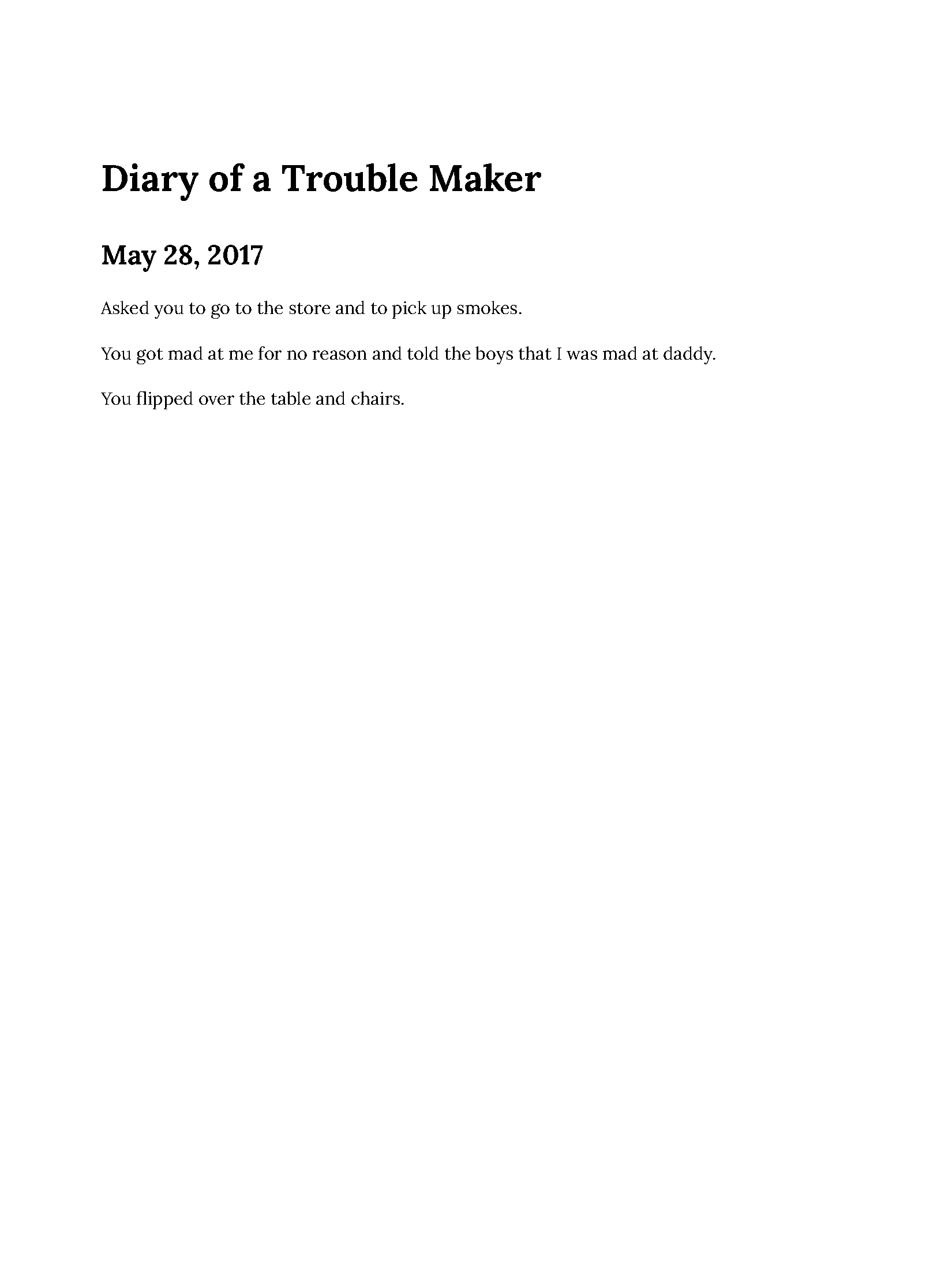
Diary of a Troublemaker, May 28, 2017. In this contemporaneous journal entry, I document an incident involving Kyle flipping a table and chairs while our children cried, along with the fear, anger, and exhaustion I experienced afterward.
July 12, 2018
In an email to Kyle on July 12, 2018, I documented betrayal, a divorce threat, chronic blame, and the emotional depletion I was experiencing inside the marriage.
The email began after Kyle told me he was “100% sure” he wanted a divorce and then asked for 24 hours to think.
I wrote:
“It took at least two hours for me to recognize that 24 hours meant that you needed at least that much time to decide if I was worth holding on to...if your family was worth holding on to.”
I described learning about his addiction as devastating and wrote that my “heart was crushed” and my “faith was obliterated.”
I also described a long-standing pattern in which I felt that my imperfections were used against me:
“There was always a mark of imperfection to be used as a weapon against me...even if you had to invent one.”
I wrote that the order of operations in our marriage had become:
“you first - me last”
and that:
“all things right equal you and all things wrong equal me”
I described myself as loyal, selfless, and giving, while believing that those qualities had gone unreciprocated.
By the second page, the language becomes even more explicit about the effect the relationship was having on me.
I wrote:
“Emotionally and mentally and physically depleted, I was at once too weak to further carry the burden of your own shame and guilt.”
I compared myself to the tree in The Giving Tree and wrote that I had allowed myself to be:
“reduced to nothing more than just a stump.”
I also described believing his apologies and promises, listening when blame was placed on me, repeatedly trying to prove that I could do better, and eventually realizing that I had been trying to convince him that I was worth holding onto when I was the one who needed convincing.
The record shows that years before the Old Sick Dead persona became public, I was already documenting betrayal, chronic blame, emotional exhaustion, and the collapse of my sense of self inside the relationship.

July 12, 2018 Email — Page 1 of 2. Written after Kyle told me he was “100% sure” he wanted a divorce and then asked for 24 hours to think, this page documents betrayal, erosion of trust, chronic blame, and my belief that my efforts were never enough.

July 12, 2018 Email — Page 2 of 2. I continue describing my emotional, mental, and physical depletion. I compare myself to the stump in The Giving Tree and write that I had been reduced to almost nothing inside the relationship.
Later That Evening
Later that same day, a separate email thread preserved Kyle’s own responses.
At 8:09 p.m., he wrote:
“I know that I don’t deserve you but I am asking for you to stay.”
He also wrote:
“I know that I’ve hurt you but I am asking for your love despite it.”
And:
“You don’t need to forgive me just don’t leave me.”
At 8:40 p.m., he wrote:
“I haven’t been good to you.”
He also stated that he still loved me and planned to “woo” me and win me back.
My reply referenced the same statements that prompted the earlier letter:
“I heard your answer yesterday. I heard 100% and I heard 24 hours.”
This later thread matters because it provides contemporaneous context from both sides of the exchange. The earlier letter records what I was experiencing and how I understood the relationship. The later thread preserves Kyle acknowledging that he had hurt me and had not been good to me while asking me to stay.

July 12, 2018 Evening Email Thread. Later that evening, Kyle wrote, “I know that I’ve hurt you” and “I haven’t been good to you,” while asking me to stay. My replies referenced the same “100%” and “24 hours” statements that prompted my earlier letter.
Psychological Abuse and Coercive Meaning
Psychological abuse can operate through repetition, private associations, contradiction, symbolic meaning, and plausible deniability.
A public viewer could see a Buddhist skull and understand it as a contemplation of death.
I experienced it after years of telling its creator:
“You use my honesty as a weapon against me.”
“You scare me.”
“I will shut down.”
I experienced it during the year my mother died.
I experienced it after the May 18, 2021 strangulation assault that I later reported and documented.
I experienced it within a relationship in which its creator had previously acknowledged trying to hurt me with his insults and language.
None of this independently proves that every element of the artwork was intentionally designed as a threat. It establishes why the work could not function as neutral spiritual imagery within my life.
The public explanation and the private effect could coexist.
For me, that ambiguity was part of its coercive power.
Spiritual Abuse and Spiritual Inversion
Spiritual abuse can occur when religious teachings, practices, or identities are used to conceal harm, reverse responsibility, demand silence, or portray the person causing harm as enlightened while casting the injured person as angry, attached, unstable, or spiritually deficient.
Kyle’s public persona emphasized Buddhism, compassion, non-harm, equanimity, healing, and freedom from suffering.
Inside the relationship, I experienced fear, coercive control, betrayal, deliberate emotional injury, and violence.
Within that environment, Buddhist concepts could be used to reinterpret my responses to harm. My anger could be treated as attachment. My fear could be characterized as instability. My demand for accountability could be framed as an inability to let go. Compassion could be demanded from me while accountability was withheld from him.
Within this context, I experienced the skull as transforming death and suffering into spiritual branding.
But death and suffering were already present in my life.
My mother’s death formed part of the emotional environment in which I encountered the work.
The strangulation assault I reported and documented made mortality physical rather than abstract.
My longstanding psychological distress had already been documented in emails, messages, and private writing.
I experienced the persona as turning those conditions into an image of spiritual depth while the person living through them remained unseen.
The Muse Who Was Erased
I was not simply watching an unrelated artist develop his work.
I was his wife, muse, audience, financial support, administrative support, and promotional support. I purchased equipment and supplies, paid for services, supported the household, helped with written content, sent marketing resources, shared files, and helped prepare professional applications.
He sent me this numbered collection because I was helping him organize and promote it.
The work developed within a life I was helping sustain.
His public identity became visible.
My labor and suffering disappeared from its public story.
Why Artwork No. 1 Matters
This skull is the opening image in the preserved numbered collection.
The documentary record establishes:
The preserved filename identifies it as Artwork No. 1.
The words “OLD SICK DEAD” appear directly across the skull.
The photograph was captured on September 2, 2021.
Kyle Morgan publicly used Old Sick Dead as his artist identity.
The next numbered image is a portrait of me marked with the same words.
Kyle sent the numbered collection to me while I was helping him organize and promote his work.
Within this archive, I interpret the skull as establishing:
Death as the persona’s central image
Buddhist mortality as its public spiritual framework
The transformation of suffering into artistic branding
The beginning of a symbolic vocabulary carried into the portrait of me that follows
The first artwork establishes the persona and its visual language.
The second establishes my proximity to it.
Together, I understand them as beginning a pattern in which my image, grief, labor, fear, and life existed within the conditions surrounding his art while being largely excluded from its public account.
Evidence Boundaries
The record establishes that:
The image is numbered as Artwork No. 1.
The preserved filename is 1 skull.jpeg.
The photograph was captured on September 2, 2021.
The image visibly contains the words “OLD SICK DEAD.”
Kyle Morgan publicly used Old Sick Dead as his artist identity.
The following numbered image is a portrait of me marked with the same words.
Earlier written communications document that I repeatedly described fear, emotional injury, weaponized vulnerability, and psychological destabilization.
Kyle acknowledged in April 2016 that he had been trying to hurt me with insults and language.
I performed substantial administrative, financial, and promotional labor connected to his artistic practice.
The image alone does not independently establish Kyle’s private intention when creating every visual element. My interpretation is based on the artwork’s placement in the numbered sequence and the documented history of the relationship in which I received it.
Conclusion
Publicly, this artwork can be presented as a Buddhist meditation on mortality.
Inside my life, it appeared after years of documented psychological injury, during the year my mother died, and after the strangulation assault that I reported and documented.
One day later, the same identity appeared beside my portrait.
The emails, messages, and journal entries are not separate from my understanding of the artwork. They are contemporaneous records explaining why death, suffering, silence, and spiritual authority carried a different meaning within our relationship than they did on his public website.
The image alone does not establish the artist’s private intention. The documented history establishes why I experienced it differently.
This is not simply the first image in an art collection.
For me, it marks the beginning of the mask.
Publication Details
Collection: Old Sick Dead Art Archive
Artifact number: 1
Artifact date: September 2, 2021
Original filename: 1 skull.jpeg
Author: Rebekah Morgan
Featured image: Artwork No. 1, Old Sick Dead Skull