

The Peace He Performed
In the weeks immediately after our separation, Kyle Morgan, working publicly as Old Sick Dead, published Buddhist artwork centered on restraint, suffering, compassion, ethical conduct, freedom, and peace. The works do not themselves prove abuse. This essay examines the distance I experienced between the moral identity presented publicly and the private record of our relationship.
The Persona Begins: Death Branded as Spiritual Identity
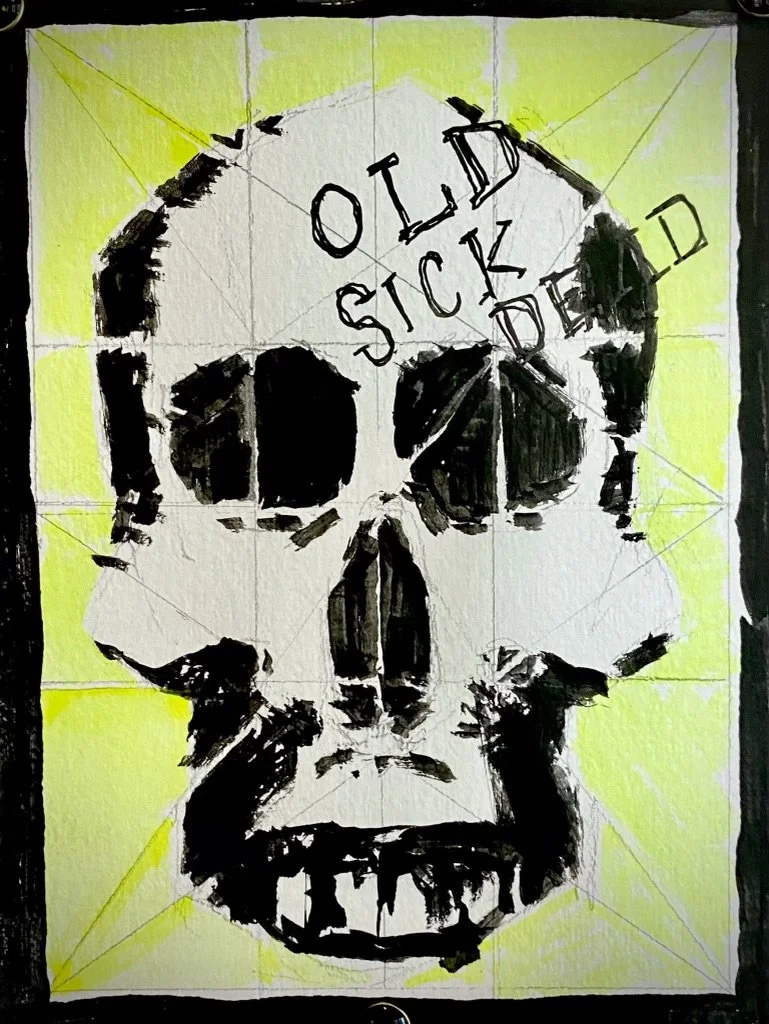
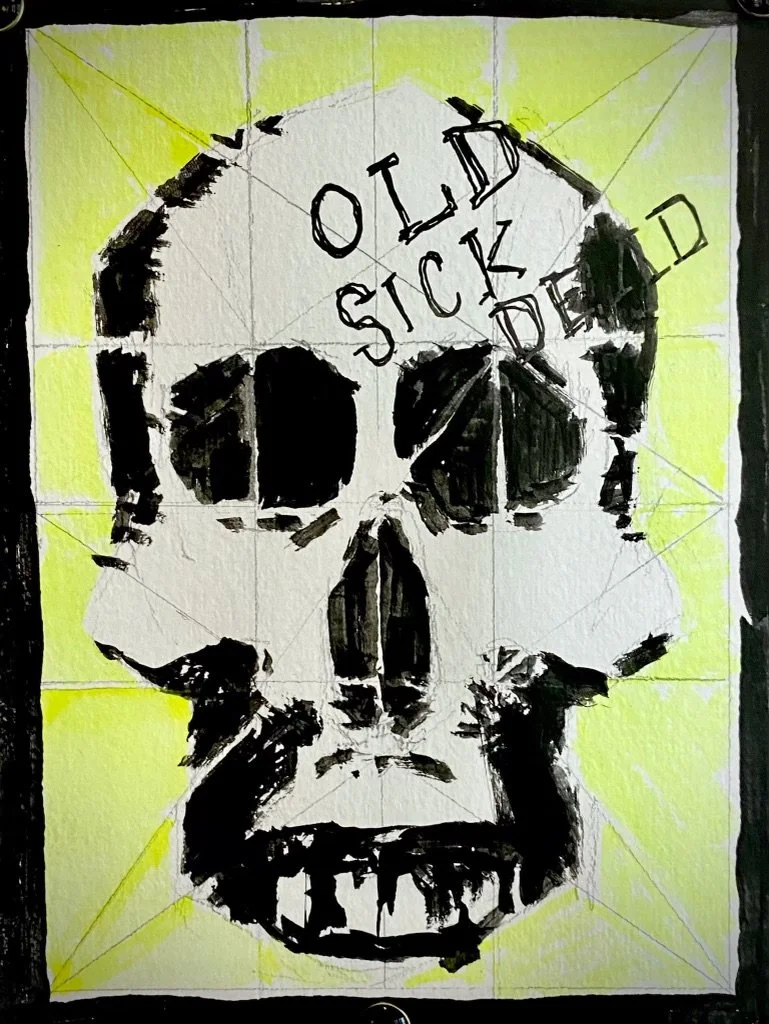
Artwork No. 1 is a skull marked “OLD SICK DEAD,” photographed on September 2, 2021. Read beside contemporaneous emails, messages, and journal entries documenting fear and psychological injury, it marks the beginning of a public spiritual persona whose imagery carried a profoundly different meaning inside my life.
Old Sick Dead Art Archive
A living archive of artwork created by Kyle Morgan under the name Old Sick Dead, examined in relation to my life, my labor, and the psychological, spiritual, and coercive control I experienced inside our relationship.
About This Archive
His art did not exist separately from my life.
It was made inside it.
I was his wife, his primary audience, his financial and practical support, and his muse. My face appears in his drawings. But my influence cannot be measured only by the works that physically resemble me. My grief, illness, spirituality, displacement, labor, fear, survival, family, and experiences became part of the emotional and symbolic environment from which he created.
He sent me a numbered collection of 123 artworks in what he represented as their order of creation, from the earliest to the most current work at the time. Alternate photographs bring this recovered collection to 142 image files.
He sent them because I was helping him organize, publish, and promote his work.
I purchased equipment and art supplies. I paid for services he used. I supported the household while he created. I helped with social media, marketing, written content, professional applications, and the development of the public identity he called Old Sick Dead.
His identity became visible.
My labor disappeared.
Even when I was present in the art, I was absent from its public story.
Kyle presented Old Sick Dead as the identity of a Buddhist artist concerned with compassion, non-harm, equanimity, impermanence, healing, and freedom from suffering. He incorporated experiences from our shared life, including our family’s homelessness, into his public account of personal transformation.
That story did not explain what surviving those experiences cost me or our children. It did not explain the labor that sustained his practice. It did not explain the fear, instability, coercion, and violence occurring behind the spiritual persona.
This is where the artwork becomes relevant to psychological and spiritual abuse.
I experienced Buddhist concepts and spiritual language being used to recast my responses to harm as attachment, anger, instability, or failure to let go. Compassion could be demanded from me while accountability was withheld from him. Equanimity could be presented as something I lacked when I reacted to mistreatment. Suffering could become material for his public identity while the person actually suffering was expected to remain silent.
The result was spiritual coercive control.
Psychological abuse can also operate through private meaning, repetition, symbolic association, contradiction, distortion, erasure, and plausible deniability. A work does not have to contain an explicit written threat to carry a coercive meaning within the relationship in which it was created.
This does not mean that every skull, monk, Buddhist teaching, or image of death is inherently abusive. It means that the imagery must be examined within its documented relational context.
Context is not separate from the evidence.
Context is what makes the evidence intelligible.
Each entry will therefore examine more than the visible artwork. When records allow, it will document:
The artwork’s original number and filename
The photographic metadata and documented date
What was happening in my life and our household at that time
Recurring images, language, symbols, and private associations
How the work was described or presented publicly
Whether I appeared in the work but was excluded from its public narrative
The labor, equipment, supplies, and services I contributed
Relevant messages, website records, applications, posts, and financial evidence
My contemporaneous experience of the work
My present interpretation after understanding the larger pattern of coercive control
The collection begins with a skull marked “OLD SICK DEAD,” photographed on September 2, 2021.
The second numbered work is a portrait of me, photographed the following day and marked with the same identity.
The order matters.
At the beginning of the preserved collection, his developing persona, death imagery, spirituality, and my face are already placed beside one another.
This is not simply an art gallery.
It is a record of how an artistic and spiritual identity was constructed from the life surrounding it. It documents the muse who was used but not acknowledged, the labor that was consumed but not credited, and the suffering that was transformed into someone else’s story of enlightenment.
This is a living archive. The 123 numbered works are one recovered collection, not the entirety of Kyle Morgan’s artwork or the complete record of how art and spirituality functioned within the abuse.
Many more artworks, sketches, portraits, digital files, public posts, website materials, and related records will be added as they are recovered, dated, researched, and placed back into the life from which they came.