
The Peace He Performed
Ten Works Published After I Left
In the weeks immediately after our separation, Kyle Morgan, working publicly under the name Old Sick Dead, was publishing Buddhist artwork on Reddit about nonattachment, transformation, restraint, suffering, compassion, love, ethical conduct, freedom, and peace.
Again and again, the posts ended with some version of the same blessing:
May you find peace in your practice.
I was living something very different.
These works are not evidence of abuse by themselves. A lotus is not abusive. Buddhist scripture is not abusive. Meditation, yoga, compassion, nonattachment, and teachings about restraint are not abusive.
I am also not presenting these images as coded confessions or attempting to diagnose their creator through his artwork.
What interests me is the documented contradiction between public moral presentation and private relational conduct.
The person strangers encountered online was publicly publishing and discussing the very things I had needed inside our relationship: restraint, non-harm, accountability, compassion, ethical behavior, truth, protection, and freedom.
That contradiction became meaningful to me because abuse does not require someone to behave abusively toward everyone.
A person can produce beautiful work.
A person can understand spiritual philosophy.
A person can speak intelligently about suffering.
A person can tell strangers to find peace.
And another person can still experience that same individual very differently in private.
This is why I am preserving the artwork together with the language Old_Sick_Dead attached to it.
The image shows what he created.
The accompanying Reddit text shows what he publicly said it meant.
Then I can explain what those ideas mean to me when placed beside the history documented throughout this archive.
January 2, 2025
No Mud, No Lotus

No Mud, No Lotus, published by Old_Sick_Dead to r/Buddhism on January 2, 2025, pairing a yellow lotus emerging through rain with a reflection on nonattachment, stress, craving, and learning to let suffering pass without clinging to it.

Old_Sick_Dead’s accompanying Reddit explanation describes the lotus as a symbol of nonattachment and compares people living through stress to water that beads up and rolls away.
In his accompanying explanation, Old_Sick_Dead describes the lotus as a symbol of nonattachment because it grows through mud and water without retaining the water on its surface.
He then turns that metaphor toward human suffering: people are born into stress, grow through stress, experience stress every day, and can learn to let it roll away.
There is wisdom in that teaching.
There is also something important about how teachings like this can function inside an abusive relationship.
When someone has been repeatedly harmed, the question cannot always become:
Why can't you let it go?
Why are you still reacting?
Why can't you detach?
Why aren't you peaceful yet?
A traumatized nervous system is not evidence of spiritual failure.
The responsibility for abusive conduct belongs to the person engaging in that conduct. It cannot be transferred onto the injured person by reframing her pain as attachment.
That distinction took me a very long time to understand.
January 4, 2025
Shed to Transform

Shed to Transform, published by Old_Sick_Dead to r/Buddhism on January 4, 2025.

The accompanying Buddhist passage selected by Old_Sick_Dead addresses anger, lust, craving, conceit, grudges, greed, hatred, and delusion.
Two days later came Shed to Transform.
The text accompanying the work centers on removing anger, repelling lust, drying up craving, destroying conceit, holding no grudges, and becoming free from greed, hatred, and delusion.
Again, none of this is abusive.
The teaching is about governing oneself.
That is precisely why it belongs in this record.
Healthy restraint moves inward:
I regulate my behavior.
I take responsibility for my impulses.
I examine my anger.
I govern what I do with my desire.
I do not make another human being responsible for what exists inside me.
Coercive control reverses that direction.
Instead of governing oneself, the controlling person attempts to govern another person.
The public teaching here was transformation through relinquishing destructive impulses.
Understanding that principle and practicing it inside an intimate relationship are two very different things.
January 6, 2025
Beware the Mind Snare

Beware the Mind Snare, published by Old_Sick_Dead to r/Buddhism on January 6, 2025.

Screenshot of the accompanying Reddit explanation or discussion for Beware the Mind Snare.
Visually, this may be one of the most psychologically striking works in the group.
Two enormous eyes stare outward.
A hook hangs immediately above the focal point.
Everything converges toward the center.
The title warns:
Beware the mind snare.
I know what it feels like to become trapped inside conflict between perception and explanation.
I would notice something.
Then I would question myself.
I would feel unsafe.
Then I would search for reasons why I should not feel unsafe.
I would recognize a pattern.
Then I would dismantle my own interpretation of it.
I would know something in my body before I could prove it intellectually, and then spend enormous amounts of energy arguing against myself.
That is one of the most psychologically destabilizing parts of prolonged abuse.
Eventually, the argument is no longer only occurring between two people.
It occurs inside the person being harmed.
The artwork did not create that experience.
But the title Beware the Mind Snare now carries an entirely different meaning for me because I know how completely my own mind became a place in which I could no longer trust what I knew.
January 9, 2025
Conditioned to Scroll
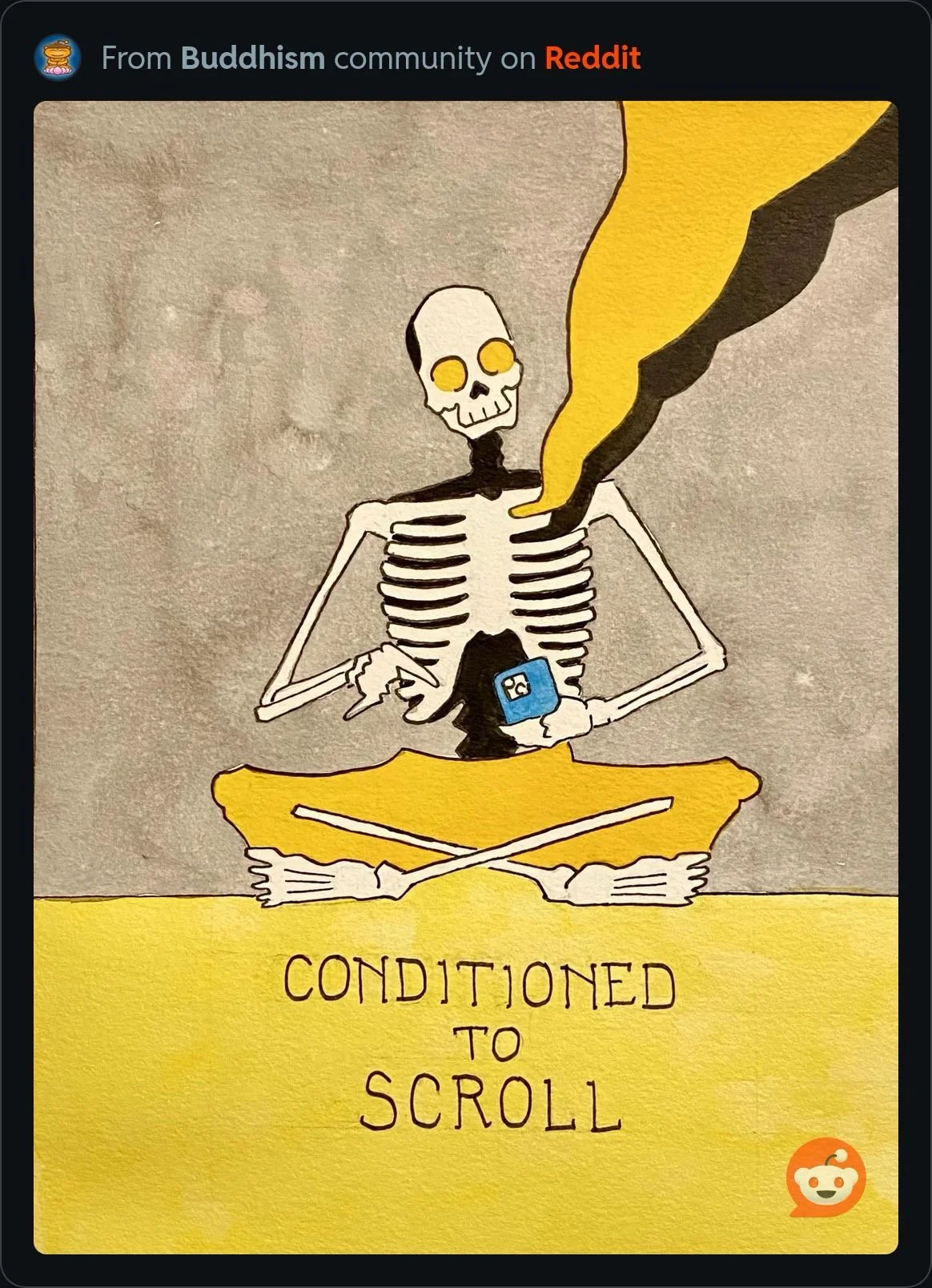
Conditioned to Scroll, published by Old_Sick_Dead to r/Buddhism on January 9, 2025.
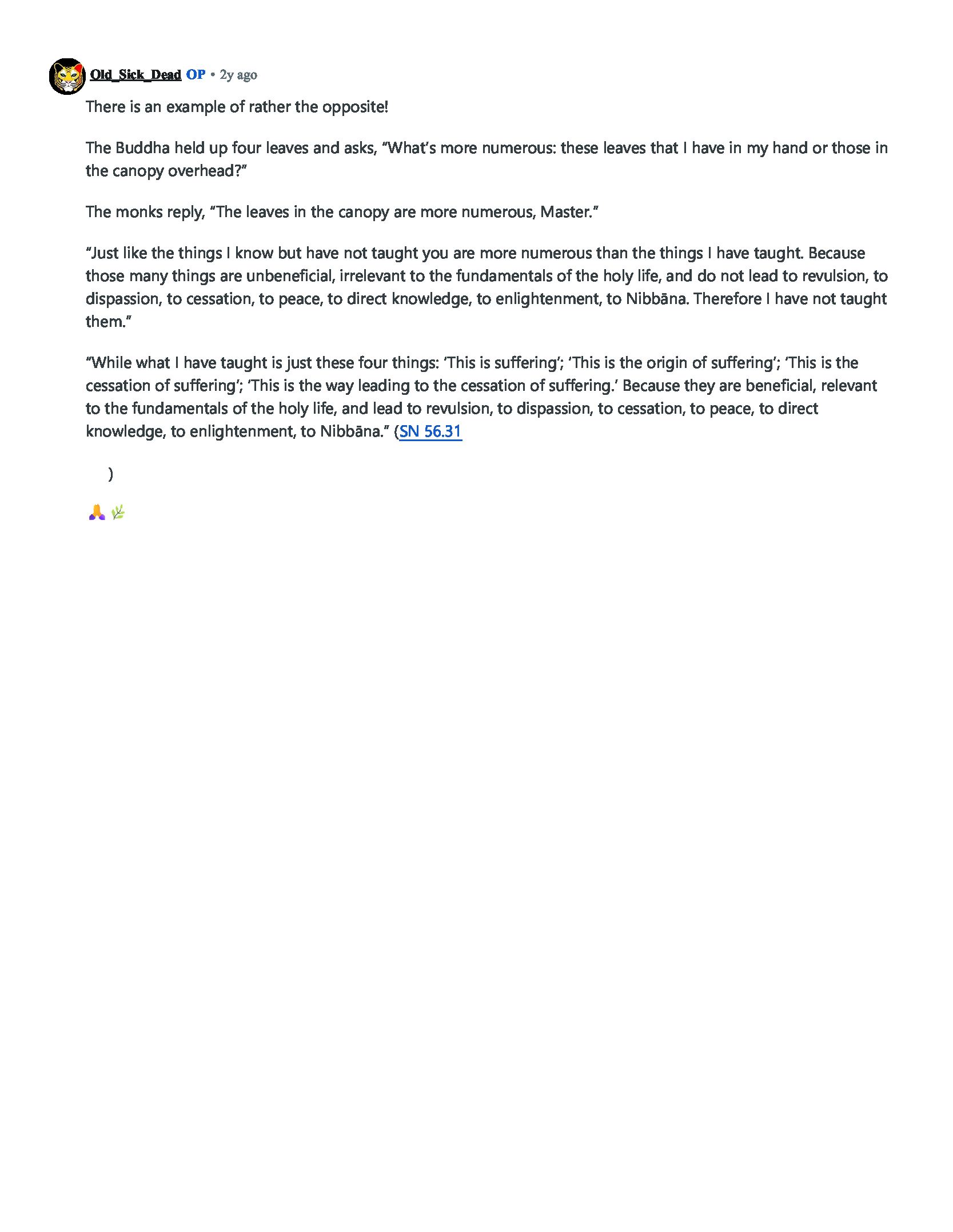
Old_Sick_Dead’s accompanying Reddit discussion invokes the Buddha’s teaching on suffering, its origin, its cessation, and the path leading to its cessation.
The artwork depicts a skeleton sitting almost meditatively while holding a phone.
In the accompanying material I preserved, Old_Sick_Dead recounts the teaching in which the Buddha compares the handful of leaves he has taught with the vastly greater number of leaves in the forest.
The point is that the essential teaching concerns suffering, its origin, its cessation, and the way leading toward its cessation.
That idea matters to me because eventually I stopped asking only:
Why is this happening?
And started asking:
What actually ends it?
For years I believed understanding would end the suffering.
Maybe if I could explain him correctly.
Maybe if I understood his childhood.
Maybe if I communicated differently.
Maybe if I became calmer.
Maybe if I forgave enough.
Maybe if I could finally locate the right combination of empathy, patience, love, silence, boundaries, accommodation, or explanation.
Understanding did not stop the pattern.
Leaving did.
There is a profound difference between understanding suffering and ending the conditions that continually recreate it.
January 10, 2025
A Bowl So Clean It Floats Upstream
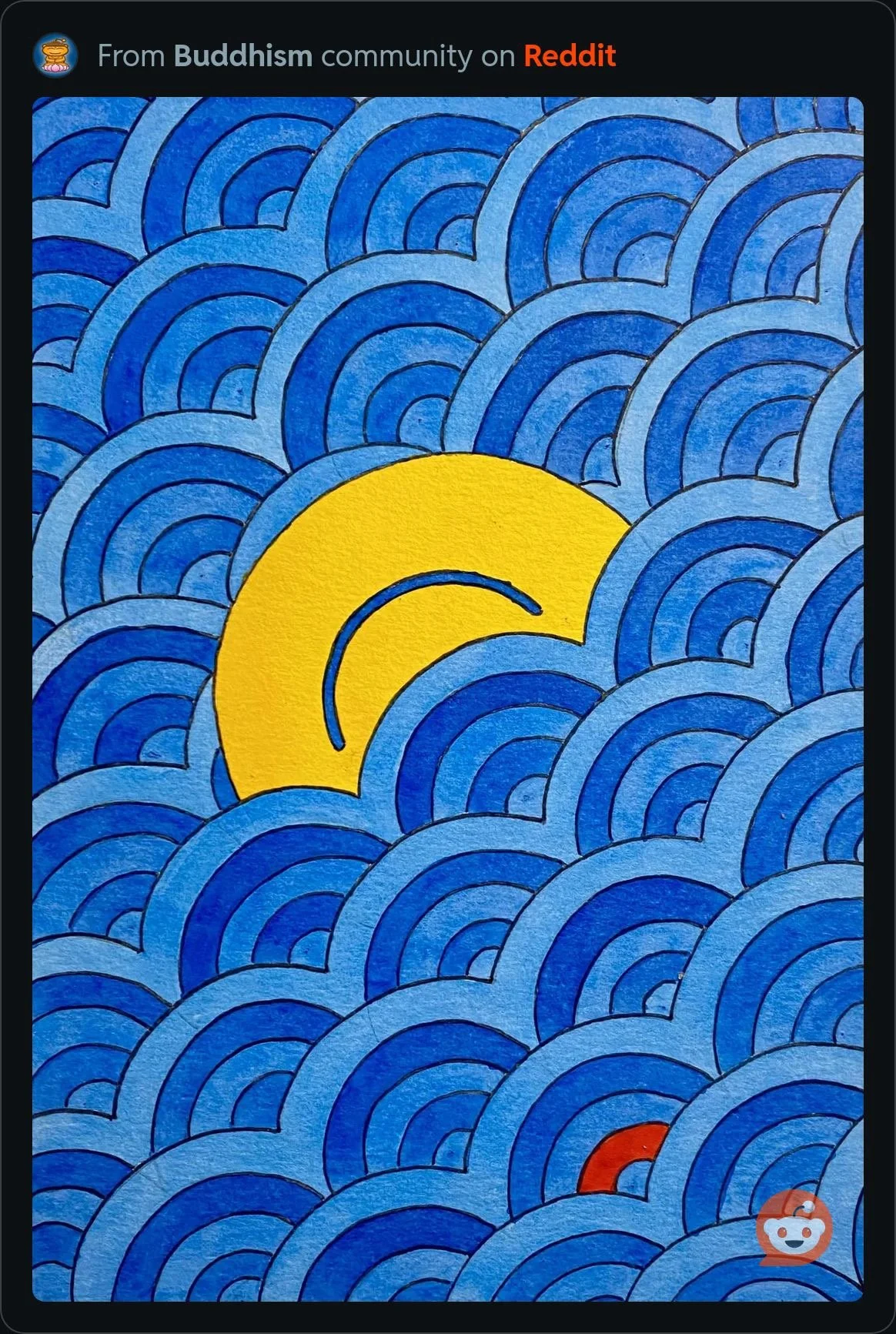
A Bowl So Clean It Floats Upstream, published to r/Buddhism on January 10, 2025.
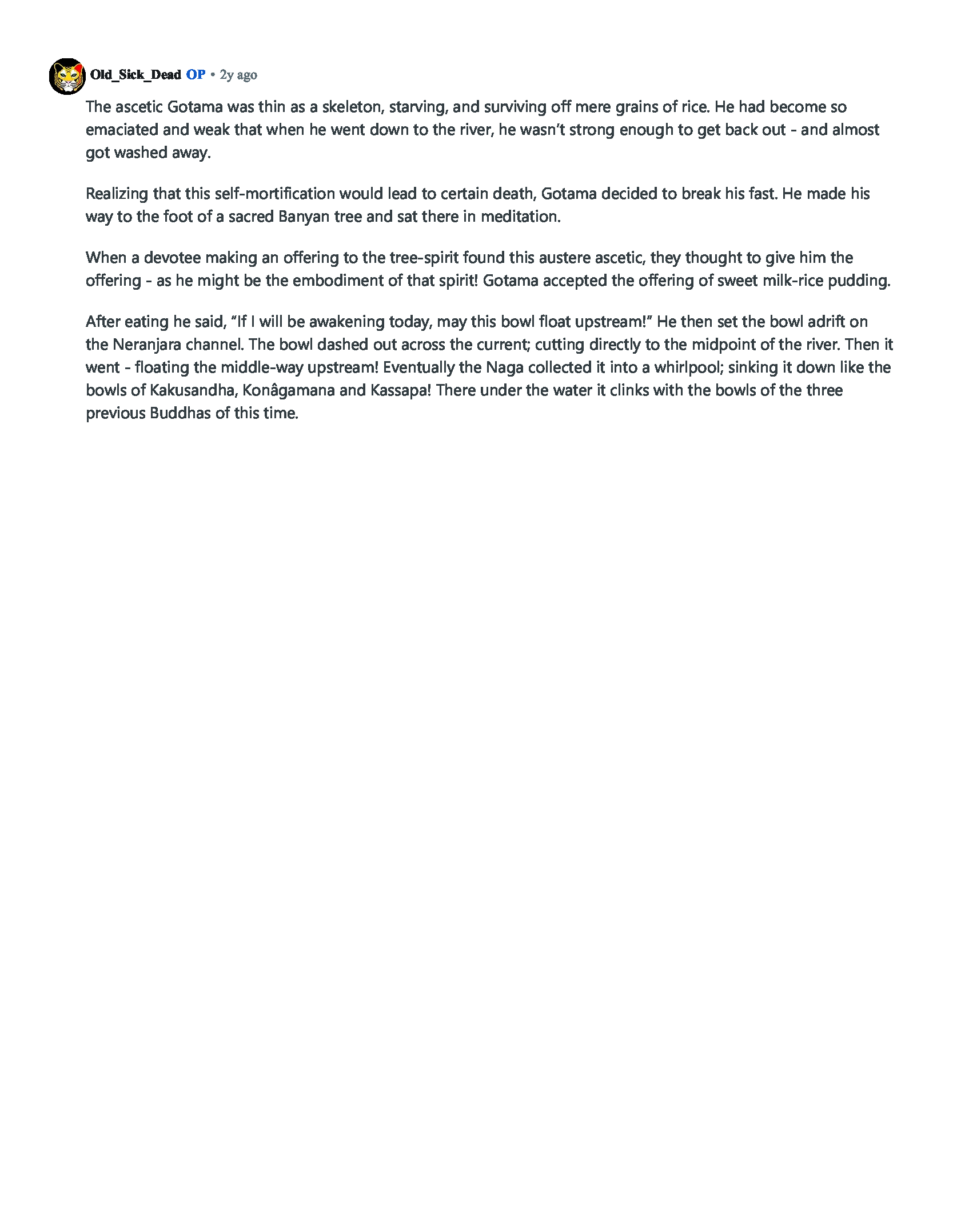
The accompanying Reddit story describes Gotama recognizing that extreme self-mortification was leading toward death, ending his fast, eating, and continuing toward awakening.
The accompanying story describes Gotama becoming emaciated through severe asceticism.
He becomes so weak that he nearly cannot escape the river.
He recognizes that continuing this self-mortification will lead to death.
So he stops.
He eats.
And the story continues toward awakening.
That lesson resonates with me.
I spent years believing endurance was proof of love.
I reduced my needs.
I tolerated.
I accommodated.
I explained.
I waited.
I survived.
Eventually, survival required recognizing that continuing to endure was not virtue.
There are situations in which the most life-preserving act available is to stop participating in one's own destruction.
January 11, 2025
The Beneficial Skeleton
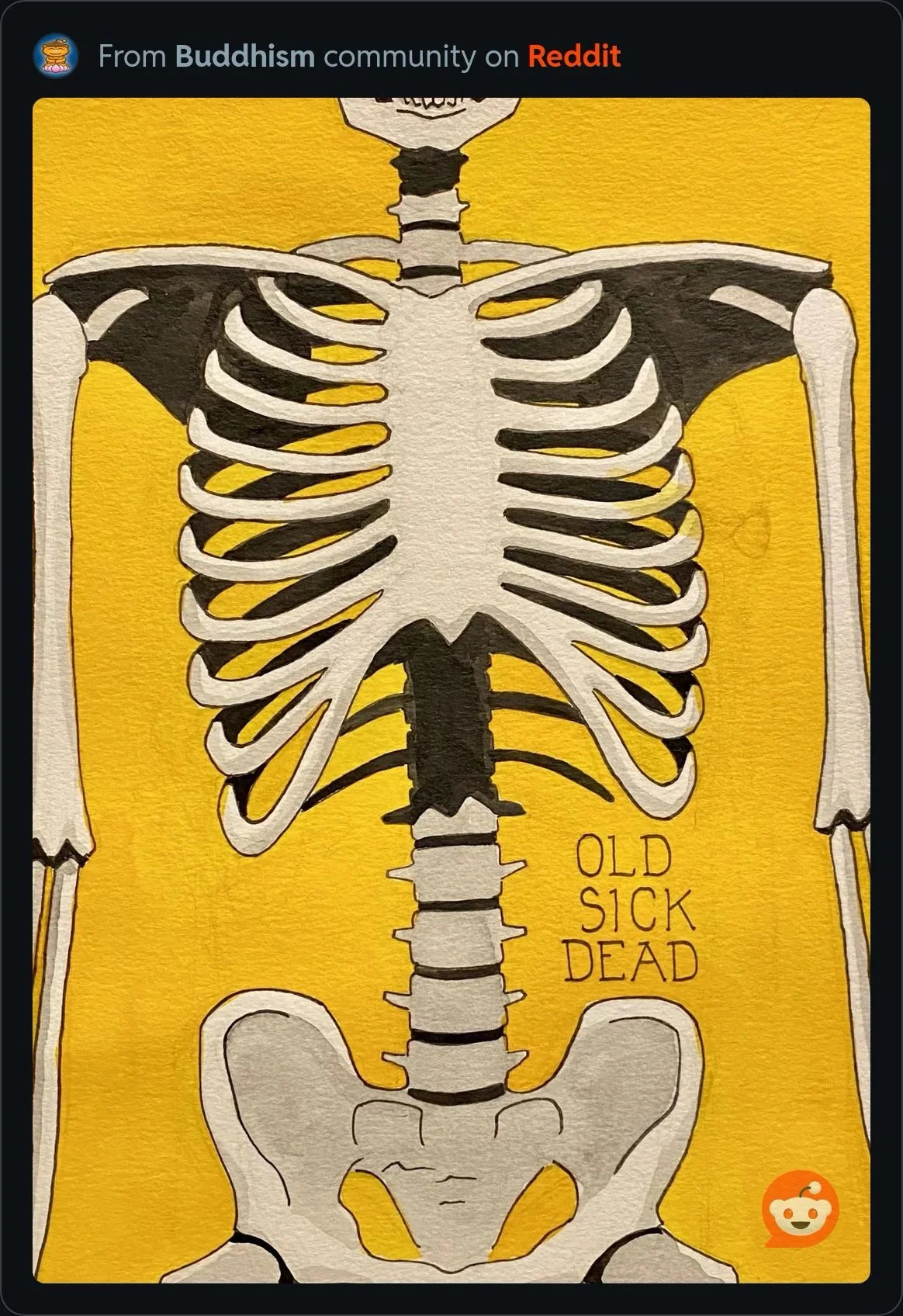
The Beneficial Skeleton, published by Old_Sick_Dead to r/Buddhism on January 11, 2025.

Old_Sick_Dead’s accompanying explanation connects contemplation of the skeleton with mindfulness, investigation, tranquility, equanimity, dispassion, cessation, and surrender of self.
His explanation of this work is particularly significant because it explicitly describes what contemplation of the skeleton is meant to cultivate.
He identifies mindfulness, investigation, energy, tranquility, immersion, and equanimity and connects them with seclusion, dispassion, cessation, and ultimately the surrendering of a self.
Elsewhere in the same discussion, he speaks about love as something concrete.
That distinction matters enormously to me.
Love is not established by saying:
I love you.
Love is revealed through conduct.
How do you behave when someone disagrees with you?
What happens when someone says no?
What happens when another person becomes inconvenient?
What do you do when you are angry?
What do you do when nobody else is watching?
How much responsibility are you willing to take for the consequences of your own actions?
The public philosophy continually returned to relinquishment of self.
The private experience I document elsewhere was one in which I progressively lost autonomy, confidence, resources, safety, and eventually my understanding of myself.
Those are profoundly different forms of surrender.
January 14, 2025
Metta
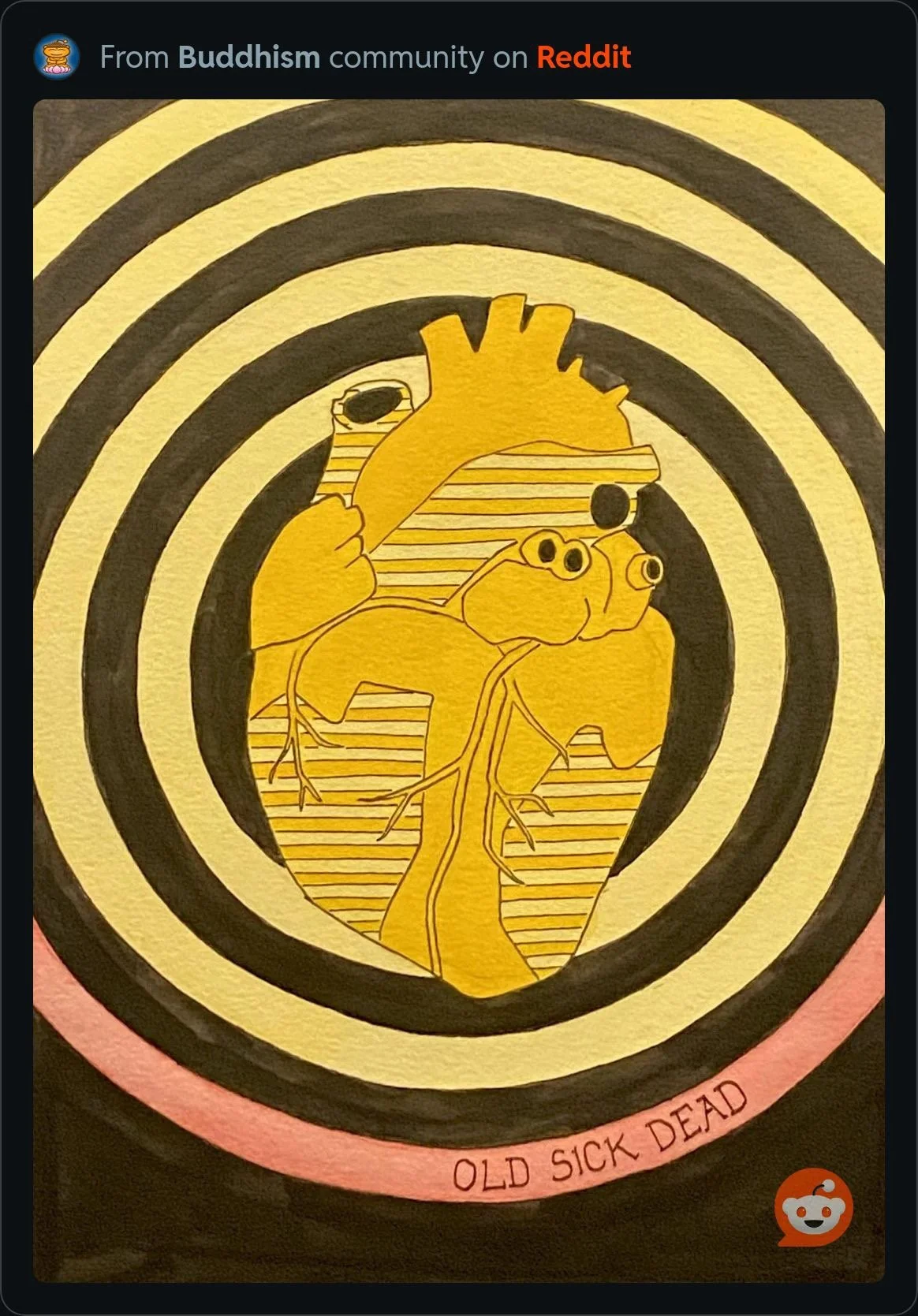
Metta, published by Old_Sick_Dead to r/Buddhism on January 14, 2025.

Old_Sick_Dead paired the anatomical-heart artwork with a Buddhist teaching on loving-kindness, including non-deception, rejection of contempt and harm, and protective love toward children.
This may be the clearest expression of the moral contradiction documented in this collection.
The artwork is an anatomical heart.
The text selected to accompany it is a Buddhist teaching about metta, or loving-kindness.
The passage calls for happiness for living beings. It rejects deception and looking down upon others. It rejects wishing pain upon another person even when provoked. It uses the protection a mother offers her child as an image of boundless care.
The words come from Buddhist scripture.
They are not his independently authored ethical manifesto.
That distinction matters.
But selecting them still matters too.
He chose this teaching.
He paired it with this heart.
He published the two together under the Old Sick Dead identity.
And I was living in the aftermath of a relationship in which the things I needed most were not teachings about compassion.
I needed compassionate behavior.
I did not need a lesson about non-harm.
I needed not to be harmed.
I did not need an artistic representation of boundless love.
I needed safety.
I did not need someone to understand the intellectual meaning of compassion.
I needed the person closest to me to practice it.
January 28, 2025
Jataveda Goes Around
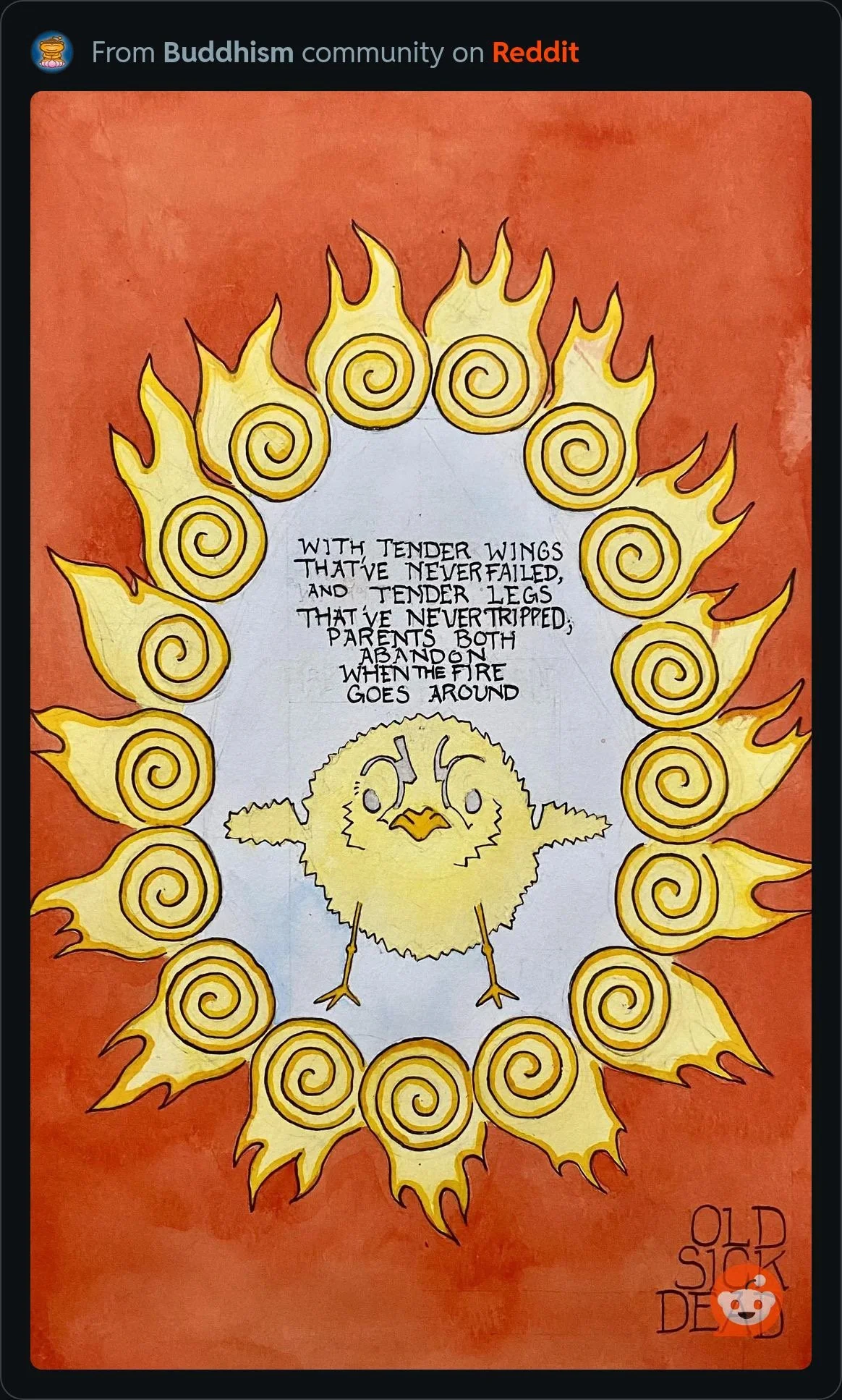
Jataveda Goes Around, published by Old_Sick_Dead to r/Buddhism on January 28, 2025.

Screenshot of Old_Sick_Dead’s accompanying Reddit explanation of the Jataka story represented in Jataveda Goes Around.
This is one of the most emotionally charged images in the sequence.
At the center is a helpless young bird.
Around it is fire.
And written directly into the artwork is a statement that both parents abandon the child when the fire comes around.
I am not claiming that this artwork was secretly about our children.
I cannot know that from the image.
That would be interpretation presented as fact.
What I can say is that parenthood, abandonment, vulnerability, danger, truth, and survival were subjects he deliberately chose to illustrate during this period.
For me, those themes exist beside a family history in which the children were already living through the consequences of the breakdown of our family.
That is why the work belongs in this chronology.
Not because it proves what he was thinking.
Because it documents what he chose to put into the world.
January 29, 2025
Guard the Senses
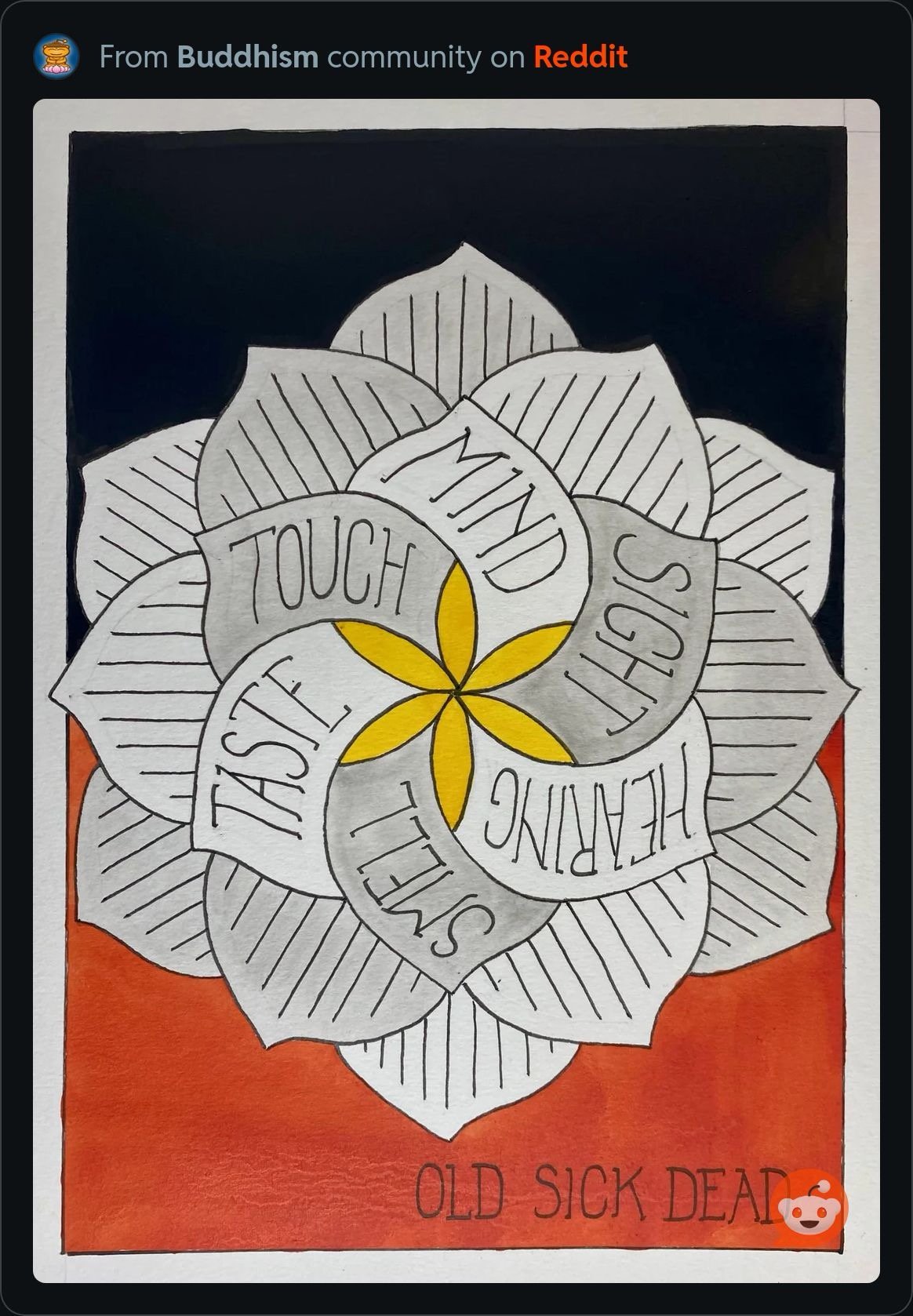
Guard the Senses, published by Old_Sick_Dead to r/Buddhism on January 29, 2025. An earlier Reddit appearance of the same artwork is preserved in my records from December 2024.

Old_Sick_Dead’s accompanying explanation explicitly connects sense restraint with ethical conduct, knowledge, dispassion, and freedom.
This explanation contains one of the most important sentences in this collection.
Old_Sick_Dead explicitly links sense restraint with ethical conduct, followed by knowledge, disillusionment, dispassion, and ultimately freedom.
That distinction matters enormously when thinking about coercive control.
Healthy restraint is self-directed.
I govern myself.
I regulate my behavior.
I decide what I will do with anger, fear, desire, jealousy, frustration, and impulse.
Abusive control moves outward.
I regulate you.
I restrict you.
I decide what you are permitted to do.
I make my reactions your responsibility.
Those are not the same thing.
The ethical teaching represented here asks a person to master himself.
It does not grant permission to master another human being.
For me, this may be one of the most consequential pieces in the collection because the public lesson was literally restraint leading to ethical conduct and freedom.
The private question was:
Whose behavior was expected to be restrained, and whose freedom was protected?
January 30, 2025
Discernment
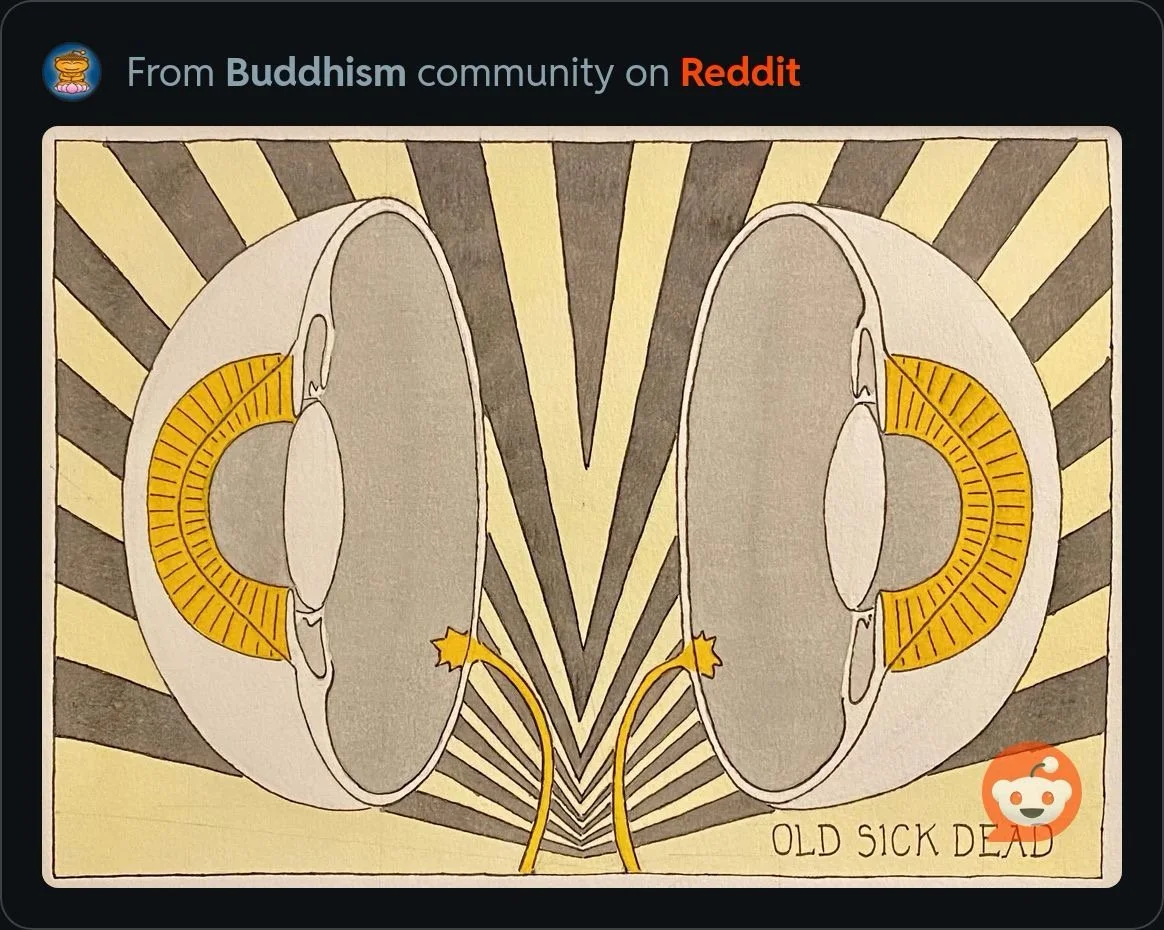
Discernment, published by Old_Sick_Dead to r/Buddhism on January 30, 2025.
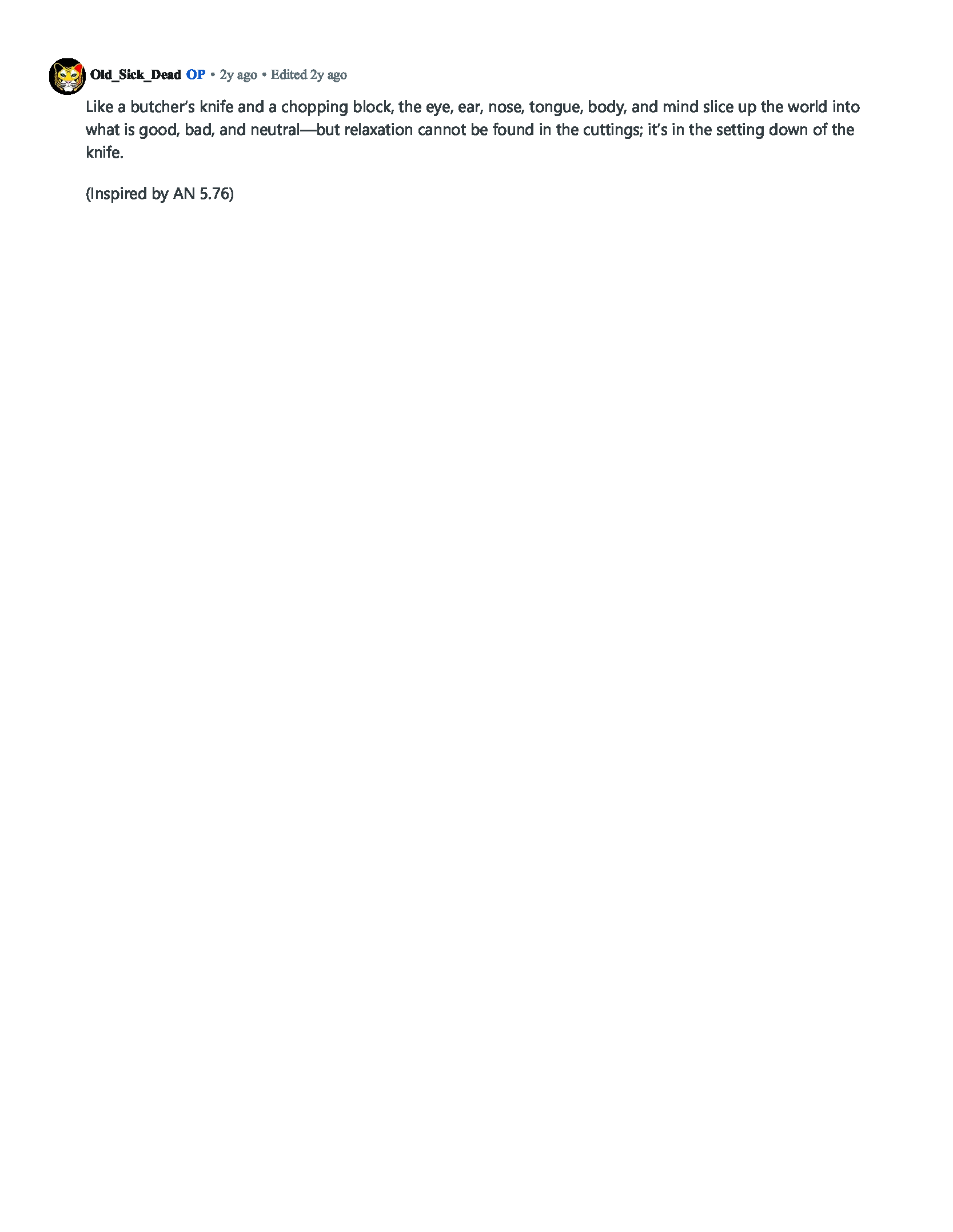
Old_Sick_Dead’s accompanying explanation compares the senses and mind to a knife that divides experience into categories and suggests that liberation is found in setting the knife down.
The following day came Discernment.
The artwork shows two enormous anatomical eyes.
His accompanying language compares the senses and mind to a knife, continually dividing experience into categories such as good, bad, and neutral. The teaching ultimately points toward putting down that instrument of division.
This feels like an appropriate place to end this sequence because abuse profoundly altered my confidence in my own perception.
What did I see?
What did I remember?
What did I know?
What could I prove?
Was I exaggerating?
Was I misunderstanding?
Was the gentle version real?
Was the frightening version real?
Eventually, I understood something that had once seemed impossible:
Both could be real.
A person can be intelligent and harmful.
A person can be compassionate toward strangers and cruel inside an intimate relationship.
A person can understand sophisticated ethical teachings and fail to live according to them.
A person can create beautiful artwork about peace while another human being experiences him as a source of fear.
The existence of one does not disprove the other.
Ten Works Across Twenty-Nine Calendar Days
Taken together, these works form an extraordinary concentration of themes.
Within twenty-nine days, Old_Sick_Dead publicly circulated artwork and teachings concerning:
nonattachment
stress
transformation
anger
lust
craving
self-restraint
suffering
conduct
impermanence
love
non-deception
non-harm
parenthood
abandonment
ethical behavior
freedom
discernment
peace
None of those subjects are incriminating.
They are human subjects.
Many of the teachings are beautiful.
What matters to me is the contrast.
Because those were the values publicly associated with the person whose private conduct I was still trying to understand.
The Public Man and the Person I Knew
One of the most difficult misconceptions about abuse is the assumption that an abusive person must behave abusively everywhere.
People imagine that cruelty will be obvious.
They imagine everyone will see it.
They imagine the person who frightens his partner must also frighten acquaintances, coworkers, students, strangers, and friends.
That is not necessarily how intimate abuse works.
The outside world may encounter:
the artist,
the Buddhist practitioner,
the yoga instructor,
the thoughtful commenter,
the person discussing compassion,
the person explaining restraint,
the person talking about ethical conduct,
the person telling strangers to find peace.
The survivor may encounter another side entirely.
Then she must somehow explain how both people occupy the same body.
That disparity can become its own form of psychological isolation.
People think:
That does not sound like him.
And the survivor begins thinking:
Then what happened to me?
When the Contradiction Moves Inside You
Eventually, that contradiction stopped existing only between his public image and my private experience.
It moved inside me.
One part of me knew.
Another part continually argued against what I knew.
Maybe I was wrong.
Maybe I misunderstood.
Maybe I was too emotional.
Maybe I was too attached.
Maybe I needed to forgive.
Maybe I needed to stop reacting.
Maybe I needed to become more peaceful.
Maybe I was the problem.
That was one of the deepest injuries.
I stopped trusting the person whose perception I needed most:
myself.
Spiritual Language Does Not Replace Accountability
I want to make this distinction explicit.
Buddhism did not abuse me.
Meditation did not abuse me.
Yoga did not abuse me.
A lotus did not abuse me.
A skeleton did not abuse me.
Spiritual philosophy did not abuse me.
The abuse was the abuse.
But spiritual language can become dangerous when it substitutes for accountability.
There is a difference between:
talking about nonattachment
and repairing the damage you caused;
talking about compassion
and behaving compassionately toward the people closest to you;
teaching restraint
and actually restraining harmful behavior;
discussing ethical conduct
and accepting responsibility for unethical conduct;
speaking about freedom
and respecting another person's autonomy;
teaching peace
and creating safety.
Those distinctions matter.
Understanding Is Not Practice
What these ten pieces demonstrate most clearly to me is that understanding an ethical principle is not the same thing as practicing it.
A person can understand compassion.
A person can explain nonattachment.
A person can discuss craving.
A person can contemplate impermanence.
A person can speak about restraint.
A person can quote teachings about non-harm.
A person can create art about freedom.
None of that automatically tells us how the person behaves inside an intimate relationship.
That is why I no longer evaluate love primarily through language.
I evaluate it through conduct.
What happened when I needed protection?
What happened when I disagreed?
What happened when I set a boundary?
What happened when I tried to leave?
What happened when nobody outside the relationship could see?
Those answers tell me more about love than any philosophy ever could.
Why I Am Preserving These Together
I am preserving these works because abuse does not exist separately from identity, reputation, culture, and community.
The person who harms someone may also make beautiful things.
He may understand philosophy.
He may genuinely experience moments of compassion.
He may help other people.
He may teach.
He may meditate.
People may admire him.
Hundreds or thousands of strangers may respond positively to his work.
None of those facts determine what another human being experienced privately.
That is the point.
These paintings do not prove the abuse.
The evidence elsewhere in this archive documents that history.
These paintings document something else:
the person the public was being shown during the same period that I was trying to understand the person I had known.
The internet saw peace.
I was trying to understand harm.
The internet saw restraint.
I was beginning to understand control.
The internet saw compassion.
I was trying to understand what compassion had looked like inside my own home.
The internet saw spiritual practice.
I was trying to recover trust in my own perception.
The art was not the abuse.
But the enormous distance between the moral identity being presented publicly and the reality I experienced privately became part of what made the abuse so difficult to recognize, explain, and survive.
That is why these ten works belong together.