
Abuse Tried to Erase Me. It Failed.
Survivor-Educator Essay
Written October 2, 2025
Content warning: This essay contains detailed descriptions of domestic violence, coercive control, physical violence, sexual abuse, threats, psychological abuse, child abuse, isolation, homelessness, and trauma.
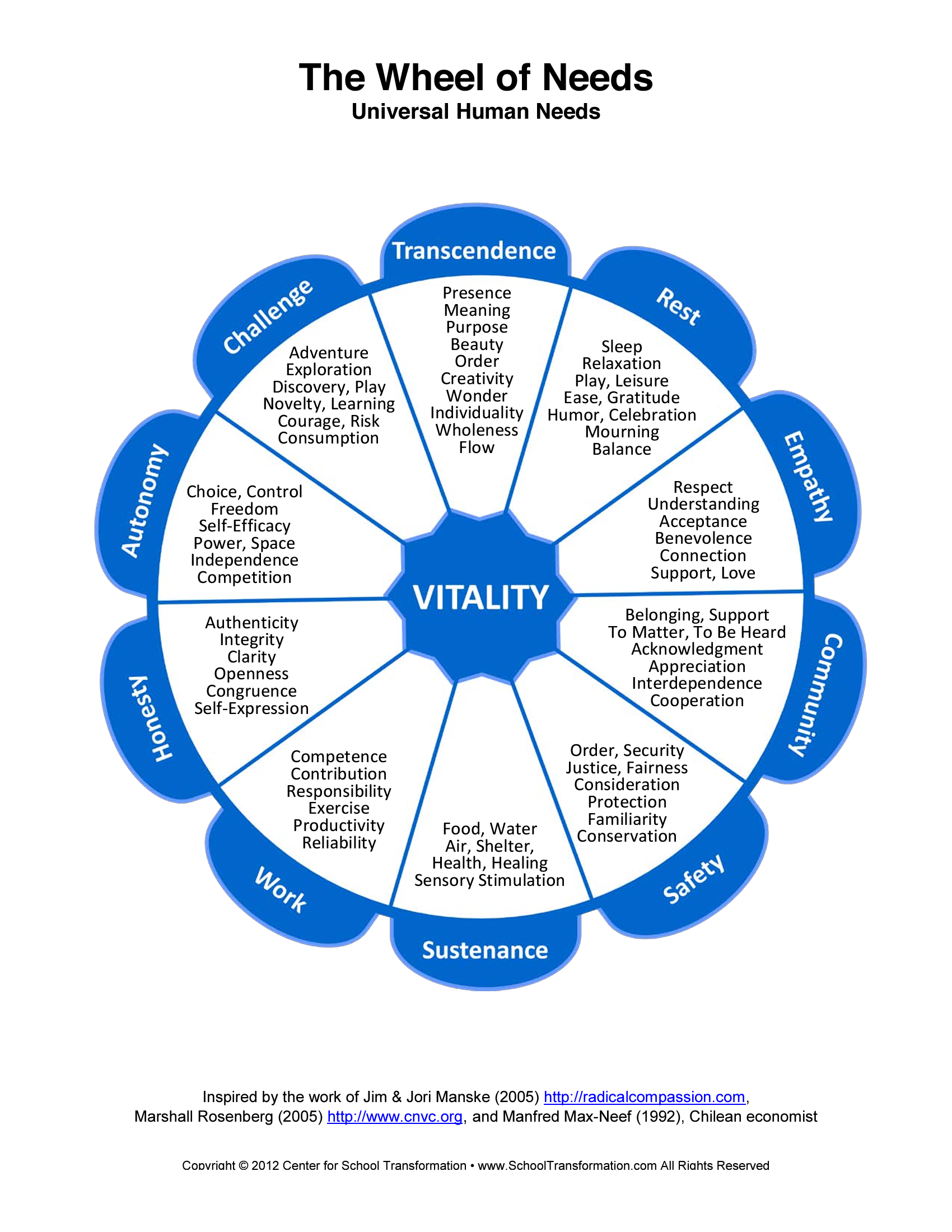
The Wheel of Needs identifies universal human needs that contribute to vitality, including safety, rest, connection, autonomy, honesty, sustenance, meaningful work, and belonging. Seeing these needs together became the starting point for recognizing how comprehensively they had been absent from my life.
First thing this morning in mediation training, we were given the Wheel of Needs.
As soon as I read through it and sat with it, I felt something hit me in my solar plexus.
It is still there now, tight and painful, pressing beneath my rib cage and making it hard to breathe.
At fifty years old, five feet seven inches tall, and weighing only 120 pounds, I live inside a body that has carried two decades of deprivation. The damage is not only emotional or psychological.
My body tells the story too.
The Wheel shows the basic needs every human being requires to live with vitality: safety, rest, empathy, honesty, autonomy, community, sustenance, transcendence, challenge, and meaningful work.
When I looked at it, I realized something devastating.
In twenty years together, thirteen of them married, I did not receive a single one of those needs in a healthy or consistent way. Instead, every one of them was dismantled, attacked, withheld, or inverted into its opposite.
After going over everything I endured, and knowing I am probably still leaving things out, I cannot name a single fundamental human need that was consistently met within that relationship.
He abused me instead of keeping me safe.
He lied instead of being honest.
He used me instead of respecting me.
He manipulated, gaslit, and degraded me until I doubted my own mind. He called me gross, sick, and disgusting so many times that I began to believe him.
He hurt me physically by pushing me, knocking me down, forcing me, and strangling me multiple times.
Once, while I was driving and we were not even arguing, he suddenly put his hands around my neck.
He left bruises on me. He lifted furniture while I was sitting on it and dropped it. He slammed his hands down on tables and walls. He broke my belongings.
My home was never safe.
He hurt me emotionally by turning love into cruelty and attachment into punishment.
He hurt me spiritually by hollowing out my sense of meaning and faith in life.
He hurt me cognitively by destroying my ability to trust my own memory, perceptions, and thoughts.
He blamed me for his cheating, as though my existence had forced him into betrayal. When I cried uncontrollably from the pain of it, he slapped me across the face and made me apologize.
My feelings were not allowed to exist, and acts of cruelty were repeatedly turned back on me as though I had caused them.
He hurt me sexually by treating my body as something he was entitled to rather than as part of a person he should cherish.
He cheated with both women and men. He snuck out at night and went to massage parlors, escorts, and sex workers, sometimes during work hours, during lunch, or before coming home.
He even weaponized yoga.
He became a yoga instructor, became involved with another student in the class, and used poses and physical ability as another way to shame me. He never offered me support, guidance, or breath work. What I experienced instead was judgment and rejection.
I also witnessed or learned of conduct that raised serious concerns for me regarding his boundaries and behavior around children.
He hurt me financially by taking money, controlling resources, and interfering with my employment and opportunities.
Our instability became so severe that we experienced homelessness multiple times.
He hurt me socially by cutting me off from family, friends, and sources of support.
He isolated me completely, moving me away from communities I had built across three states until almost no one remained.
He never celebrated me.
Not our anniversary.
Not my birthday.
Not holidays.
Not even my accomplishments.
Instead, those moments were often sabotaged and the wreckage was somehow made mine to carry.
He was abusive toward my children.
He told them I was sick and crazy. He triangulated them against one another. He undermined their trust in me and, at times, their trust in themselves.
Their schooling was disrupted. My education was interrupted repeatedly. Stability was always temporary.
The home was unsafe not only for me, but for them.
Now that he is gone, my relationship with my children looks very different. We are close. We trust one another. We spend time together. We talk.
That closeness has forced me to reconsider what the earlier division actually meant.
What once looked like ordinary conflict within a struggling family now looks to me like division that had been cultivated and reinforced around us.
I believe he also put substances into my coffee and into or onto my personal hygiene products, including medications, pesticides, herbicides, and bleach.
He neglected me when I was sick and abandoned me after surgeries.
He convinced me I was crazy and pressured me into undergoing a five-hour psychiatric evaluation just to prove that I was not.
He threatened to kill himself if I left.
He threatened to kill me.
He pushed me toward a level of despair where I did not know how much more I could survive.
He took photographs and videos of me, not kind or loving ones, but recordings of me at my worst, often without my consent and sometimes without my knowledge, including while I was in the hospital.
He woke me deliberately, making it impossible to rest.
He shamed me for resting after long days of work while he did nothing.
I resorted to Adderall just to stay awake.
He humiliated me in front of other people.
He withheld affection, gave me the silent treatment for days, and remained cold and rejecting.
My cats repeatedly became sick while he lived in the home. After he was gone, I noticed that pattern stopped.
I was hospitalized in a psychiatric facility for ten days during a period when I later learned he was cheating on me.
He made false allegations against me.
He created false, ugly, and cruel narratives about me behind my back.
I never met a single one of his coworkers at any of his many jobs. I was never invited to work events or included in that part of his life.
He never acknowledged me on social media.
His online presence erased me completely.
No photographs of me.
No photographs of us.
No acknowledgment that I was his wife or that we had built a life together.
Nothing.
Even his profile pictures often did not show his real face. Looking back, I came to believe that the concealment served a purpose: it allowed him to maintain separate versions of himself without the other people he was involved with seeing me or the life he had at home.
He took off his wedding ring without ever discussing it with me. He later claimed that it hurt his finger, but I only learned he had stopped wearing it because I noticed it was gone.
He isolated me and our children from society.
We were removed from ordinary life: no parks, no beaches, no movies, no outings, and almost none of the routine experiences most families share.
The closest comparison I have is the isolation of the COVID shutdown, except mine did not end.
For me, that period began on February 17, 2020, when we became homeless in Portland for the first time, and lasted until he finally left on December 5, 2024.
The rest of the world eventually reopened.
Mine did not.
The world kept moving, but I remained completely cut off from it.
I did not even watch television.
When my mother died in 2021, I was left with virtually no adult support and almost no one to talk to regularly except my abuser and people I interacted with on Facebook.
I was profoundly isolated and spent much of that period confined to my bathroom.
I sat on the tile floor for hours at a time, day after day, trying to regulate myself through what became the darkest and most abusive period of my life.
My children were isolated too, spending much of their time confined to their bedroom.
I spent so much time sitting on that hard floor that I developed painful sores and blistering over the bones of my buttocks, injuries that resembled pressure sores.
That is how physically reduced my life had become.
The bathroom floor had become one of the only places where I could retreat and try to make my nervous system settle.
We became homeless again in 2022.
Then, in 2023, I tried to help our family by stepping back into the world through a workforce pilot program in housing support.
Even crossing the bridge to the bus stop terrified me.
My legs shook as I walked.
I carried that fear into every step.
I was trying to rebuild a life while my body was still behaving as though I was in danger.
In the end, the effects of what I had been living through followed me into that opportunity, and I lost the job too.
I had never been fired before.
For my children, survival mode was all they knew.
My two youngest grew up without knowing what consistent stability or safety felt like.
My youngest son has had only one birthday party.
They were taken out of school, and my own education was interrupted repeatedly.
The message was always the same:
We were not allowed to belong to the world outside him.
Now, stepping back into the world feels like waking from a coma.
I have been away for so long that I am still learning things most people take for granted. Even the different kinds of cars on the road can feel new to me.
He controlled every part of my life, and I did not understand the extent of that control while I was living inside it.
I still have difficulty wrapping my mind around it.
Even now, I am discovering ways my choices, relationships, movement, work, rest, finances, and sense of reality were shaped by someone else’s control.
It is difficult to comprehend the architecture of captivity when you have spent years mistaking it for ordinary life.
He harmed me in ways I still do not have words for.
Abuse was not one thing.
It was everything.
The Aftermath
What I survived was not what people casually imagine when they hear the words domestic violence.
It was long-term coercive control, chronic deprivation, intimidation, isolation, and repeated violence.
It changed the way my brain and nervous system functioned.
My body adapted to constant threat. My mind became organized around survival rather than peace, concentration, memory, rest, or planning for the future.
It changed my ability to function.
I became hypervigilant, exhausted, overwhelmed, and unable to fully rest.
I could be extremely productive while still feeling driven by an invisible emergency.
I struggled to concentrate, organize information, make decisions, remain still, and feel present in my surroundings.
Those difficulties were not laziness or a failure of character.
They were adaptations to prolonged danger.
When a person lives under coercive control for years, danger does not simply disappear from the nervous system the moment the abusive person leaves.
The body continues scanning.
The brain continues preparing.
The survivor continues bracing for impact.
And when you finally escape, you go looking for help and discover how difficult appropriate help can be to find.
Through my insurance, I struggled to locate trauma-specialized providers who truly understood prolonged coercive control.
Many providers describe themselves as trauma-informed. That does not necessarily mean they have experience treating someone whose trauma was relational, cumulative, and sustained across decades.
Survivors can find themselves trying to heal, educate themselves, locate resources, protect their children, and rebuild their lives all at once.
Healing also requires safety.
My nervous system cannot learn peace while my children and I are still facing displacement, instability, legal conflict, financial insecurity, or the possibility of homelessness.
My children’s nervous systems need safety too.
Children who grow up in environments of coercive control and chronic instability can learn vigilance instead of calm.
Their developing minds adapt to unpredictability, fear, conflict, and instability.
Leaving was necessary.
But leaving was not enough.
We need stable housing.
We need predictable routines.
We need rest.
We need community.
We need enough sustained safety for our bodies to stop believing that another emergency is always about to begin.
Safety must come before healing.
And yet, here I am.
On October 2, 2025, not even a year after he finally left on December 5, 2024, I am attending mediation training and studying the very systems that failed me.
People see strength.
They see preparation.
They see me moving forward.
What they do not see is that my over-preparedness is trauma armor.
They do not see how completely I erased my own needs to survive.
They do not see that I am only now beginning to understand that I am allowed to have needs again.
Even after leaving, the consequences did not simply disappear.
My children and I were facing eviction after our rental home began showing signs of structural failure: the ceiling sagging, the walls separating, and the floors buckling.
My landlord had not provided me with the inspection report I was seeking.
I lost my home daycare after the property became unsafe for me to continue operating it. Without that income, we were pulled into eviction court.
After years of instability inside the relationship, institutional and housing instability continued after separation.
My divorce was finalized on September 25, 2025.
My eviction hearing occurred on September 29, 2025, the exact anniversary of the day my children and I had previously become homeless on September 29, 2022.
That was not only a housing crisis.
For me, it was another trauma layered onto an already injured nervous system.
The public often asks survivors to heal while removing the very conditions required for healing.
We are told to regulate ourselves while facing homelessness.
We are told to rest while fighting for our children, housing, income, medical care, and legal protection.
We are told to move forward while the ground beneath us continues to move.
Years of abuse changed the way my brain and nervous system functioned.
But the brain is capable of change.
Neuroplasticity means that the brain can continue forming and reorganizing neural connections throughout life.
Recovery can include relearning safety, attention, connection, creativity, trust, and rest.
But those capacities are extraordinarily difficult to rebuild while danger and instability remain constant.
My children and I need safety before our nervous systems can fully settle.
We need more than escape.
We need somewhere safe to land.
Why I Share
I write this not only to survive, but to educate.
Survivors like me exist.
Some never get the opportunity to tell the story themselves.
This was not simply a bad marriage.
It was not mutual conflict.
It was not a communication problem.
What I experienced was coercive control, violence, deprivation, isolation, and fear woven into ordinary life for years.
It stripped away fundamental human needs until almost nothing remained.
Domestic Violence Awareness Month must be about more than asking why survivors do not leave.
It must ask what happens after they do.
Where will they live?
How will they support their children?
Who will help their nervous systems recover?
Who will recognize the cognitive, emotional, and physical effects of prolonged trauma?
Who will protect them from post-separation abuse?
Who will prevent institutions from recreating the instability and powerlessness they escaped?
Survivors cannot heal without safety.
Children cannot heal without stability.
Leaving an abusive person is not the end of the story.
Sometimes it is only the beginning of the fight to become fully human again.
Abuse tried to erase me for twenty years.
It failed.