
I Have the Emails
Sometimes I think that is one of the saddest parts of all of this. I do not have to rely entirely on memory to understand what happened to me. I can go backward through my own life and find myself there, still writing, still explaining, still trying to understand something I did not yet have the language to name.
I can read myself in 2008.
I can read myself in 2009.
I can read myself in 2018.
And now, in 2026, I can read those words knowing what happened afterward.
This did not suddenly become bad at the end. I was already trying to survive it near the beginning.
In December 2008, I wrote after an interaction that hurt me. I told him, “You really hurt me today.” But almost immediately, I moved back toward taking care of him. I worried about whether he was sick or depressed. I told him I loved him. I accepted the apology. The record shows how quickly I moved from naming my own hurt to comforting the person who had hurt me.
I was still trying to make love solve what love could not solve.
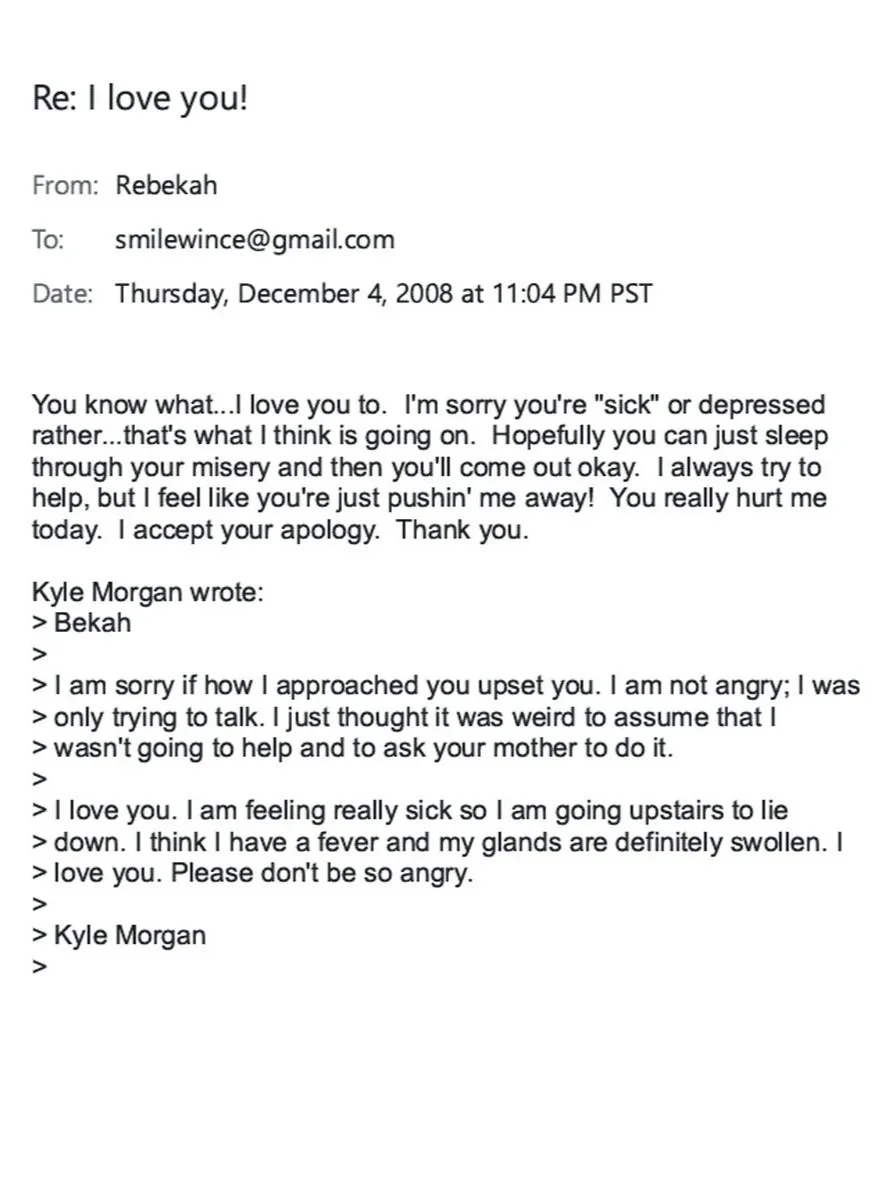
December 4, 2008 email thread documenting hurt, an attempted apology, and how quickly I moved from naming my own pain back toward caring for him.
Then came January 2009. I wrote him a letter so long that I attached it as a document. Even the short email I sent with it tells me something now. I apologized for how long it was and asked him to take the time to read it. Before he had even read what I was trying to say, I was already apologizing for taking up too much space with my own pain.
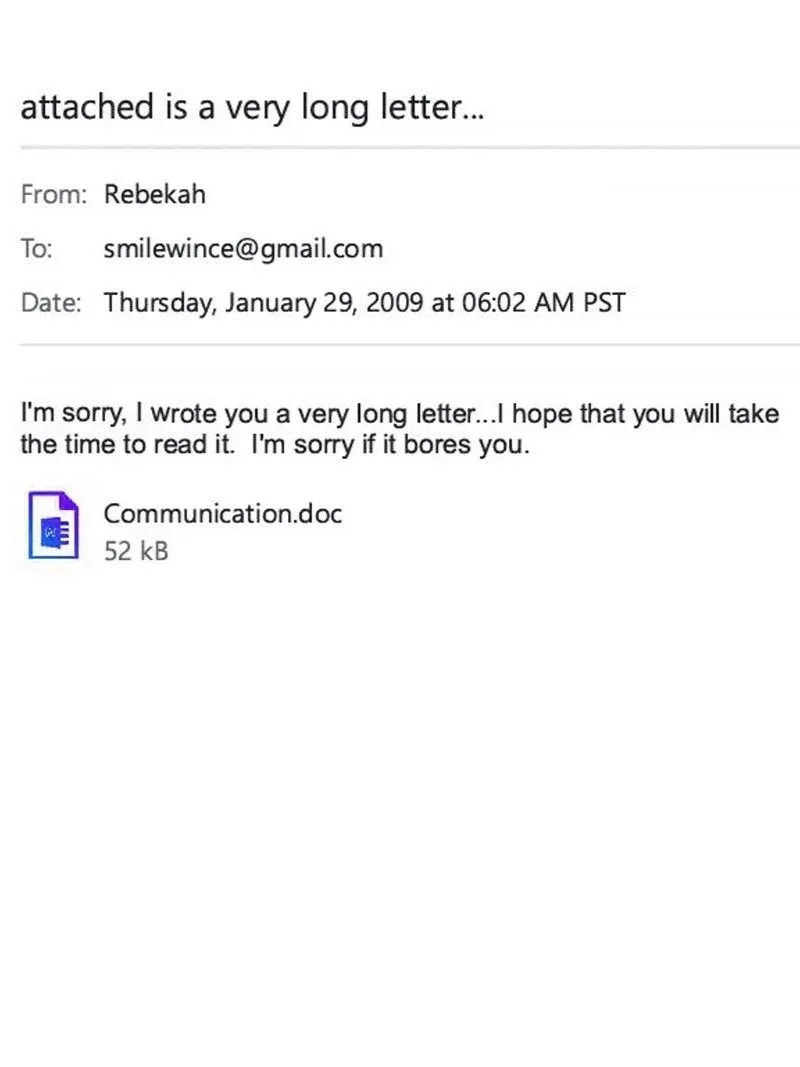
January 29, 2009 transmittal email accompanying the attached six-page letter. Before he had read it, I apologized for its length and for the possibility that it might bore him.
Inside that letter, I examined myself from every direction. I tried to understand my anxiety. I described my physical reactions. I questioned my own perceptions. I considered his perspective. I acknowledged my own mistakes. I tried to separate feelings from facts. I tried to communicate more carefully.
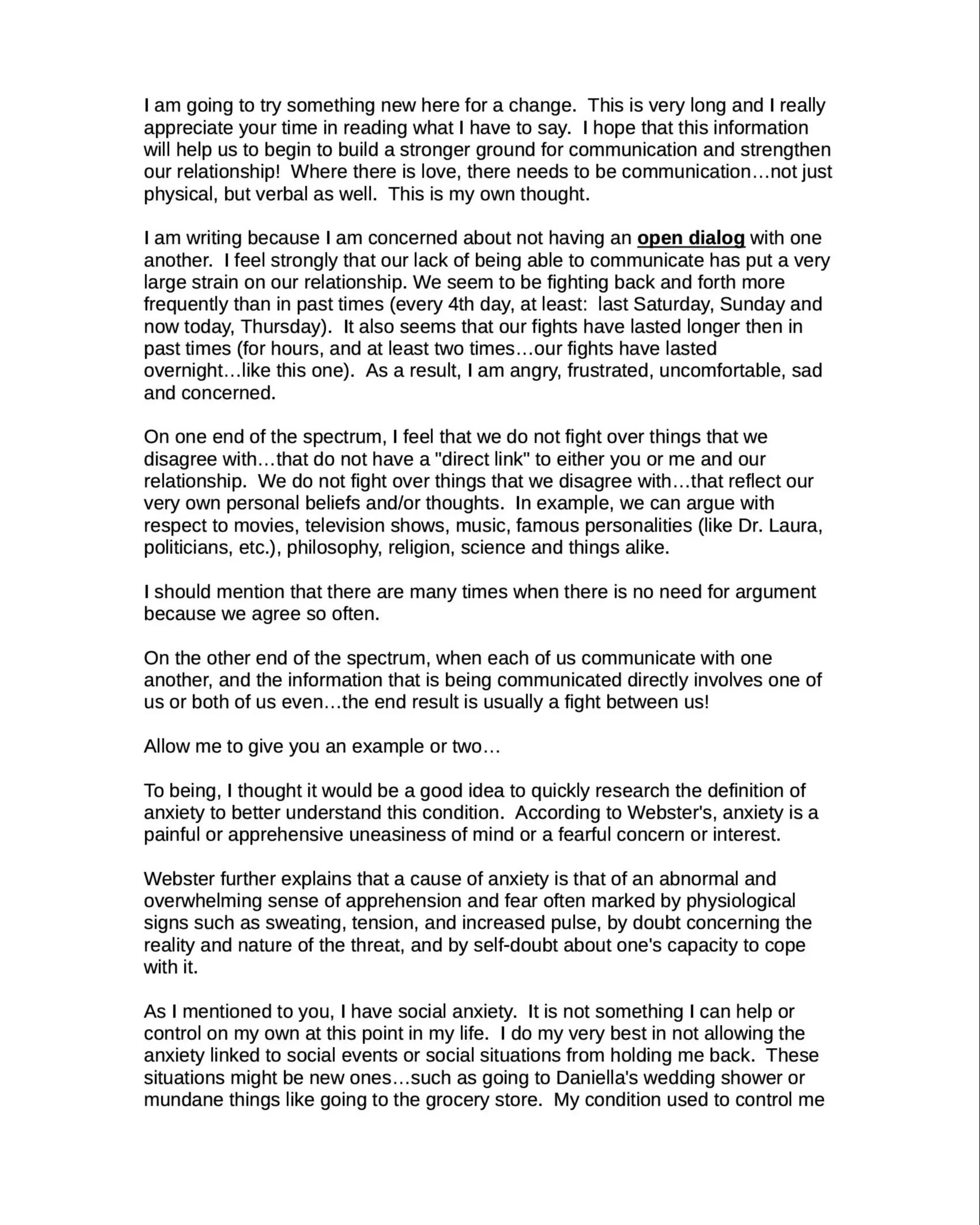
Page 1 of the January 29, 2009 letter, introducing the lack of open dialogue, increasingly frequent arguments, and conflicts that lasted for hours or continued overnight.
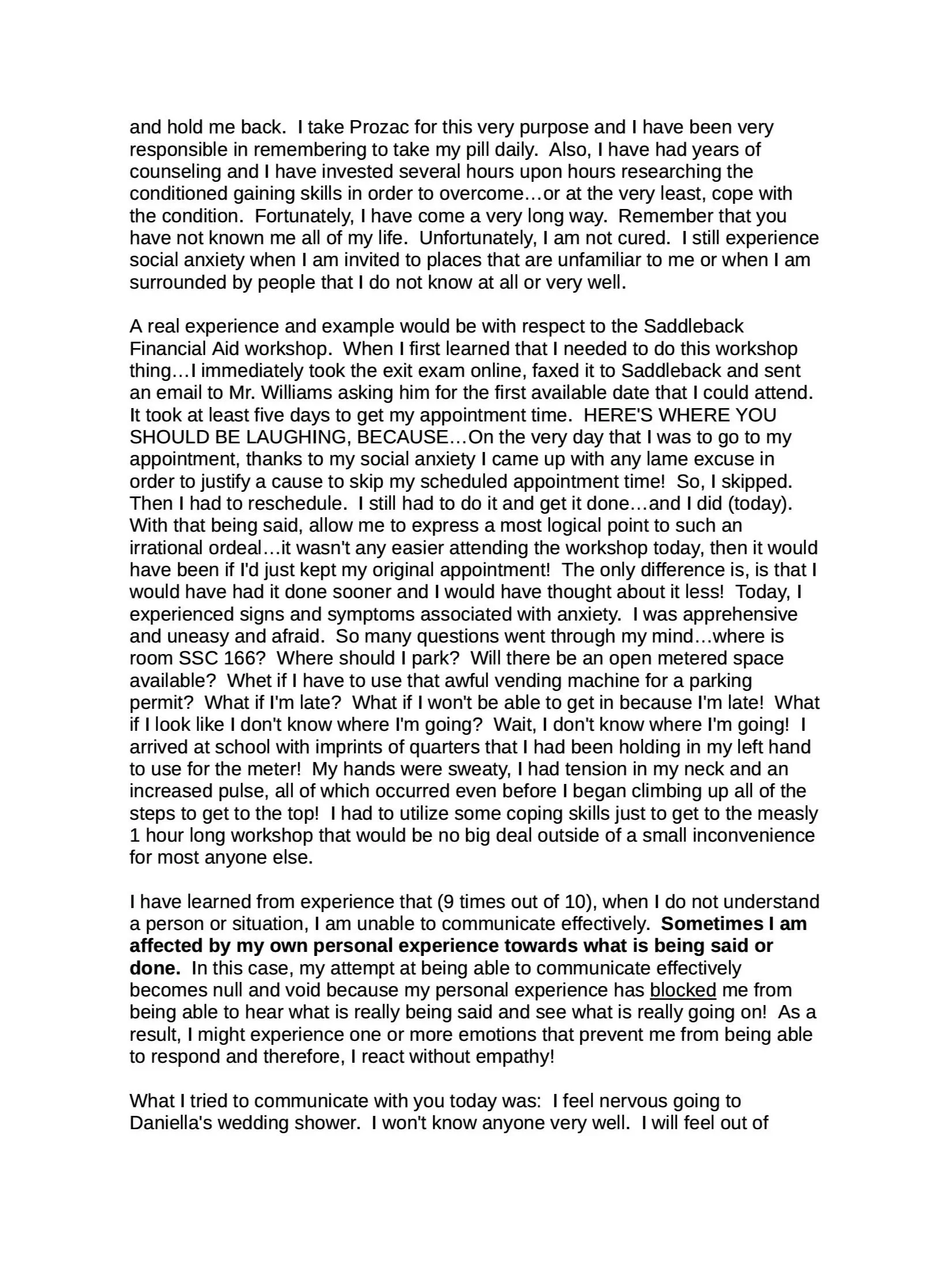
Page 2 of the January 29, 2009 letter, describing my history of anxiety, treatment, coping efforts, and the physical effects of distress.
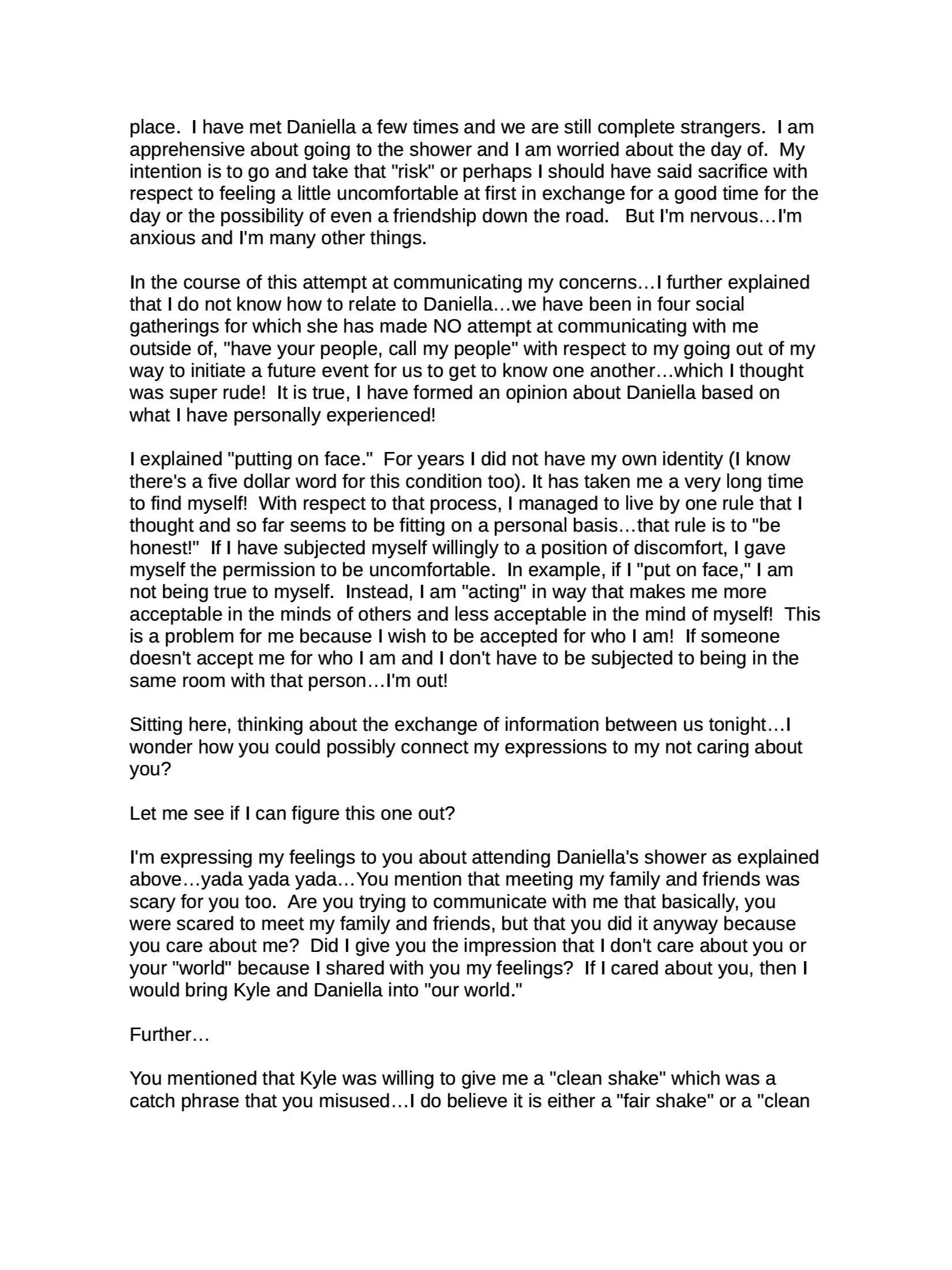
Page 3 of the January 29, 2009 letter, documenting my effort to explain anxiety, remain authentic, and understand how expressing fear had been interpreted as not caring.
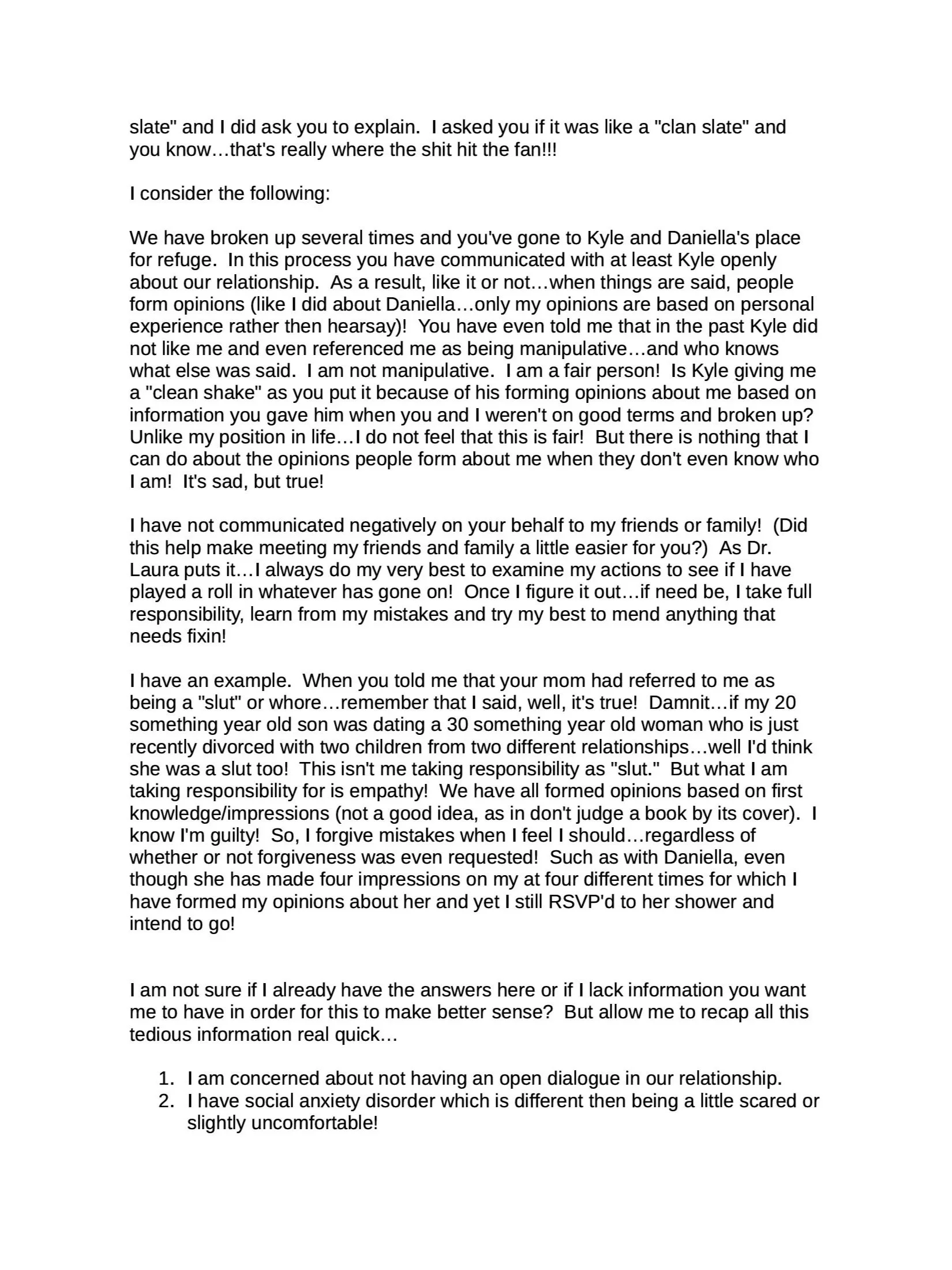
Page 4 of the January 29, 2009 letter, describing repeated breakups, outside discussions about the relationship, and my concern that other people had formed opinions about me without knowing me.
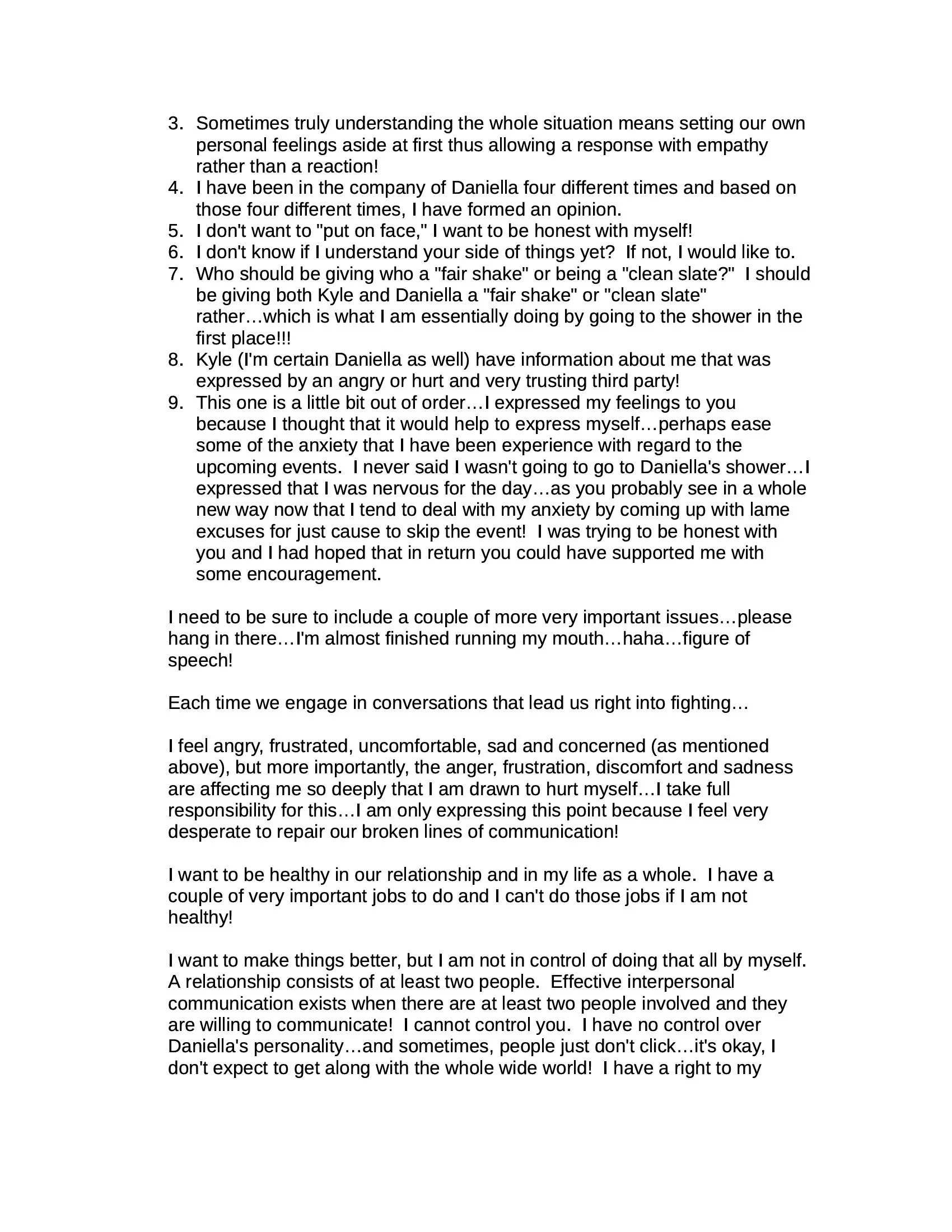
Page 5 of the January 29, 2009 letter, asking for empathy and encouragement, describing the effect of the conflict on me, and recognizing that I could not repair the relationship alone.
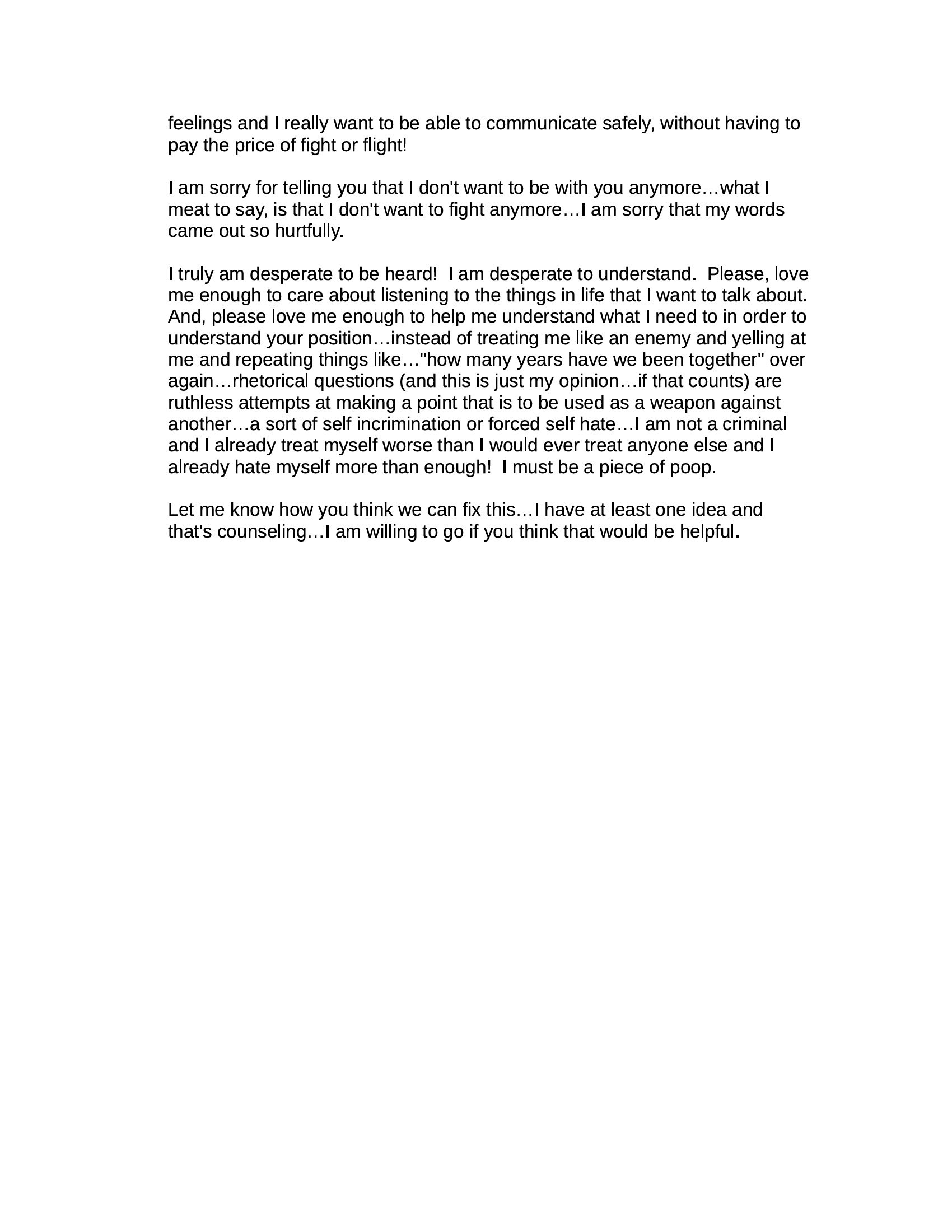
Page 6 of the January 29, 2009 letter, ending with my request to communicate safely without entering fight or flight, my statement that I was desperate to be heard, and my proposal that we attend counseling.
I was not writing like someone determined to make another person the villain of her life. I was writing like someone desperately searching herself for whatever she could change to make the relationship safe.
I kept coming back to communication. I wanted to understand him. I wanted him to understand me. I wanted to be able to tell someone I loved that I was hurt, afraid, confused, or uncomfortable without the conversation becoming another fight.
Near the end of that letter, the language becomes painful to read now. I wrote that our fights affected me so deeply that I was drawn toward hurting myself. I immediately took responsibility for that too. I wrote that I wanted to be healthy and that I could not repair our relationship alone.
Then I wrote, “I really want to be able to communicate safely, without having to pay the price of fight or flight!”
And then I wrote, “I truly am desperate to be heard!”
Desperate to be heard. January 2009.
I described feeling treated like an enemy. I described yelling. I described old mistakes being repeated back to me and rhetorical questions that felt like weapons. And after all of that, I still asked how we could fix it. I suggested counseling.
I was still looking for the door back to love.
For years, I believed there had to be some combination of words that would finally make everything understandable. If I communicated better, maybe things would change. If I explained myself better, maybe I would be heard. If I understood him better, maybe he would understand me. If I became less anxious, more patient, more forgiving, more self-aware, more useful, more attractive, more productive, more accommodating, less emotional, less demanding, maybe eventually I would feel safe.
I did not understand that a person can spend years becoming better at explaining pain without ever becoming safer from it.
Years passed, and I kept writing. At some point, the writing changed. I went from explaining to documenting, from documenting to proving, and from proving to defending myself.
By July 2018, nine years after I wrote that I was desperate to be heard, I was writing from somewhere much darker. I described the order of operations in my marriage as him first and me last. I wrote that everything right seemed to equal him and everything wrong seemed to equal me. I wrote that no matter what I did, it was never enough. I described imperfections being used against me and the feeling that even when life looked good, something could always be found or invented to diminish me.

Page 1 of my July 2018 writing, documenting chronic blame, impossible standards, betrayal, and the sense that I had been placed last inside my own marriage.

Page 2 of my July 2018 writing, describing emotional, mental, and physical depletion and comparing what remained of me to the stump in The Giving Tree.
I wrote about believing apologies, believing half-truths, and listening when the blame was placed on me. Then I wrote, “When I reached inside of myself for something to take out and give to you, there was nothing left.”
I described myself as emotionally, mentally, and physically depleted. I compared myself to The Giving Tree and wrote that I had allowed myself to be reduced to nothing more than a stump.
A stump.
That word destroys me now because nine years earlier, I was still standing there with my arms full, offering explanations, empathy, accountability, research, counseling, forgiveness, another conversation, another chance.
By 2018, I was describing what remained after years of giving.
And still, 2018 was not the end. Not even close.
The relationship continued for more than six more years, and those years did not become easier because I had finally begun to recognize what was happening. The abuse and coercion became worse.
Over the course of twenty years, what I experienced was not one type of harm. It reached almost every part of my life.
There was physical violence. I have described being pushed, knocked down, slapped, strangled, bruised, dragged, intimidated, and injured. I described being dragged across the floor by my leg while my children screamed and cried. I described being slapped while I was already devastated by betrayal. I described my home as a place where I never truly felt safe.
There was sexual betrayal on a scale that changed my understanding of my own marriage. It was not one affair, and it was not one person. During those years, I discovered or came to believe that he had sexual relationships or sexual contact involving coworkers, someone I considered my best friend, women, men, sex workers, escorts, prostitutes, massage parlors, strip clubs, adult arcades, pornography, hookup sites, gay kink sites, trans hookup sites, secret searches, secret accounts, and encounters I often learned about only after the fact.
My later victim-impact statement documents that I reported Craigslist use to find sex workers, visits to strip clubs, massage parlors and adult arcades, and sexual activity in cars, public bathrooms and motels. I also reported that household money was used to support that hidden sexual life. Years later, I learned that a woman I had considered my best friend had also crossed into my marriage.
The betrayal was not only about sex.
It was about reality.
It was about knowing that I could be sharing a home, raising children, paying bills, trying to repair a marriage, and worrying about whether I was lovable enough while another life existed beside mine that I was not allowed to see.
Every discovery forced me to go backward and reinterpret things I had already lived. That does something terrible to a person. You stop trusting memory. You stop trusting chronology. You stop trusting ordinary explanations. You start asking whether the day you thought you were having was ever the day you were actually having.
And when I reacted to betrayal, I often experienced the reaction itself becoming the problem. My grief became evidence that I was unstable. My anger became evidence that I was unreasonable. My questions became evidence that I was controlling.
My pain became something that could be recorded.
He recorded me behind my back. I have described being photographed or filmed when I was vulnerable, including during periods of illness, and I later documented being recorded during the final separation conflict in front of our children.
The camera could preserve my reaction without preserving everything that happened before it.
That may be one of the cruelest things about coercive dynamics. A person can be pushed and pushed and pushed, and then the moment they finally break down becomes the only moment anyone else sees.
There was financial abuse. I experienced money disappearing from the household while I was trying to keep us functioning. I experienced interference with work and opportunities. I experienced instability that eventually became homelessness four times.
Before that relationship, I had never been homeless. During it, my children and I lived through homelessness repeatedly. We lost homes, belongings, stability, and the basic assumption that we would know where we were going to sleep. We lived in motels, a tent, and eventually a family shelter before being rehoused.
Four times homeless.
There is a particular humiliation in being forced to rebuild the most basic parts of life again and again while still being expected to behave as though nothing fundamental has happened to you.
There was isolation. I experienced my access to family, friendships, education, employment, community, and opportunities narrowing over time. I moved away from communities I had built. I lost relationships. I stopped trusting people. I stopped asking for certain things. I became accustomed to calculating another person’s likely reaction before making decisions that should have belonged to me.
School became harder. Work became harder. Friendships became harder. Family became harder. Community became harder.
Eventually, almost everything outside the relationship became harder.
There was neglect. I remember being sick and needing care and not receiving it in the way a person should be able to expect from someone who says they love them. I remember surgeries and vulnerability and still feeling alone.
There was minimization. He did not celebrate me, not consistently. Not my birthdays, anniversaries, holidays, accomplishments, the work I built, my education, the things I survived, the things I contributed to my community, or the effort it took to keep a family moving when everything underneath us was unstable.
My later writing says it plainly: “He never celebrated me.”
There is also one allegation I have written about that I have to state carefully because it is serious. I believe he put substances in my coffee and other drinks. I have documented that belief in my own writing. That allegation is part of my account, not a fact I am claiming has been independently proven.
That distinction matters to me because this entire essay is about truth. I do not need to turn every fear, suspicion, memory, allegation, record, finding, and criminal charge into the same category of fact.
Some things I know because I lived them. Some things I wrote contemporaneously. Some things I later documented. Some things other people witnessed. Some things institutions investigated. Some things resulted in official findings. Some things remain allegations.
The record is strongest when I let each thing be exactly what it is.
The abuse did not stop with me. It reached all four of my children. I believe all four of them were harmed by what happened inside our family, although not always in the same way and not always at the same time.
There was fear, instability, triangulation, divided loyalties, and things said about me to my own children. There were children exposed to adult conflict they should never have had to witness. There was emotional rejection and disruption. There was the constant uncertainty of a family living around someone else’s moods, choices, secrets, anger, and withdrawal.
There were children watching their mother deteriorate while she was still trying to convince everyone that the family could be saved.
Some of what happened to my children I understood while it was happening. Some of it I understood only later, when they had words for experiences they had been carrying themselves.
After he finally left, I got my younger children into therapy. Their disclosures were reported to CPS. A formal investigation followed, and in March 2025 CPS issued founded findings involving abuse of both of them, including mental injury and threat of harm.
Those official findings matter, but they are not the entire history of my family. They are the portion that reached that particular institution during that particular period, involving those particular children, and met that particular evidentiary process.
My family is larger than a finding letter.
My history is larger than a case file.
By November 2024, after twenty years together, I finally said I wanted a divorce. Even then, we were still living under the same roof. I was still operating my daycare. My children were still there.
There was no clean separation.
There was a love letter, roses, promises, and attempts to reconcile.
Then came escalation.
On December 3, 2024, while we were still living together, he submitted a TA-DVS application through DHS identifying himself as the victim and making allegations against me. My record describes that application as false and retaliatory. On December 4, the conflict escalated again. On December 5, 2024, he finally left the home, one day before what would have been our thirteenth wedding anniversary.
December 6.
Thirteen years of marriage.
Twenty years together.
And after everything I had written in 2008, 2009, 2018, and all the years between, I was still there until December 5, 2024.
So when I say prolonged, I mean prolonged. I do not mean one terrible relationship that ended and then became a story I could tell afterward.
I mean twenty years of my actual life.
And December 5 did not end it.
Leaving changed the terrain.
After he left, I got my children into therapy. Their disclosures brought CPS into our lives. Evidence concerning what had happened to me was also escalated to law enforcement. On February 11, 2025, he was arrested and indicted on multiple felony domestic-violence charges, including felony strangulation. A criminal no-contact order followed. Then came the CPS founded findings.
Then family court continued.
Then everything people imagine happens after someone “gets out” became another enormous structure I had to survive.
There was false abuse reporting, no meaningful relief, CPS, police, family court, criminal court, the no-contact order, evidence, exhibits, affidavits, records requests, complaints, appeals, and deadlines. There was the loss of my daycare, the loss of income, housing instability, the apartment situation, displacement, eviction, starting over in Portland, and City Council.
I was trying to participate in my own community while simultaneously fighting to remain functional inside it. I was trying to obtain help from systems while also having to defend myself inside those systems. I was trying to figure out who actually had the authority to make anyone answer for anything.
I was trying to protect four children while trying to stabilize housing, food, transportation, income, medical care, education, work, and safety. I was trying to recover physically while prolonged stress kept showing up in my body. I was trying to breathe, sleep, think, make enough money, keep appointments, meet deadlines, answer emails, find documents, organize evidence, remember which person needed which version of which story by which date, and prove things that had already happened.
I was trying to explain twenty years of a human life to someone who had been assigned five minutes of it.
And separation has not ended the conflict.
I continue to experience family court as another place where I have to defend myself, respond, document, spend resources, and remain tied to the consequences of a relationship I ended. My own 2025 victim-impact statement described what I experienced as interference with my work, stability, and court proceedings, as well as financial destabilization associated with continuing family-court conflict.
There are also people around him. Third parties. People watching. People reporting things I post publicly. What survivors sometimes call flying monkeys.
I spent years desperate to be heard. Now I am finally speaking publicly about my own life, using my own writing, my own photographs, my own records, my own documents, and my own contemporaneous words, and even that can become another thing I have to defend.
That is difficult to explain to anyone who thinks separation is an ending.
For me, December 5, 2024 was not an ending.
It was a transition from one form of survival into another.
At some point I stopped living a life and started administering a disaster.
And I am still administering it.
I am still dealing with the courts, the systems, the records, the medical consequences, the financial consequences, and the rebuilding. I am still trying to stabilize my children. I am still trying to understand what happened. I am still trying to build enough safety around myself to figure out who I even am without all of this.
My body is carrying the record too. Stress does not remain politely inside a file folder. It lives somewhere. It lives in sleep, breathing, blood pressure, migraines, muscles, and the nervous system. It lives in the body that still has to wake up tomorrow morning and answer another email.
And sometimes one medical problem becomes the reason another medical problem is harder to treat.
That is when the cruelty of fragmentation becomes impossible for me to ignore.
A doctor sees one piece. A court sees another. An agency sees another. A caseworker sees another. A housing program sees another. A benefits program sees another. A judge sees another.
Everyone gets a piece.
I am the only person who has to live inside all of them at once.
This is what I mean when I say the systems are unfair. I do not mean every person working inside a system is cruel. I do not need a conspiracy to explain what happens to people.
A system can destroy enormous portions of a human life without any single person waking up in the morning and deciding to destroy that human being.
Everyone can handle their little piece. Everyone can follow procedure. Everyone can document that they did their job.
And the human being in the middle can still be left with no meaningful way out.
People without money cannot spend years playing chess in courtrooms against people who know how every piece moves. People without resources cannot endlessly appeal. People without stable housing cannot maintain perfect archives as easily as institutions can demand them.
People who are sick still have deadlines. People who are traumatized still have to remember exact dates. People who are terrified still have to sound reasonable. People who are exhausted still have to advocate effectively. People who are drowning are still expected to fill out the paperwork correctly.
And when they cannot, they disappear.
Not always literally.
Sometimes they remain technically alive for years. They breathe, eat, sleep when they can, make another appointment, answer another letter, attend another hearing, and survive another month.
And because they are still alive, everyone can pretend the system worked.
But surviving is not living.
That distinction is becoming almost unbearable to me.
A human being can survive and still lose years, health, work, housing, money, relationships, identity, community, trust, and the ability to imagine a future that contains anything except the next emergency.
You can keep a human being alive while taking almost everything that made being alive feel like a life.
Then you can call them resilient.
I do not want resilience to become another word for how much suffering a human being can absorb without inconveniencing anybody else.
I have absorbed enough.
I have had to start again on almost every level on which a person can start again. My marriage is gone. My home changed. My work disappeared. My financial life changed. My family structure changed. My community changed. My sense of safety changed. My future changed.
Even my name is not the same anymore.
I am rebuilding identity, safety, income, housing, health, work, community, trust, and a future at the same time.
So when I say I am at the bottom, I mean the bottom.
Bottom bottom.
And there is no person in the world coming to put all of this back together for me. That may be one of the loneliest truths I am living with. There is no rescue coming, so I am trying as hard as I can to do it myself.
Meanwhile, almost every day, it feels like another system pushes back. There is another deadline, another denial, another requirement, another problem, another explanation, another person who needs proof, another door that was supposed to lead to help somehow opening into another hallway.
I used to think systems worked more like doors. Something happens. You find the correct door. You tell the truth. Someone investigates. Someone sees what happened. Something gets corrected.
Instead, I experience them more like hallways. One door leads to another hallway. One person gives you another number. One agency says another agency is responsible. One decision requires an appeal. One appeal creates another deadline. One record requires another record to prove what the first record already says.
Every part is divided into pieces, and somehow the human being is expected to remain whole while navigating all of them.
That human being is me.
There are complaints. There is oversight. There are advisory bodies. There are people whose jobs involve reviewing what other people have done.
But I keep coming back to the same question: who has power over the people who have power over you?
A complaint is not accountability. Oversight is not accountability. Advisory power is not enforcement power. Being allowed to tell someone what happened is not the same as someone having the power to correct it.
Being heard is not the same as being protected.
There can be processes everywhere and relief nowhere.
Every time someone tells me there is another place I can complain, I want to know what happens after the complaint. Who can independently investigate? Who can compel the evidence? Who can reverse the decision? Who can require the harm to be corrected? Who can impose consequences?
Who can actually make the people exercising power answer for what they do?
Because if the same institutions ultimately control the evidence, the standards, the investigation, the review, or the outcome, then the system still holds the power.
And that is where I keep coming back to truth.
The only thing I have ever really had against any of this is the truth.
But telling the truth does not automatically set a person free. Sometimes telling the truth is where the next fight begins.
The truth teller gets questioned, has to document, has to remember, has to produce records, has to appeal, has to remain credible while exhausted, and has to repeat the most painful parts of their life to strangers while somehow doing it calmly enough to be believed.
Eventually people become tired. They stop appealing. They stop complaining. They stop writing. They stop asking. They stop believing another door will be different from the last one.
And then the silence created by exhaustion becomes convenient evidence that there was never really a problem.
That is why truth tellers need each other.
One person can be dismissed as an exception. One person can be discredited. One person can be exhausted. One person can be buried in paperwork. One person can be punished until telling the truth becomes more painful than staying quiet.
But when enough people tell the truth, something different becomes possible. Their stories begin holding each other up. One person’s experience gives context to another person’s experience. What looked isolated begins to repeat. What was dismissed as unfortunate begins to look structural.
The truth begins to hold together.
It becomes harder to separate, harder to minimize, harder to explain away, and harder to bury one human being at a time.
Maybe that is why I have written for so long. Maybe some part of me understood before I did that I needed to leave a trail.
The emails became a record. The record became a chronology. And now I can turn around and look at it while I am still living through the consequences.
There she is in 2008 saying, “You really hurt me today,” and then accepting the apology. There she is in 2009 apologizing because the letter explaining her pain might be too long. There she is researching anxiety and examining herself from every direction because she thinks understanding herself better might save the relationship.
There she is saying she wants to communicate safely. There she is saying she is desperate to be heard. There she is offering counseling. There she is in 2018 saying she has nothing left to give and describing herself as a stump.
There she is living six more years after that letter. There she is discovering more betrayal, surviving violence, trying to work, trying to go to school, trying to keep friendships, trying to raise four children, trying to keep a home, and trying to hold together a family while becoming increasingly isolated inside it.
There she is becoming homeless again and again and again and again. There she is rebuilding. There she is building a daycare. There she is finally saying she wants a divorce. There she is still under the same roof. There she is watching separation become another escalation.
There she is on December 5, 2024, watching a relationship of twenty years finally walk out the door one day before her thirteenth wedding anniversary.
There she is in 2025 learning that leaving does not mean it stops. There she is dealing with CPS, police, an arrest, felony charges, a criminal no-contact order, family court, the loss of her daycare, housing instability, appeals, records, and complaints.
There she is trying to rebuild another home, another identity, another future.
And there she is in 2026, still inside it, still explaining, still documenting, still proving, still trying to breathe.
And here I am.
I wish I could reach backward through those documents. I wish I could sit beside the woman who wrote them. I wish I could tell her that she does not need another paragraph, does not need to find a more perfect combination of words, does not need to become easier to understand, and does not need to prove that she is worth holding on to.
She is already a human being. She is already worth protecting. She is already worth hearing.
And I am her.
I am not reading about somebody who disappeared.
I am reading myself.
I carried her all the way here, and I am still carrying her.
Some days this feels unbearable. Other days it feels worth bearing because I look at my children and my three cats and I know why I am still getting up.
I love them. I love them enough to keep answering. I love them enough to keep trying. I love them enough to keep building from a place where I sometimes cannot even see the foundation yet.
But loving them does not make any of this acceptable. Their love does not erase my exhaustion. My love for them should not be used as evidence that I can withstand unlimited suffering.
I should not have to prove how badly a human being can be hurt and still get out of bed.
I do not deserve to die this destroyed, this exhausted, this heartbroken.
I do not deserve to spend twenty years surviving one thing after another and then reach the end of my life having never been given enough safety to actually live.
I do not want to be called resilient because I managed to remain alive through things that should never have been allowed to consume this much of a human life. I do not want endurance to be my greatest accomplishment. I do not want my children to remember a mother who spent the rest of her life filling out forms, gathering evidence, answering allegations, fighting systems, recovering from losses, and trying to prove what happened to her.
I want an ordinary life.
I want to wake up and have nothing terrible to explain. I want a home that feels like home. I want work that matters to me. I want to laugh with my children. I want to sit with my cats. I want to write something because it is beautiful instead of because I need a record that proves I was telling the truth.
I want to know who I am when there is nothing left to defend.
I am not there.
I am still in it.
I am still answering, still documenting, still rebuilding things that keep getting knocked down, still carrying consequences from choices I did not make, and still trying to make a life while enormous pieces of my time and energy are consumed by surviving what has already happened and responding to what is still happening.
Sometimes I think about the woman who wrote those emails in 2008 and 2009. She thought she had a communication problem. She thought if she could explain herself clearly enough, calmly enough, lovingly enough, somebody would finally understand her.
She kept writing.
Nine years later, she called herself a stump.
Six years after that, the relationship finally ended.
And she is still writing.
That is the part that breaks my heart.
I have spent nearly twenty years leaving evidence that I was hurting. I have the emails. I have the letters. I have the photographs. I have the records. I have the court filings. I have the findings. I have the chronology.
At some point, how much evidence should one human being have to produce before she is allowed to stop proving that her life happened to her?
I am still here. That is true.
But please do not confuse that with this being over.
And please do not confuse my survival with a life.