
What Happens After a Narcissistic or Psychologically Abusive Relationship
People talk about leaving as though leaving is the end.
It is not.
Sometimes leaving is when you finally begin to understand how profoundly the relationship changed you.
The person may be gone, but your body still braces for them. Your mind still argues with them. Your decisions still account for their reactions. You hear their criticism before making choices they will never even know about.
You may technically be free and still feel watched.
And one of the cruelest parts is that you may not immediately recognize any of this as trauma.
You may simply think you are losing your mind.
You forget things.
You cannot concentrate.
You reread the same paragraph five times.
You walk into a room and forget why you went there.
You lose words in the middle of sentences.
You cannot organize your thoughts the way you once could.
You feel stupid.
Scattered.
Confused.
But a brain that has spent years monitoring danger has been doing an enormous amount of work.
It has been tracking moods, remembering contradictions, anticipating conflict, analyzing tone, calculating consequences, suppressing reactions, trying to prevent escalation, and constantly attempting to determine what is real.
Your brain was busy surviving.
And survival leaves marks.
Not always where other people can see them.
The Fog
One of the most disorienting consequences of prolonged psychological abuse is the fog.
You may remember what happened without remembering it neatly.
Some moments are painfully vivid.
Other periods seem blurred together.
You know something was terribly wrong, yet when someone asks you to explain exactly what happened, language suddenly fails you.
This can become especially destabilizing when the relationship involved denial, contradiction, blame shifting, minimization, manipulation, or gaslighting.
Something happened.
You reacted.
And somehow, by the end of the conversation, you were defending your reaction instead of discussing what happened.
Do that enough times and you can begin losing confidence in your own perception.
Maybe I misunderstood.
Maybe I am too sensitive.
Maybe it really wasn't that bad.
Maybe they did not mean it that way.
Maybe I caused it.
Maybe I am remembering it wrong.
Eventually self-doubt becomes automatic.
You begin asking other people what is real.
Sometimes you begin asking the person hurting you.
That is one of the most destabilizing places a human being can end up: depending on the person distorting your reality to tell you what reality is.
The Many Versions of the Same Person
Part of the confusion comes from trying to reconcile multiple versions of one person.
The person who adored you.
The person who frightened you.
The person who promised you everything.
The person who humiliated you.
The person who apologized.
The person who denied there was anything to apologize for.
The person who could be compassionate.
The person who seemed indifferent to your suffering.
The person everyone else thought was wonderful.
The person you experienced behind closed doors.
Your mind keeps trying to fit those versions together.
If this person loves me, why are they hurting me?
If they are hurting me, how can they also be loving?
If they are generous with everyone else, why are they cruel to me?
If everyone thinks they are wonderful, what does that say about me?
If they insist that I am the problem, what if they are right?
That conflict is part of what people mean when they talk about cognitive dissonance: trying to hold incompatible realities at the same time.
The mind wants coherence.
It wants the story to make sense.
Sometimes it never does.
And that can become its own kind of torment.
You Become a Detective
Afterward, many survivors begin investigating their own relationship like a crime scene.
You reread old messages.
Reconstruct timelines.
Search old emails.
Look at photographs differently.
Remember comments that seemed insignificant years ago.
Notice contradictions you could not see while you were living inside them.
You begin searching words you may never have known before.
Gaslighting.
Trauma bonding.
Coercive control.
Intermittent reinforcement.
DARVO.
Projection.
Psychological abuse.
Narcissistic traits.
Post-separation abuse.
You listen to podcasts.
Watch videos.
Read books.
Compare stories.
You become desperate to understand.
Was this abuse?
Were they a narcissist?
Did they ever love me?
Did they know what they were doing?
Was any of it real?
Why did I stay?
Why did I return?
Why did I defend them?
Why do I still miss them?
Why can I not stop thinking about this?
At first, information can feel like oxygen.
You finally discover language for experiences you could never explain.
That can be enormously validating.
But the search itself can become consuming.
Because underneath all the research is often one desperate hope:
If I can understand exactly what happened, maybe I can finally make it stop hurting.
The Investigation Follows You Into Sleep
The thinking does not necessarily stop because you want it to.
Conversations replay.
Arguments rewrite themselves.
You imagine what you should have said.
You rehearse explanations.
You imagine discovering another lie.
You mentally confront them with everything you now understand.
You dream about them.
You dream about escaping them.
You dream about reconciling with them.
You dream about discovering something else.
Sometimes the investigation continues while you sleep.
You wake up exhausted from a relationship you were not physically inside for the previous eight hours.
This can feel like obsession.
But rumination after confusing or threatening experiences can also be the mind's attempt to integrate what happened.
What happened?
How did I miss it?
What was real?
Could it happen again?
How do I make sure I never end up here again?
The mind is trying to protect you.
Unfortunately, protection can start feeling like imprisonment.
You Take Responsibility for Everything
One of the deepest injuries can be pathological over-responsibility.
You examine everything you ever did wrong.
Every angry message.
Every accusation.
Every time you screamed.
Every time you shut down.
Every time you checked something.
Every time you begged.
Every time you said something cruel.
Every time you reacted in a way you are ashamed of.
Accountability matters.
Being harmed does not make every reaction healthy.
You are still allowed to examine your own behavior honestly.
But accountability is not the same thing as assuming responsibility for another adult's choices.
After enough blame, you may begin doing the blaming yourself.
Maybe if I had been calmer.
Maybe if I had been more trusting.
Maybe if I had made more money.
Maybe if I had been more attractive.
Maybe if I had asked fewer questions.
Maybe if I had stopped challenging them.
Maybe if I had been easier to live with.
Maybe if I had loved them better.
You can spend years analyzing how you reacted while barely examining what you were reacting to.
Context matters.
Patterns matter.
Power matters.
Coercion matters.
What happened before the reaction matters.
What happened after it matters.
You can regret things you did without assuming responsibility for things somebody else chose to do.
Both can be true.
You Minimize the Harm
People living inside harmful relationships can become extraordinarily skilled at explaining away the person hurting them.
They had a terrible childhood.
They are traumatized.
They are insecure.
They are depressed.
They are stressed.
They were angry.
They were drinking.
They did not mean it.
They apologized.
They are trying.
They love me.
I wasn't perfect either.
Some of those things may even be true.
They still do not make harmful behavior harmless.
Understanding somebody's wounds is not the same thing as consenting to be wounded by them.
Compassion can become dangerous when you extend endless compassion to the person hurting you and almost none to yourself.
Their childhood matters.
Their trauma matters.
Their pain matters.
Their mental health matters.
But yours does too.
At some point you may realize that you became so skilled at understanding the person hurting you that you disappeared from your own moral equation.
The Trauma Bond
Then there is something particularly difficult to explain to people who have never experienced it.
You can know someone is hurting you and still desperately crave them.
You can leave and feel as though you are going to die without them.
You can intellectually understand that the relationship was destructive while emotionally wanting nothing more than for that person to call.
That contradiction creates enormous shame.
Why would I miss somebody who hurt me?
Because attachment does not operate like a courtroom.
Your nervous system does not review the evidence and issue a verdict.
In relationships characterized by cycles of affection, rejection, fear, conflict, relief, reconciliation, and renewed affection, attachment can become profoundly dysregulated.
Pain is followed by comfort.
Fear is followed by reassurance.
Rejection is followed by reunion.
The same person who activates your distress may also become the person who temporarily relieves it.
That can create a bond survivors sometimes describe as feeling addictive.
The craving can be real.
The longing can be real.
The grief can be real.
None of those feelings prove the relationship was healthy.
Missing someone is not evidence that returning to them is safe.
Sometimes it tells you how deeply your nervous system became organized around them.
The Abuser's Voice Can Outlive the Relationship
Eventually you may notice something haunting.
The person no longer has to tell you what to do.
You already know.
They would hate this outfit.
They would think this is stupid.
They would say I am dramatic.
They would accuse me of wasting money.
They would laugh at this.
They would think I am selfish.
They would be angry if I went.
So you do not wear it.
You do not buy it.
You do not go.
You do not speak.
You do not trust your instinct.
You still obey rules nobody is actively enforcing.
This is one of the deepest consequences of prolonged control.
External surveillance can become internal surveillance.
The person leaves.
The rules remain.
Hypervigilance
You carry the vigilance too.
You read faces.
Analyze tone.
Notice pauses.
Track footsteps.
A delayed text feels significant.
Someone sighs and your stomach drops.
A door closes hard and your whole body reacts.
Someone becomes quiet and you immediately wonder what you did wrong.
You detect tiny changes that other people seem not to notice.
That ability may once have helped you predict conflict.
Now it follows you into ordinary life.
Peace can feel suspicious.
Silence can feel punitive.
Kindness can feel manipulative.
Consistency can feel unfamiliar.
Chaos can feel weirdly recognizable.
And the nervous system does not always distinguish between familiar and safe.
The Marks Are Not Always Visible
Not every mark left by psychological abuse is visible on the body.
Sometimes the marks are in the routines.
The habits.
The small things a person does every day without realizing they may have learned them while trying to stay safe.
Someone tells you something ordinary and you instinctively wonder whether they really mean it.
You receive a compliment and immediately search for the motive.
You are praised and brush it off because being noticed feels strangely unsafe.
You develop a poker face in social settings because showing the wrong emotion once had consequences.
You smile when uncomfortable.
Laugh while describing something painful.
Avoid eye contact when discussing something difficult.
You soften statements before anyone has challenged you.
Maybe.
I think.
I could be wrong.
This probably sounds stupid, but...
You watch the other person's face while you speak instead of concentrating completely on what you are saying.
Their expression changes and you lose your train of thought.
You backtrack.
Clarify.
Qualify.
Apologize.
You can know exactly what happened and still stumble over the story.
Your voice shakes.
You stutter.
Your mouth goes dry.
Your breathing changes.
Sometimes you begin hyperventilating simply trying to defend a point.
Because your conscious mind thinks:
We are having a disagreement.
Your body thinks:
We are in danger.
You say “I'm sorry” constantly.
Sorry for asking.
Sorry for needing something.
Sorry for disagreeing.
Sorry for taking too long.
Sorry for crying.
Sorry for being tired.
Sorry for needing help.
Sorry for taking up somebody's time.
Sorry for taking up space.
Sometimes the apology arrives before anybody has even suggested that you did something wrong.
It is an offering to a threat that may no longer exist.
You may monitor yourself constantly.
Was I too loud?
Did I talk too long?
Am I annoying them?
Do I look angry?
Did that sound rude?
Could they misunderstand what I just said?
You become both the watched person and the watcher.
Sometimes trauma appears in the house.
You clean.
Then clean again.
Straighten something that is already straight.
Arrange it.
Rearrange it.
Walk away.
Come back.
Fix it again.
Maybe order calms you because the environment is one thing you can control.
Maybe cleanliness once prevented criticism.
Maybe disorder still creates a vague sensation that somebody is going to be angry.
You may struggle to rest while anything remains unfinished.
If someone else is working, you feel guilty sitting down.
If the room is messy, your body refuses to relax.
From the outside, you may look extraordinarily productive.
Inside, you may simply be unable to experience rest without guilt.
Then there are the locks.
You lock the door.
Check it.
Walk away.
Come back.
Check it again.
Your conscious mind knows it is locked.
Your nervous system wants confirmation.
You may choose the chair facing the entrance.
Notice exits automatically.
Become uncomfortable when somebody stands between you and the door.
Jump when someone enters a room unexpectedly.
Your phone can become another source of vigilance.
A notification makes your heart jump.
A missed call creates dread.
You reread messages repeatedly before sending them.
You check whether you accidentally posted something, called someone, left something visible, or said something that could somehow be used against you.
You rehearse conversations before having them.
Imagine every possible response.
Prepare explanations for objections nobody has made yet.
You arrive early.
Check directions repeatedly.
Bring everything anyone might possibly need.
Make backup plans for backup plans.
You try to eliminate every possible reason somebody could become irritated with you.
You may keep evidence.
Screenshots.
Emails.
Receipts.
Dates.
Notes.
Conversations.
Not because you necessarily want to live in the past.
Sometimes because you learned that what happened could later be denied.
That your memory could be challenged.
That proof might become the difference between trusting yourself and being persuaded that you imagined it.
You may prefer eating alone.
Travelling alone.
Driving yourself.
Shopping alone.
Going places alone.
Not because you hate people.
Because alone means control.
You decide when you leave.
Where you stop.
Which route you take.
What music plays.
What you eat.
How long you stay.
Nobody punishes you for changing your mind.
Nobody's mood becomes your responsibility.
Solitude can feel safer than negotiation.
And then there are the requests for permission.
Is it okay if I open the window?
Do you care if I eat this?
Can I shower?
Is it okay if I go to bed?
Do you mind if I buy this?
Can I watch this?
You may intellectually understand that nobody controls those choices anymore.
Your first instinct is still to check whether you are allowed.
The person may no longer be criticizing the house, but you still clean it.
They may no longer question your choices, but you still explain them.
They may no longer monitor your face, but you keep it neutral.
They may no longer demand an apology, but you still say sorry.
They may no longer be policing your clothes, your food, your voice, your movements, your friendships, your phone, your sleep, your expression, or your decisions.
But sometimes you are.
The surveillance has moved inside.
None of these behaviors alone proves someone has experienced abuse. Anxiety, obsessive-compulsive symptoms, neurodivergence, previous trauma, temperament, and many other conditions or experiences can produce similar behaviors.
But ordinary habits can carry history.
The survivor may never consciously think:
I am protecting myself.
They simply know they feel better facing the door.
Driving themselves.
Keeping their expression neutral.
Cleaning one more thing.
Checking the lock again.
Declining the compliment.
Having an exit.
Saying sorry before anybody has accused them of anything.
Sometimes the scars are not on the surface.
They are embedded in the way a person moves through an ordinary Tuesday.
The Psychological Injuries
Underneath those routines, something even more serious may be happening.
Sometimes the aftermath becomes a mental-health injury.
Not every survivor develops a psychiatric disorder, and no single symptom establishes a diagnosis.
But prolonged trauma and chronic fear can leave people struggling with severe anxiety, panic, depression, low self-esteem, sleep disturbance, nightmares, intrusive memories, dissociation, emotional numbness, social withdrawal, difficulties with trust, and post-traumatic symptoms.
Anxiety can become constant.
Not ordinary worry.
A persistent sensation that something is wrong even when you cannot identify what.
The phone rings and your heart races.
Someone's tone changes and your stomach drops.
An unfamiliar sound immediately demands investigation.
Something wonderful happens and part of you waits for whatever is going to ruin it.
Your body learned that safety could disappear quickly.
It does not completely trust safety yet.
For some people, anxiety becomes panic.
The heart pounds.
Breathing becomes rapid.
Hands shake.
The chest tightens.
You become dizzy.
The room feels strange.
Your body floods with the certainty that something terrible is happening.
Your mind may know you are physically safe.
Your body disagrees.
Depression can appear too.
Not merely sadness over losing the relationship.
Sometimes it is collapse after years of fighting.
Things that once brought pleasure feel empty.
Basic tasks require enormous effort.
Showering.
Preparing food.
Answering a message.
Opening the mail.
Making a phone call.
Getting dressed.
Leaving the house.
Imagining a future.
You survived.
But you may no longer know how to live.
Low Self-Esteem Can Become an Identity
After enough criticism, humiliation, betrayal, rejection, blame, comparison, or gaslighting, self-esteem can become profoundly damaged.
You stop thinking:
They treated me badly.
And begin thinking:
There must be something wrong with me.
Not attractive enough.
Not intelligent enough.
Not successful enough.
Too sensitive.
Too emotional.
Too needy.
Too difficult.
Too angry.
Too suspicious.
Too much.
Never enough.
Eventually the other person does not even have to criticize you anymore.
You know the script.
You can perform it yourself.
That is why rebuilding self-esteem is not as simple as telling someone to “love yourself.”
You may first have to discover how many of the beliefs you carry about yourself were formed inside an environment that repeatedly diminished you.
PTSD, Complex Trauma, and the Body That Still Remembers
Some survivors develop post-traumatic stress disorder, or PTSD.
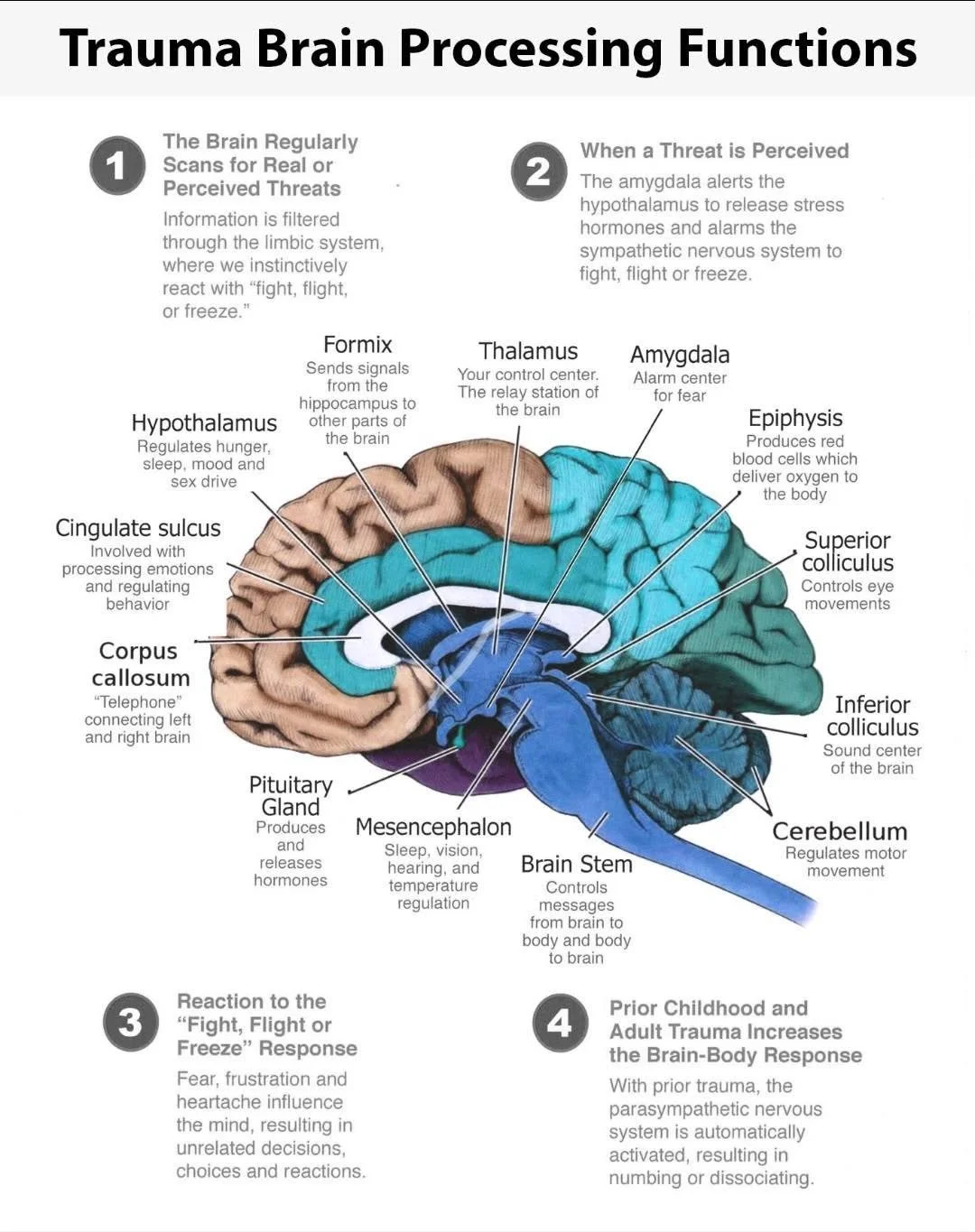
An educational graphic illustrating how perceived threats and prior trauma may affect the brain-body stress response, including fight, flight, freeze, numbing, and dissociation.
PTSD can involve intrusive memories or nightmares, avoidance of reminders, changes in mood and beliefs, hyperarousal, sleep disturbance, concentration difficulties, and exaggerated startle responses.
The important point is that the past is not always being voluntarily remembered.
Sometimes it is being involuntarily reexperienced.
A smell.
A particular sentence.
A slammed door.
A location.
A date.
Someone walking away during an argument.
A particular expression.
Suddenly the body reacts.
Your chest tightens.
Your stomach drops.
Your hands shake.
You freeze.
Become furious.
Need to escape.
Your conscious mind may know:
That happened then. I am here now.
Your nervous system may still answer:
We are in danger.
Some people who have experienced prolonged or repeated interpersonal trauma describe a broader pattern known as Complex PTSD, or CPTSD.
CPTSD is recognized as a distinct diagnosis in the ICD-11, although it is not a separate diagnosis in the DSM-5-TR.
The distinction matters because prolonged trauma can affect more than memories of particular events.
It can affect how a person experiences themselves.
How they regulate emotions.
How they relate to other people.
How much shame they carry.
How safe closeness feels.
How safe being alone feels.
They may want intimacy and fear it at the same time.
Need reassurance and then feel trapped by closeness.
Want people desperately and distrust them deeply.
Instead of simply believing:
Something terrible happened to me,
the injury can become:
Something is fundamentally wrong with me.
That is one of the most damaging things prolonged abuse can do.
It can turn somebody else's behavior into your identity.
Dissociation and Numbness
Not all trauma looks dramatic.
Sometimes you feel almost nothing.
You feel unreal.
Detached.
Far away from your body.
You move through the day mechanically.
People speak and you hear the words without absorbing them.
You describe something horrifying in a strangely calm voice.
Someone listening might wonder why you are not more emotional.
But sometimes the absence of emotion is the injury.
Disconnecting may once have helped you endure what was happening.
Trauma does not always look like sobbing.
Sometimes trauma looks like someone calmly describing something terrible while feeling as though it happened to another person.
Sometimes the emotions arrive hours later.
Sometimes days later.
Sometimes they do not arrive at all.
Shame
Then there is shame.
Shame that you stayed.
Shame that you went back.
Shame that you believed them.
Shame that you defended them.
Shame that other people warned you.
Shame about how you reacted.
Shame that you screamed.
Shame that you begged.
Shame that you still miss them.
Shame that you are not “over it.”
Guilt says:
I did something I regret.
Shame says:
I am something regrettable.
That distinction matters.
Shame turns an experience into an identity.
And sometimes the survivor becomes almost as punishing toward themselves as the relationship was.
What If I Was the Narcissist?
One of the more painful forms of rumination can be wondering whether you were actually the abusive one.
You remember your worst moments.
The screaming.
The accusations.
The checking.
The begging.
The threats to leave.
The returning.
The rage.
The cruel things you said.
And you think:
What if I was the narcissist?
What if I abused them?
That question should not simply be dismissed.
Everyone is capable of harmful behavior, and genuine accountability matters.
But behavior has to be examined in context.
Patterns matter.
Power matters.
Coercion matters.
Fear matters.
What happened before the reaction matters.
What happened after it matters.
A person can behave badly inside a profoundly unhealthy or abusive relationship without that automatically making them the primary source of abuse.
Accountability requires honesty.
It does not require erasing context.
Decision Paralysis
Even tiny choices can become difficult.
What do you want for dinner?
I don't know.
Where do you want to go?
I don't care.
What music do you like?
Whatever you want.
What do you want your life to look like?
Silence.
When preferences have been mocked, overridden, challenged, punished, or treated as inconvenient for long enough, wanting something can begin to feel dangerous.
So you stop practicing.
Eventually you may not know whether you genuinely dislike something or whether you simply learned that liking it created problems.
You may ask permission even when nobody is requiring it.
You may feel guilty spending your own money.
Guilty resting.
Guilty saying no.
Guilty changing your mind.
Guilty having a boundary.
That is how thoroughly another person's preferences can become embedded inside your own decision-making.
Anger Often Comes Later
For some survivors, anger arrives after the relationship.
During the relationship, you may have been too busy surviving to fully experience it.
Appeasing.
Explaining.
Negotiating.
Keeping the peace.
Protecting the children.
Trying to keep the family intact.
Preventing another explosion.
Getting through the day.
Then enough distance appears for the reality to land.
And rage comes with it.
How dare they.
How dare they do that to me.
How dare they convince me it was normal.
How dare other people believe them.
How dare I have had to become this small just to survive somebody else's behavior.
That anger can be frightening.
But anger is not automatically pathology.
Sometimes anger is the nervous system finally recognizing:
A boundary was violated.
Grieving Someone Who Is Still Alive
Then comes grief.
Not one grief.
Many.
You grieve the person.
The person you thought they were.
The relationship you believed you had.
The relationship you kept hoping you would eventually have.
The future.
The holidays.
The home.
The family structure.
The plans.
The inside jokes.
The years invested.
The version of yourself who still believed there was enough love to fix everything.
And this grief is complicated because the person may still be alive.
There is no funeral.
No socially recognized death.
People tell you to move on.
Meanwhile an entire imagined future has died.
Losing Trust in Other People
After prolonged psychological abuse, intimacy itself can become frightening.
You become suspicious of charm.
Compliments.
Sudden affection.
Apologies.
People who seem intensely interested in you.
You search for the hidden cost.
What do they want?
When will they change?
When will I discover who they really are?
Kindness can feel suspicious because kindness once had conditions.
An apology can feel suspicious because apologies once reset a cycle.
Love can feel suspicious because love and harm once arrived from the same person.
You may push healthy people away.
You may tolerate unhealthy people because dysfunction feels more recognizable than consistency.
You may become hyperindependent.
You may decide that needing nobody is the safest way to never be controlled again.
But hyperindependence is not always freedom.
Sometimes it is fear wearing armor.
Sometimes the Abuse Does Not End When You Leave
There is another reason survivors may struggle to “move on.”
Sometimes leaving does not end the abuse.
It changes its form.
When somebody can no longer control you through the relationship itself, control may continue through finances, children, property, litigation, repeated communications, reputation, social media, mutual acquaintances, threats, accusations, unwanted contact, or third parties.
This is often described as post-separation abuse.
For some survivors, separation is the period when the behavior escalates.
That makes recovery extraordinarily complicated.
How do you convince your nervous system that the danger is over when new conflicts keep arriving?
How do you stop documenting when documentation is still necessary?
How do you stop thinking about the person when you are still required to respond to things they are doing?
How do you stop watching for the next move when experience has taught you that another move may actually come?
A survivor may be accused of being “obsessed with their ex” while simultaneously dealing with financial consequences, legal proceedings, parenting conflict, harassment, accusations, or continuing attempts at control.
Sometimes what looks from the outside like an inability to let go is a nervous system responding to a situation that has not completely let go of them.
When Institutions Become Part of the Trauma
Then the survivor may turn toward systems that are supposed to help.
Police.
Courts.
Child welfare.
Healthcare.
Housing programs.
Benefits systems.
Schools.
Attorneys.
Advocates.
And sometimes the process itself becomes another source of trauma.
This is often discussed as institutional betrayal, institutional harm, or retraumatization.
A traumatized person may be expected to remember exact dates while struggling with memory.
Tell the same story repeatedly.
Remain calm while describing terrifying events.
Organize years of evidence while dealing with executive-functioning problems.
Meet complicated deadlines.
Navigate systems while financially depleted.
Explain inconsistencies without becoming emotional.
Endure skepticism without appearing defensive.
Prove it.
Explain it better.
Why did you stay?
Why did you return?
Why did you react like that?
Why did you wait to report?
Why are you still talking about it?
For somebody whose perception was already challenged inside the relationship, being forced to defend that perception again can be profoundly destabilizing.
This does not mean every unfavorable decision is institutional abuse.
Institutions have rules, evidentiary standards, competing responsibilities, and imperfect information.
But the way institutions treat traumatized people matters.
A system can help restore agency.
Or it can recreate the feeling of having none.
The original abuse remains the responsibility of the person who committed it.
But systems can deepen injury when survivors leave interactions feeling stripped of dignity, credibility, voice, or control.
Sometimes the Story Started Long Before the Relationship
For some survivors, there is another layer underneath everything.
Adverse Childhood Experiences, or ACEs, describe significant forms of childhood adversity such as abuse, neglect, household violence, substance misuse in the home, serious mental illness in the household, incarceration of a family member, and certain forms of family instability.
ACEs do not determine somebody's future.
They do not mean a person will enter an abusive relationship.
They do not make somebody responsible for being abused.
But childhood adversity can influence the survival strategies a person develops.
A child may learn to scan adults' moods.
Keep the peace.
Become invisible.
Become extremely independent.
Suppress needs.
Predict conflict.
Caretake adults.
Accept unpredictability.
Earn affection through pleasing other people.
Those adaptations may have been brilliant survival strategies.
They may have helped a child get through childhood.
The difficulty is that the nervous system can continue using old survival strategies long after the original environment is gone.
Then an adult relationship can activate wounds that began much earlier.
Familiarity can feel compelling even when the familiar thing is painful.
But familiar does not mean wanted.
Familiar does not mean chosen.
And childhood trauma never transfers responsibility for abuse from the person who chose harmful behavior to the person who survived it.
It simply means that sometimes the breakup happening today awakens wounds that are decades old.
That can make the aftermath feel enormous.
Because the survivor may not be healing from one relationship alone.
What Eventually Happens to the Person
After enough time inside chronic psychological stress, something deeper than heartbreak can happen.
The person changes.
Not because they are weak.
Not because they wanted it.
And not necessarily permanently.
But their life can become organized around survival instead of living.
Their attention is continually directed outward.
What mood are they in?
What did that silence mean?
Did I do something wrong?
What are they going to say happened?
What do I need to do to prevent this from getting worse?
The person becomes extraordinarily skilled at understanding everybody except themselves.
They can explain the other person's childhood.
Their wounds.
Their attachment style.
Their triggers.
Their behavior patterns.
Their excuses.
Their contradictions.
Their motives.
Their lies.
They can spend thousands of hours asking:
Why did they do this?
Did they love me?
Were they narcissistic?
Were they traumatized?
Did they know what they were doing?
And still have almost no idea what they themselves need.
Because their attention has been directed outward for so long that inward attention feels unfamiliar.
Their mood before your feelings.
Their needs before your needs.
Their interpretation before your perception.
Their comfort before your boundaries.
Their desires before your preferences.
Their voice before your own.
You adapt.
Then adapt again.
Then adapt to the adaptation.
Until eventually you look around and realize you do not know who you are without the relationship.
What do I want?
What do I think?
What do I believe?
What makes me happy?
What am I afraid of?
What are my boundaries?
What kind of life would I choose?
Those questions can become astonishingly difficult.
That is why people sometimes describe themselves afterward as a shell.
A ghost.
A person they no longer recognize.
They may appear functional from the outside while feeling internally as though there is almost nobody left.
And perhaps that is one of the deepest injuries of prolonged psychological abuse.
The person begins disappearing from their own life.
Recovery Is Not “Getting Over Your Ex”
This is why telling somebody to “move on” misses almost everything.
They may be rebuilding memory.
Concentration.
Trust.
Agency.
Boundaries.
Self-esteem.
Emotional regulation.
Their relationship with their own body.
Their ability to make decisions.
Their understanding of love.
Their sense of safety.
Their internal reality.
Their identity.
Their belief that their needs matter.
Their ability to imagine a future that does not revolve around another person's behavior.
Recovery can mean learning that saying no does not require a dissertation.
That somebody else's disappointment is survivable.
That conflict does not automatically mean catastrophe.
That calm is not necessarily the silence before an explosion.
That rest does not have to be earned.
That kindness does not always have a hidden price.
That love does not have to injure you before comforting you.
That understanding somebody's trauma does not require surrendering yourself to it.
That your childhood does not sentence you to repeat it.
That an institution misunderstanding your experience does not determine whether your experience was real.
That taking responsibility for your mistakes does not require accepting responsibility for somebody else's choices.
That you can stop living permanently inside the investigation.
At some point recovery has to change the direction of the questions.
From:
What happened to them?
To:
What happened to me?
From:
Why did they become this person?
To:
What did living with this do to me?
From:
What are they?
To:
Who am I now?
Not who they said you were.
Not who you had to become to keep the peace.
Not the version of yourself organized around vigilance, appeasement, fear, guilt, and survival.
You.
What do you like?
What do you believe?
What makes you laugh?
What feels beautiful to you?
What do you want to eat?
Where do you want to go?
Who feels safe?
What are your boundaries?
What are you unwilling to tolerate again?
What kind of life would you choose if nobody were standing over your shoulder judging it?
Recovery does not necessarily mean returning to exactly who you were before.
Sometimes too much has happened for that.
Maybe the goal is not to go backward.
Maybe it is to become someone who no longer has to organize an entire existence around surviving another human being.
Someone who can hear their own voice before hearing the voice of the person who hurt them.
Someone who does not need permission to have preferences.
Someone who does not need a legal defense for every boundary.
Someone who can receive a compliment without looking for the trap.
Someone who can leave the dishes in the sink and still rest.
Someone who can lock the door once.
Someone who can disagree without struggling to breathe.
Someone who can experience silence without assuming punishment is coming.
Someone who understands that safety does not have to be purchased through self-erasure.
The person may have survived years of learning to disappear.
Recovery is the slow, sometimes brutal, sometimes beautiful process of becoming visible to yourself again.
And eventually the question may become astonishingly simple:
What do I want?
Then one day, perhaps quietly, an answer comes.
And for the first time in a very long time, you recognize the voice answering.
It is yours.