
January 13, 2009 — “A Person With Integrity”
Content warning: This entry discusses animal death, euthanasia, dog-bite incidents involving children, the killing of a beloved animal, a disputed allegation against a neighbor, and discriminatory language concerning race, religion, and sexual orientation elsewhere in the examination.
Record Summary
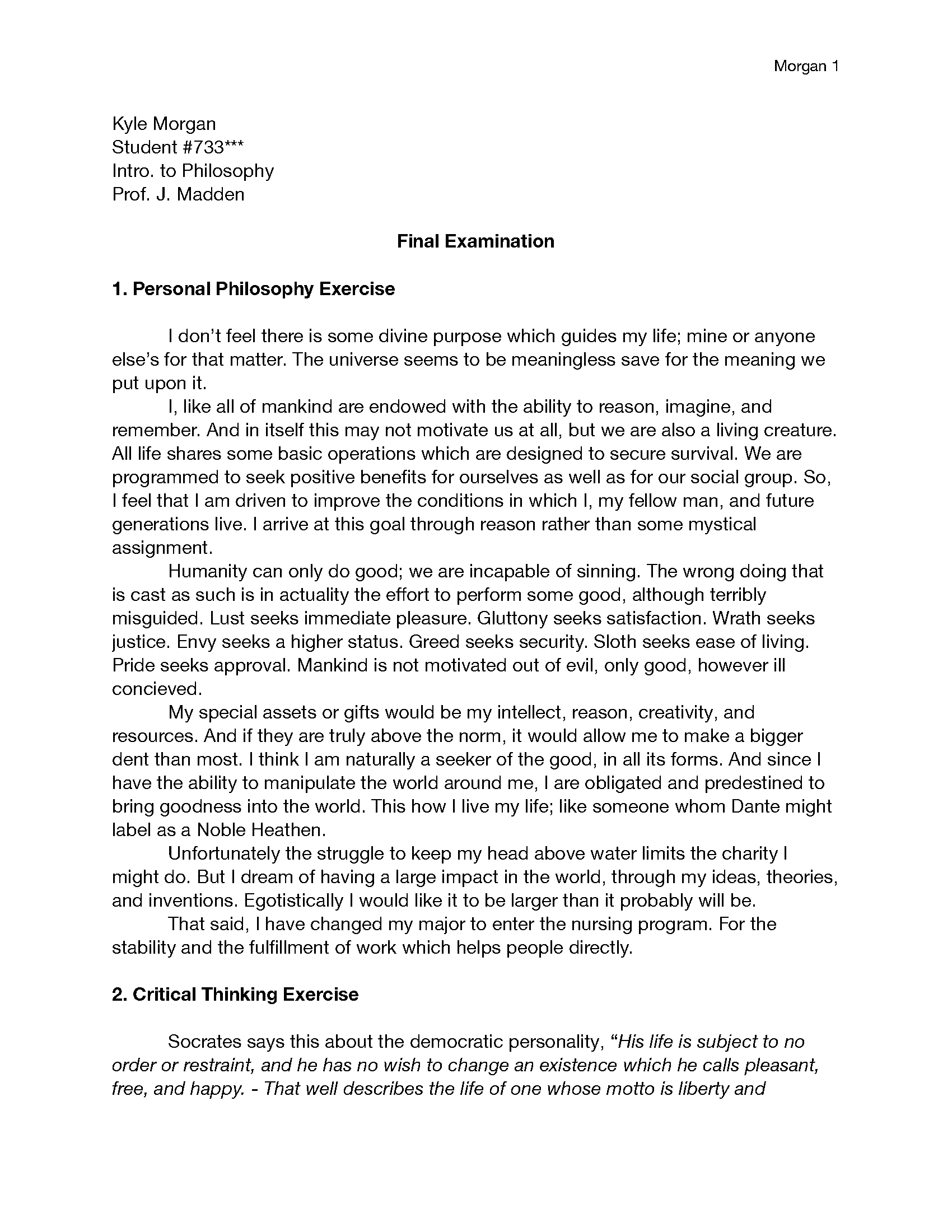
I recently located a four-page final examination identifying Kyle Morgan as the student in an Introduction to Philosophy course taught by Professor J. Madden.
The examination contains four sections:
Personal Philosophy Exercise
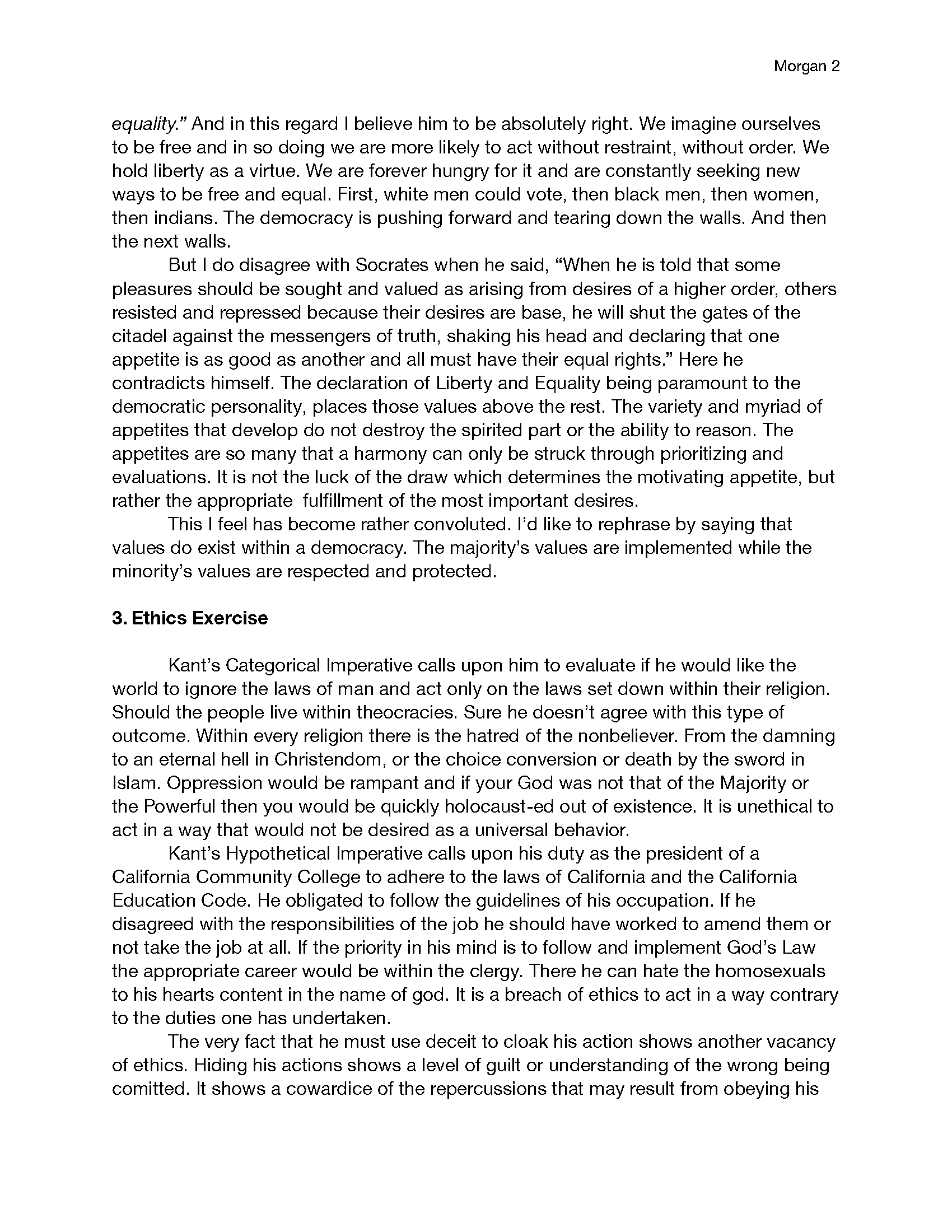
Critical Thinking Exercise
Ethics Exercise
Epistemology Exercise
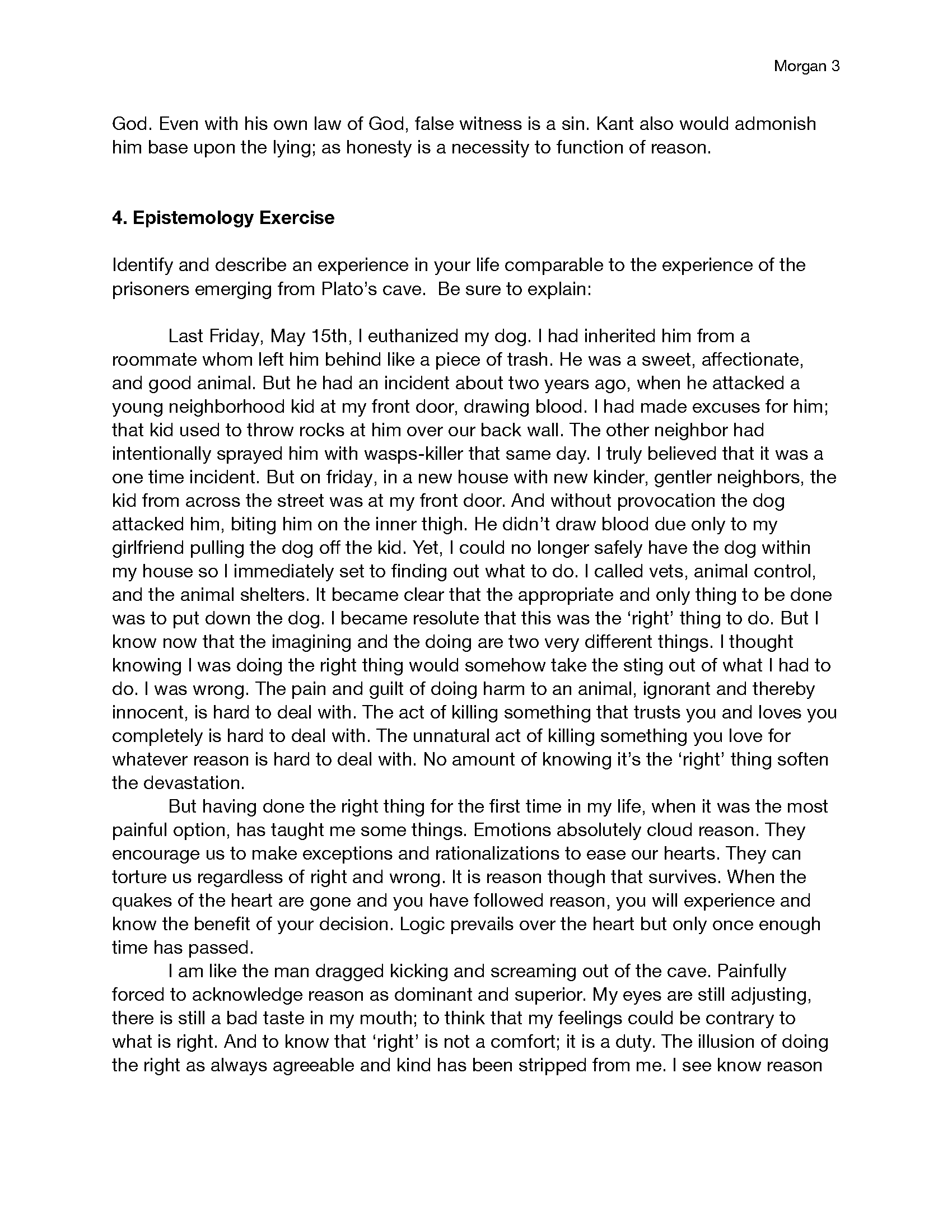
For the fourth section, Kyle was instructed to describe an experience from his own life comparable to the experience of prisoners emerging from Plato’s cave.
He chose the euthanasia of Jack.
Kyle began:
“Last Friday, May 15th, I euthanized my dog.”
At the time, Kyle instructed us that Jack had to be put down and that there was no other option. I relied on what Kyle presented as a necessary and unavoidable conclusion.
Years later, I found his contemporaneous written account of that decision.
Identifying Jack and Dating the Record
The examination does not identify the dog by name. I identify him as Jack based on my firsthand knowledge of the events Kyle described.
The examination does not display a submission date, but Kyle wrote that the euthanasia occurred on “Friday, May 15th.”
The document identifies the same Introduction to Philosophy course and Professor J. Madden associated with Kyle’s January 2009 assignment, “A Person With Integrity.” May 15, 2009, fell on a Friday.
Taken together, these details strongly indicate that the examination was written in May 2009, shortly after Jack’s death. The year remains an inference from the internal evidence unless confirmed by the original file metadata or another course record.
Who Jack Belonged To
Kyle wrote:
“I had inherited him from a roommate whom left him behind like a piece of trash.”
That account is inaccurate.
Jack was given to me by my former roommate after that roommate moved out of our home and essentially left Jack behind. I became responsible for him. Kyle did not inherit Jack from his own roommate.
By writing “I had inherited him” and repeatedly calling Jack “my dog,” Kyle removed me from Jack’s history and positioned himself as Jack’s owner.
That rewritten ownership matters because Kyle then presented himself as the person authorized to investigate the options, determine that euthanasia was necessary, and cause Jack’s death.
In the same account, I am identified only as “my girlfriend,” even though Jack had been given to me and I was the person who physically intervened during the later incident.
Kyle’s Account of the Earlier Incident
Kyle described Jack as:
“a sweet, affectionate, and good animal.”
He wrote that Jack had been involved in an incident with a child approximately two years earlier. According to Kyle’s account, Jack attacked a neighborhood child at the front door and drew blood.
Kyle wrote:
“I had made excuses for him; that kid used to throw rocks at him over our back wall.”
He then alleged:
“The other neighbor had intentionally sprayed him with wasps-killer that same day.”
I dispute that allegation.
The neighbor did not like Kyle, and the two men were involved in a feud. I do not remember exactly how the conflict began or the name the neighbor called Kyle.
I remember Kyle going to confront the neighbor in his garage. Kyle saw wasp spray in the garage and subsequently constructed the story that the neighbor had intentionally sprayed Jack with it.
Seeing wasp spray in a person’s garage did not establish that the person used it on Jack.
Kyle’s examination identifies no witness, date, veterinary finding, photograph, contemporaneous communication, or other evidence supporting the allegation. It also omits the existing conflict between Kyle and the neighbor and the circumstances from which Kyle developed the accusation.
Kyle presented the spraying allegation as an established fact. It is not my account of what occurred.
The Later Incident and My Role
Kyle described a later incident at a new home involving a child who came to our front door.
He claimed that Jack attacked the child “without provocation” and bit him on the inner thigh.
Kyle then wrote:
“He didn’t draw blood due only to my girlfriend pulling the dog off the kid.”
I was the girlfriend Kyle referenced.
His own account documents that I physically intervened and pulled Jack away from the child, preventing a more serious injury.
Kyle did not describe himself performing that immediate protective act.
The examination also does not acknowledge that Jack had been given to me, describe my relationship with Jack, record my position concerning euthanasia, or mention any discussion with me about what should happen next.
Despite my relationship with Jack and my role during the incident, I appear only as “my girlfriend.”
Kyle’s Ownership of the Decision
Kyle did not describe Jack’s euthanasia as a shared decision.
He repeatedly used first-person language:
“I euthanized my dog.”
“I immediately set to finding out what to do.”
“I called vets, animal control, and the animal shelters.”
“I became resolute.”
“what I had to do”
“knowing I was doing the right thing”
Kyle presented himself as the person who investigated the available options, interpreted the information he received, reached the conclusion, became resolute, and caused Jack to be euthanized.
He described Jack as “my dog” and the home as “my house.” He did not write “Rebekah’s dog,” “our dog,” “our home,” or “we decided.”
The language did more than assign the final decision to Kyle. It rewrote Jack’s ownership.
Jack had been given to me, but Kyle placed himself in every central role within the account: owner, investigator, decision-maker, moral authority, and grieving actor.
The Claim That There Was No Other Option
Kyle wrote:
“It became clear that the appropriate and only thing to be done was to put down the dog.”
The phrase “it became clear” does not identify who supposedly reached that conclusion.
Kyle did not name:
Any veterinarian he contacted
Any animal-control employee
Any animal shelter
Any professional who recommended euthanasia
Any veterinary or behavioral evaluation
Any diagnosis or written recommendation
Any placement or surrender option that was considered
Any official bite report
Any reason another option could not be pursued
After claiming that euthanasia was the only option, Kyle immediately returned to his own judgment:
“I became resolute that this was the ‘right’ thing to do.”
The examination documents that Kyle claimed euthanasia was the only appropriate option. It does not independently establish that a qualified professional told him it was the only option or that no alternative actually existed.
At the time, Kyle presented that conclusion to us as settled and unavoidable.
His Language About Killing Jack
Kyle did not rely only on the clinical word “euthanized.” He repeatedly described Jack’s death as killing.
He wrote:
“The pain and guilt of doing harm to an animal, ignorant and thereby innocent, is hard to deal with.”
He continued:
“The act of killing something that trusts you and loves you completely is hard to deal with.”
And:
“The unnatural act of killing something you love for whatever reason is hard to deal with.”
These are Kyle’s words.
Kyle expressly recognized Jack as innocent, trusting, loving, sweet, affectionate, and good. He also identified himself as the person responsible for the decision that caused Jack’s death.
Turning Jack’s Death Into a Philosophy Lesson
Kyle used Jack’s death to construct an argument about emotion and reason.
He wrote:
“But having done the right thing for the first time in my life, when it was the most painful option, has taught me some things.”
He then stated:
“Emotions absolutely cloud reason.”
Kyle characterized emotion as something that encourages exceptions and rationalizations. He presented reason as the authority that remains after emotion subsides:
“Logic prevails over the heart but only once enough time has passed.”
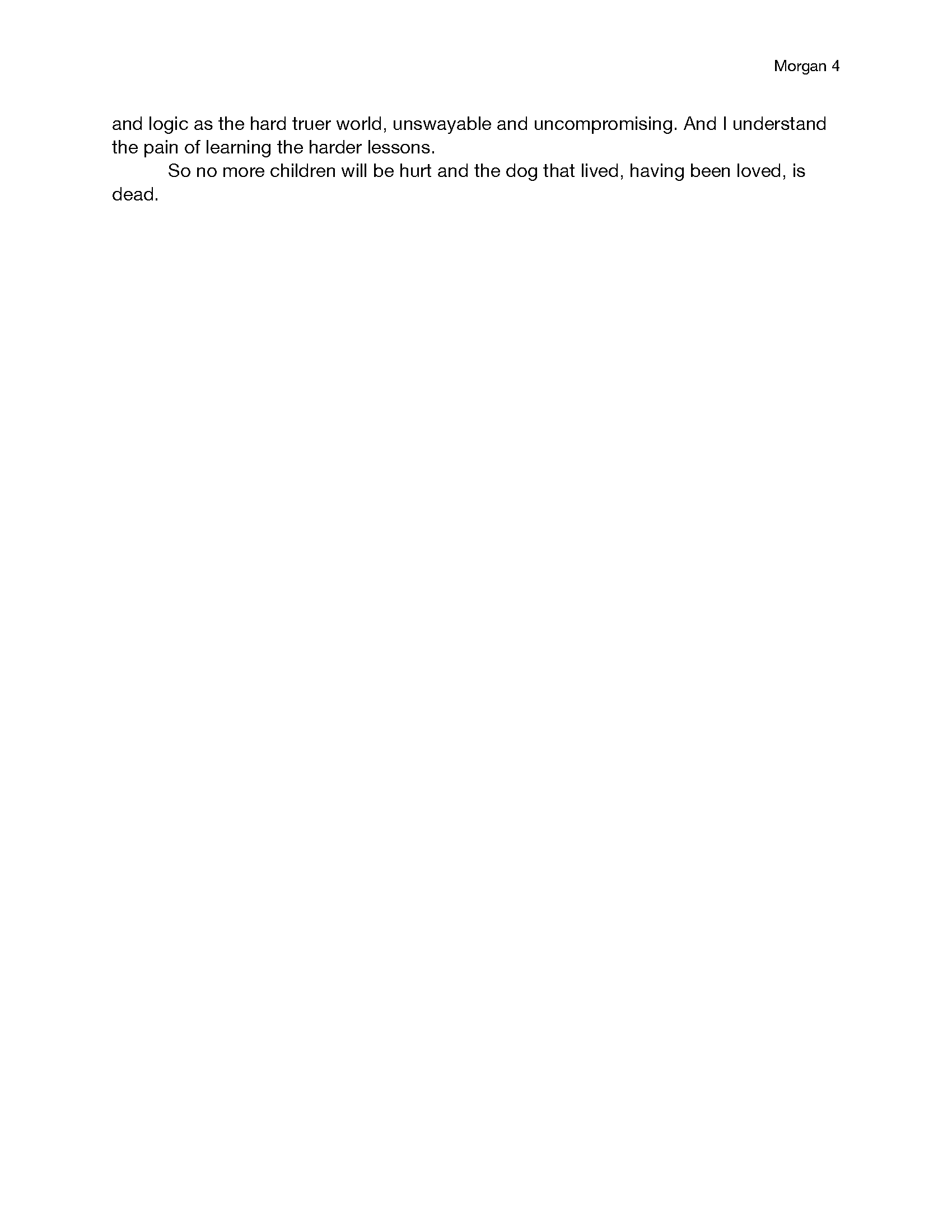
He compared himself to a prisoner being dragged “kicking and screaming” from Plato’s cave and described himself as painfully forced to recognize reason as “dominant and superior.”
Within this framework, compassion, attachment, grief, and opposition could be dismissed as emotion interfering with reason. Kyle’s conclusion was positioned as objective and morally necessary, while resistance to it could be characterized as irrational.
His reasoning also assumed that his decision was correct. He wrote that, after enough time, a person who followed reason would “know the benefit” of the decision.
This left no meaningful space for the possibility that the decision itself had been wrong.
Jack’s death became evidence in a story about Kyle’s willingness to suppress emotion and perform what he portrayed as a painful moral duty.
The Philosophy Surrounding the Account
The earlier sections of the examination provide context for how Kyle framed Jack’s death.
Kyle wrote:
“Humanity can only do good; we are incapable of sinning.”
He argued that behavior considered wrongdoing is actually an effort to accomplish something good, although it may be “terribly misguided.”
This philosophy allowed harmful conduct to be reinterpreted as fundamentally well-intentioned.
Kyle also identified his “intellect, reason, creativity, and resources” as special assets. He suggested that these qualities might be above the norm, described himself as “naturally a seeker of the good,” and wrote:
“I have the ability to manipulate the world around me.”
In this context, “manipulate” may mean influence or alter the surrounding world. The word should not, by itself, be treated as an admission of interpersonal manipulation.
Its presence remains notable because Kyle positioned his own intellect and reason as sources of unusual moral authority.
He also described himself as:
“obligated and predestined to bring goodness into the world.”
He compared himself to someone Dante might call a “Noble Heathen” and wrote that he dreamed of having a large impact through his ideas, theories, and inventions.
Immediately before writing about Jack, Kyle condemned concealment and dishonesty.
He wrote that using deceit to hide an action demonstrated a “vacancy of ethics,” that hiding conduct showed guilt or an understanding of wrongdoing, that bearing false witness was sinful, and that honesty was necessary for reason.
Those statements do not independently prove anything about his later conduct. They preserve the ethical standards Kyle claimed to recognize and apply to others.
The Internal Contradiction
Kyle framed himself as guided by reason rather than emotion. However, the examination does not provide the information necessary to evaluate whether euthanasia was actually the only reasonable option.
There are no professional names, quoted recommendations, veterinary conclusions, behavioral findings, or explanations of alternatives that were considered and rejected.
Instead, the narrative asks the reader to accept Kyle’s conclusion because he portrayed himself as rational, morally resolute, and willing to make the painful choice.
Kyle also acknowledged that Jack was innocent and that killing him was unnatural, while presenting the act as proof that Kyle had finally done the right thing.
The Final Shift Away From Responsibility
Kyle began the section with an active declaration:
“I euthanized my dog.”
He ended it differently:
“So no more children will be hurt and the dog that lived, having been loved, is dead.”
At the beginning, Kyle identified himself as the actor.
At the end, Jack simply “is dead.” The person who caused his death disappears from the sentence.
The final statement converts Jack’s death into a morally resolved outcome: children will be safe, Jack had been loved, and the decision is complete.
Why This Record Matters
This record preserves Kyle’s contemporaneous account of Jack’s death.
It documents that Kyle:
Identified himself as the person who euthanized Jack
Rewrote himself as the person who inherited and owned Jack
Removed me from Jack’s history even though Jack had been given to me
Claimed responsibility for investigating the available options
Asserted that euthanasia was the only appropriate choice
Described becoming resolute in that conclusion
Did not describe consulting me or reaching a shared decision
Documented that I physically pulled Jack away from the child
Repeatedly characterized the euthanasia as killing
Described Jack as innocent, trusting, loving, sweet, affectionate, and good
Used Jack’s death as evidence of reason prevailing over emotion
Presented his decision as a painful but morally correct act
Included a disputed allegation against a neighbor with whom he had an existing conflict
Omitted the circumstances from which he developed that allegation
This document supports my firsthand account that Kyle instructed us that Jack had to be euthanized and that no alternative existed.
Kyle documented himself as the person who investigated the options, declared that only one option existed, became resolute, and caused Jack to be euthanized.
Evidence Boundaries
The examination establishes that:
The document identifies Kyle Morgan as the student.
It identifies the course as Introduction to Philosophy and the instructor as Professor J. Madden.
The writer states, “I euthanized my dog.”
The writer claims to have contacted veterinarians, animal control, and animal shelters.
The writer describes euthanasia as the “appropriate and only thing to be done.”
The writer repeatedly describes the euthanasia as killing.
The writer identifies his girlfriend as the person who pulled the dog away from the child.
The writer describes the dog as innocent, trusting, loving, sweet, affectionate, and good.
The writer uses the dog’s death as an example of reason prevailing over emotion.
The writer claims that he inherited the dog from a roommate.
The writer alleges that a neighbor intentionally sprayed the dog with wasp killer.
The examination does not name Jack. I identify him based on my firsthand knowledge of the event.
The examination does not name me in the fourth section. My identification as “my girlfriend” is supported by my firsthand knowledge and Kyle’s January 2009 assignment for the same course and professor, in which he explicitly identified “my girlfriend, Rebekah.”
Kyle did not inherit Jack from his own roommate. Jack was given to me by my former roommate after that roommate moved out and essentially left Jack behind. I became responsible for him.
I also dispute Kyle’s allegation that our neighbor intentionally sprayed Jack with wasp killer. I remember Kyle confronting the neighbor in his garage, seeing wasp spray there, and subsequently constructing the accusation. I do not remember exactly how the feud began or what name the neighbor had called Kyle.
The examination contains no independent evidence verifying the spraying allegation.
The examination also does not independently verify that Kyle contacted every agency he claimed to have contacted. It does not establish what any professional actually told him, whether Jack received a veterinary or behavioral evaluation, whether a professional expressly recommended euthanasia, or whether no alternative existed.
Finally, the examination does not establish whether Kyle personally administered the euthanasia or authorized a veterinarian to perform it. His statement “I euthanized my dog” establishes that he claimed responsibility for authorizing and causing Jack’s death.