
Unrequited Love, Weaponized
A Letter Written During the MarriagE
Archive ID: WR-2018-001
Artifact date: July 12, 2018, at 12:22 p.m. PDT
Artifact type: Email containing a personal letter
Category: Written Communications
Status: Contemporaneous written communication
Author: Rebekah Morgan
Recipient: Kyle Morgan
Original subject line: No Subject
Length: Two pages
Content note: This entry discusses betrayal, emotional abuse, coercive control, codependency, psychological depletion, threatened divorce, and loss of self.
Artifact Summary
On July 12, 2018, I emailed this two-page letter to my husband after he told me that he was “100% sure” he wanted a divorce and then asked for 24 hours to think.
I wrote that his request forced me to confront what it meant for someone to need time to decide whether I, and our family, were “worth holding on to.”
The letter documents what I was already experiencing more than six years before I ultimately left the relationship: betrayal, chronic blame, impossible standards, half-truths, repeated apologies, broken promises, emotional depletion, and the gradual disappearance of my identity inside the marriage.
Context
I wrote this letter while I was still inside the relationship. It was not reconstructed after the marriage ended.
The email header establishes that I sent it on Thursday, July 12, 2018, at 12:22 p.m. PDT. The subject line was blank.
At the time, I believed I was responding to another possible end of our marriage. He had told me that he was certain he wanted a divorce, then said that he needed 24 hours to think about it. I understood that to mean he was deciding whether I and our family were worth keeping.
The letter also refers to an “addiction,” earlier betrayals, partial confessions, apologies, blame, and promises that the harm would not happen again.
I did not permanently leave until December 2024.
Reading this email now is painful because it shows that I was already naming the relational structure in 2018. I understood that I had been placed last, blamed for everything wrong, and continually required to prove that I deserved to be loved.
What I did not yet understand was how difficult recognizing the pattern and escaping it would be.

Rebekah Morgan During the Period of Emotional Depletion, 2018
Photograph of Rebekah Morgan during the same general period in which the July 12, 2018 email was written. Looking back, I remember feeling emotionally exhausted and increasingly disconnected from myself while trying to hold the marriage together.
The Artifact
The original email appears below in two pages. A readable transcription follows the images.
Email Page One
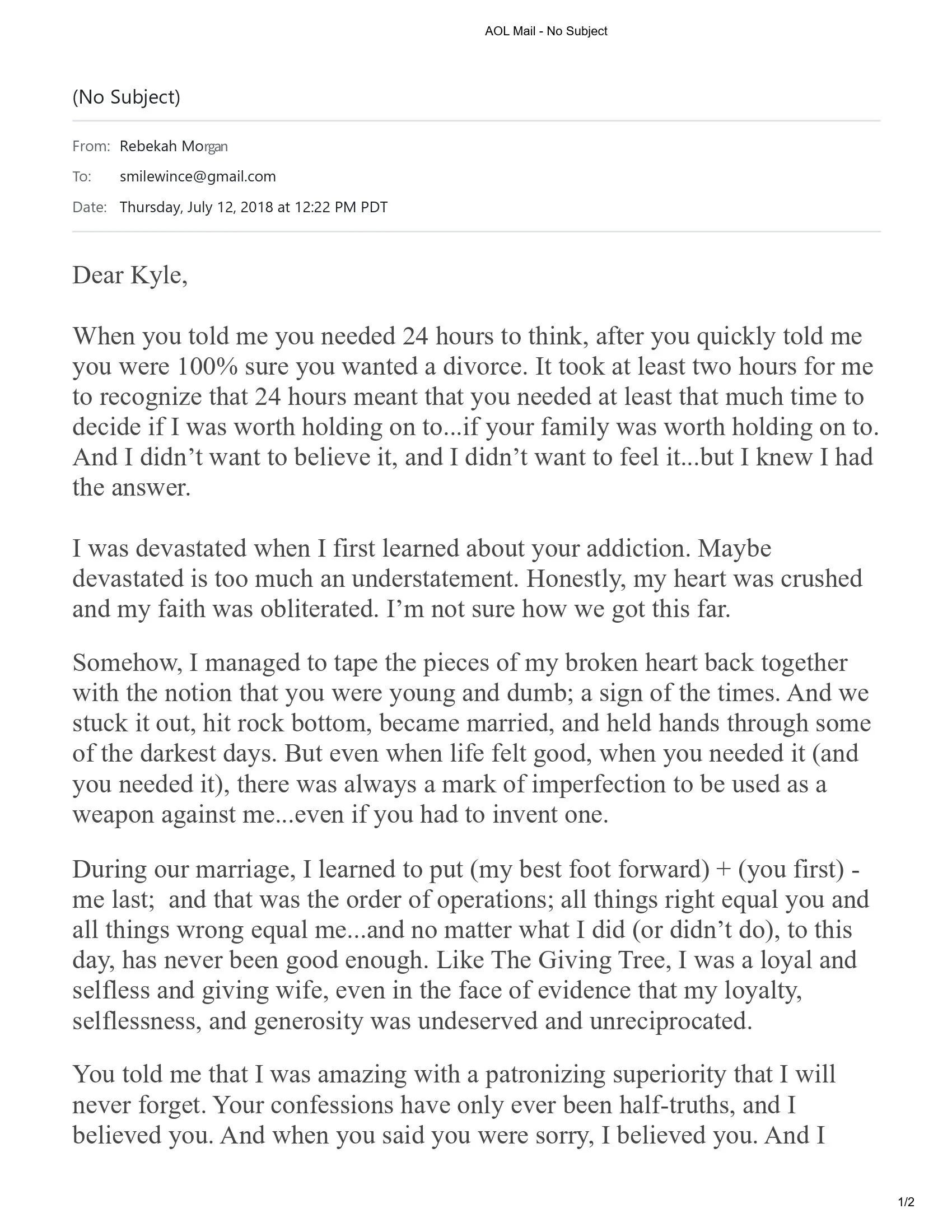
Page one of a two-page email sent by Rebekah Morgan to Kyle Morgan on July 12, 2018, at 12:22 p.m. PDT. The letter begins after he said that he wanted a divorce and then requested 24 hours to decide whether to remain with the family.

Page two of the July 12, 2018 email. Rebekah describes becoming emotionally, mentally, and physically depleted, compares herself to the tree reduced to a stump in The Giving Tree, and concludes that she had been trying to convince someone else of a worth she needed to recognize herself.
Transcription
Unrequited Love, Weaponized
Dear Kyle,
When you told me you needed 24 hours to think, after you quickly told me you were 100% sure you wanted a divorce, it took at least two hours for me to recognize that 24 hours meant that you needed at least that much time to decide if I was worth holding on to—if your family was worth holding on to.
I did not want to believe it, and I did not want to feel it, but I knew I had the answer.
I was devastated when I first learned about your addiction. Maybe devastated is too much of an understatement. Honestly, my heart was crushed and my faith was obliterated. I am not sure how we got this far.
Somehow, I managed to tape the pieces of my broken heart back together with the notion that you were young and dumb—a sign of the times. We stuck it out, hit rock bottom, became married, and held hands through some of the darkest days.
But even when life felt good, when you needed it—and you needed it—there was always a mark of imperfection to be used as a weapon against me, even if you had to invent one.
During our marriage, I learned to put my best foot forward, put you first, and place myself last. That was the order of operations.
All things right equaled you.
All things wrong equaled me.
No matter what I did, or did not do, it was never good enough.
Like The Giving Tree, I was a loyal, selfless, and giving wife, even in the face of evidence that my loyalty, selflessness, and generosity were undeserved and unreciprocated.
You told me that I was amazing with a patronizing superiority I will never forget.
Your confessions had only ever been half-truths, and I believed you.
When you said you were sorry, I believed you.
I listened when you put the blame on me.
When I reached inside myself for something to take out and give to you, there was nothing left.
Emotionally, mentally, and physically depleted, I was too weak to continue carrying the burden of your own shame and guilt.
Like the tree, I trapped myself in a codependent relationship—you the narcissist and me the enabler—convinced that I was happy.
But I was irresponsible, and like the tree, I allowed myself to be reduced to nothing more than a stump.
That is not happiness.
From the moment we met, I was flooded with a love, respect, and admiration for you that could not be measured against anything I had ever felt before.
On our first date, the wonder of you stole my voice. Just staring at you left me speechless.
You became a big deal fast.
In that same breath, I found myself broken and on the floor.
I listened when you told me it was my fault, and I believed you.
I got back up and brushed myself off to prove that I could do better.
I believed you when you said it would not happen again.
In the tragic end, you expressed no gratitude, felt no empathy, and encountered no limit to what you believed you could demand.
I hate you for the pain and suffering of my unrequited love.
And I hate myself for loving you.
Unlike all the heartfelt words in all the letters before, and my many attempts to convince you and beg you to see that I was a woman worth holding on to, I know now that it was me who needed convincing all along.
—Rebekah
What This Email Documents
This email describes a relationship in which love had become labor and loyalty had become a resource that could be continually extracted from me.
The central pattern was not one argument, one disclosure, or one threatened divorce. It was an unequal structure in which responsibility continually moved toward me while entitlement moved away from him.
His conduct could be explained, minimized, forgiven, or transferred onto me. My conduct remained permanently subject to inspection.
Threatened abandonment
The letter begins with him saying he was “100% sure” he wanted a divorce and then asking for 24 hours to decide.
For me, that uncertainty did not feel neutral. It placed me in the position of waiting to learn whether I and our family had been judged worth keeping.
Blame shifting
I wrote that “all things right” equaled him and “all things wrong” equaled me.
Whatever had happened, responsibility eventually returned to me. Even after I was hurt, I was expected to examine myself, improve myself, and prove that I could do better.
Impossible standards
Nothing I did could create lasting approval or safety.
The standard could change whenever necessary, ensuring that I remained inadequate and continued working for acceptance.
Invented flaws
I recognized that an imperfection could be exaggerated or manufactured whenever a reason to criticize, blame, or punish me was needed.
This kept me focused on correcting myself instead of evaluating the larger pattern.
Half-truths and controlled disclosure
I described his confessions as half-truths.
Partial admissions could create the appearance of honesty while preventing me from understanding the full scope of what had happened. I repeatedly accepted incomplete disclosures because I wanted confession to mean that repair was possible.
Harm followed by promises
The email records a repeated sequence: I was hurt, he apologized, I believed him, and he promised that it would not happen again.
Those promises restored hope without producing lasting safety.
Emotional extraction
I continually searched within myself for more patience, forgiveness, understanding, loyalty, labor, and sacrifice.
By July 2018, I wrote that when I reached inside myself for something else to give him, “there was nothing left.”
I described myself as emotionally, mentally, and physically depleted.
Contempt disguised as praise
Even affirming words could be delivered from a position of superiority.
Being told that I was “amazing” did not feel loving. I experienced it as patronizing and diminishing.
Self-erasure
The equation I described placed him first and me last.
Over time, this was no longer ordinary compromise or generosity. It became the disappearance of my needs, judgment, identity, and internal authority.
The image of the tree reduced to a stump was how I understood myself in 2018: still present, but stripped of nearly everything I had once possessed.
Entrapment through hope
I did not remain because I was unaware that I was hurting.
I remained because I was attached, depleted, hopeful, conditioned to accept responsibility, and still trying to save the marriage through greater effort.
I believed apologies. I believed promises. I believed that if I could identify and correct my own failures, the relationship might finally become safe.
Why This Artifact Matters
This email establishes that I was documenting the relational pattern in July 2018, more than six years before I permanently left.
It shows that I was already writing about betrayal, half-truths, chronic blame, impossible standards, threatened abandonment, repeated promises, codependency, depletion, and loss of self.
It also complicates the question survivors are so often asked:
Why didn’t you leave?
Recognition did not automatically create safety, resources, emotional freedom, or a clear path out.
I could recognize that I had been reduced to a stump and still believe that it was my responsibility to grow something else for him.
I could understand that I was being blamed and still search myself for what I needed to correct.
I could know that I was disappearing and still be unable to imagine a survivable life outside the relationship.
Leaving was not one sudden moment of understanding. Understanding occurred repeatedly over years while I remained inside the conditions that made acting on it extraordinarily difficult.
This email is evidence of that prolonged recognition.
I knew I was disappearing.
I was even beginning to understand that I had been begging someone else to recognize a worth I needed to recognize within myself.
But I did not yet know how to leave.
Archive Note
This entry preserves a two-page email sent by Rebekah Morgan to Kyle Morgan on July 12, 2018, at 12:22 p.m. PDT.
The original email had no subject line. The title “Unrequited Love, Weaponized” has been assigned for this archive entry and was not the original email subject.
The transcription has been lightly edited for spelling, punctuation, and paragraph structure. The substance and meaning of the original writing have not been changed. The original page images are included so readers can compare the transcription with the contemporaneous record.
The contextual photograph was taken during the same general period. It is included to document the author’s life during the period in which the email was written. It is not presented as independent proof of the events described.