
The Confession Hidden in Plain Sight
Recovered Work: The Sketchbooks
Artifact Analysis
Content note: This essay discusses coercive control, infidelity, grief, spiritual masking, emotional abuse, and artwork discovered after the end of a relationship.
These drawings were not gifts.
They were discoveries.
He never brought them to me. He never explained them. He never told me that he had been recording my face, my clothing, my jewelry, my posture, and my grief inside his private sketchbooks.
I found them later, after the relationship had ended, while reconstructing the history of what I had lived through.
Most of the figures are me.
I know because the details belong to my body and my life. My knit hat. My necklace. My pendant. My clothing. My face. My hair. My posture. These are not anonymous women who happen to resemble me. They contain specific details I recognize as my own.
The exception is the double portrait.
The composed woman above is the woman he was involved with during our relationship. The figure collapsing beneath her is me.
I cannot claim to know every thought behind the drawing. I can identify the subjects. I can describe what is visibly present. I can place the image inside the history I lived.
Once I did that, the sketchbooks changed.
They were no longer a collection of unrelated studies.
They became a visual record of how he privately arranged us. One woman elevated. One woman deteriorating. One preserved as an ideal. One distorted beneath the weight of it.
The drawings had been hidden.
The structure inside them was not.

The Double Face
The woman above is the person he was involved with during our relationship. She appears composed, elevated, and complete. The figure beneath her is me, wide eyed and distorted, appearing to melt or die below the image of the woman he wanted. I found this drawing in his private sketchbooks. It was never shown or explained to me.
The drawing contains two women.
The woman above is carefully formed. Her expression is distant and controlled. Her features are composed. She occupies the highest position on the page and appears complete within herself.
The woman below is me.
My head is tilted beneath hers. My eyes are enlarged. My face appears strained, unstable, and unfinished. I look as though I am melting under the weight of the image above me.
This is not simply a double portrait.
It is a hierarchy.
One woman is elevated.
The other is collapsing.
The woman above was someone he wanted. She was not the only outside source of attention, but she held particular significance within the private world he was constructing.
I was the wife living inside the consequences.
I was absorbing the deception, triangulation, confusion, comparisons, punishments, and instability surrounding that private world while still trying to hold our actual life together.
The drawing places both realities on the same page.
The idealized woman above.
The destabilized wife below.
I did not create that arrangement.
I found it.
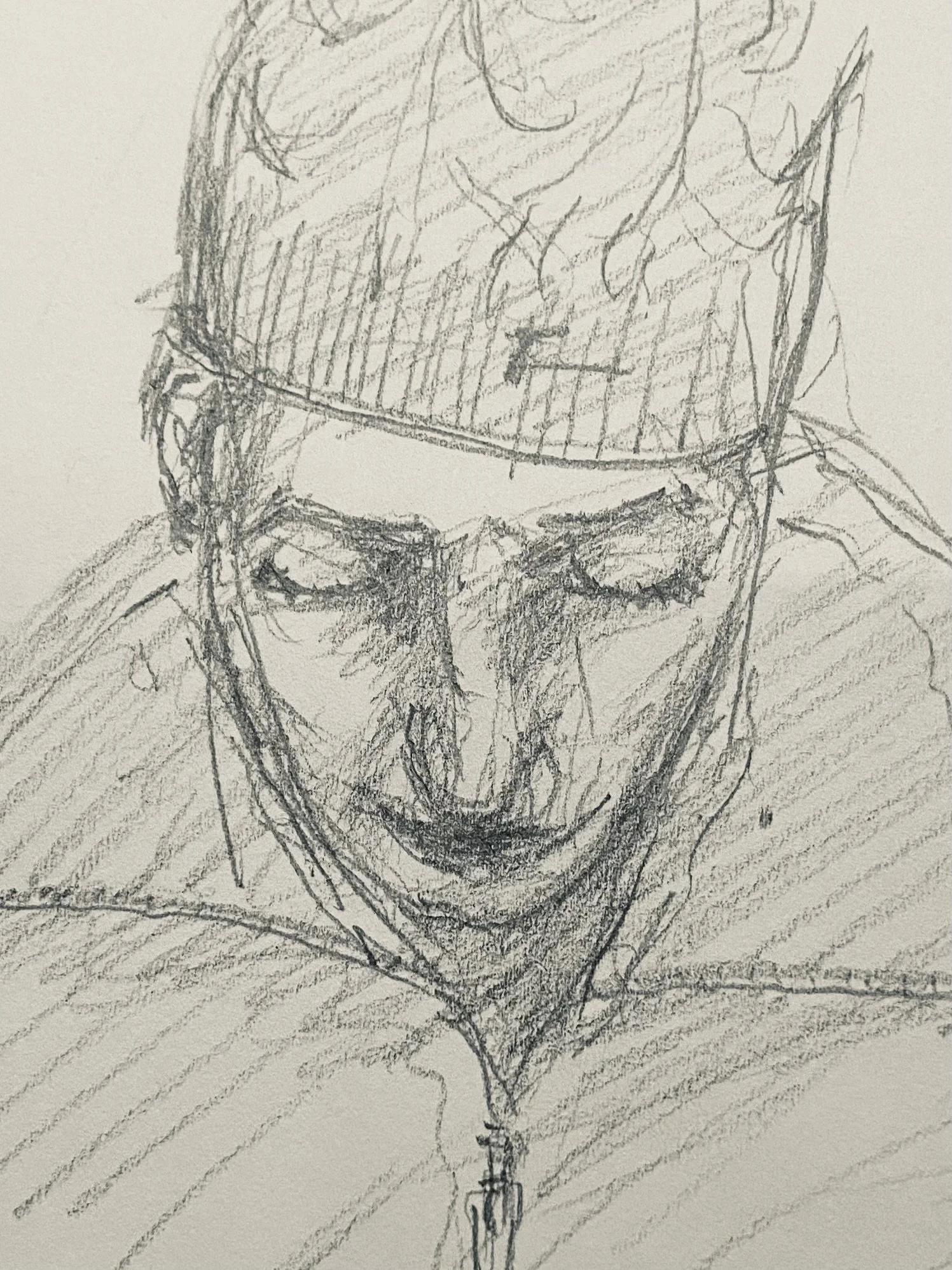
Contemplative Self Portrait
December 25, 2020. A private portrait of me wearing my own knit hat I found the drawing later inside his sketchbooks. It was never given or shown to me.
This is me.
The hat is mine.
The face is mine.
Her closed eyes and lowered head create the appearance of contemplation. To an outside viewer, she may seem peaceful, inward, almost prayerful.
But I did not receive this drawing as an act of tenderness.
I did not know it existed.
That distinction changes the meaning for me.
The viewer sees a quiet portrait.
I see myself recorded privately by someone who used my image without including me in its meaning.
I became the subject of a portrait I was never meant to see.
My face was present.
My personhood was absent.
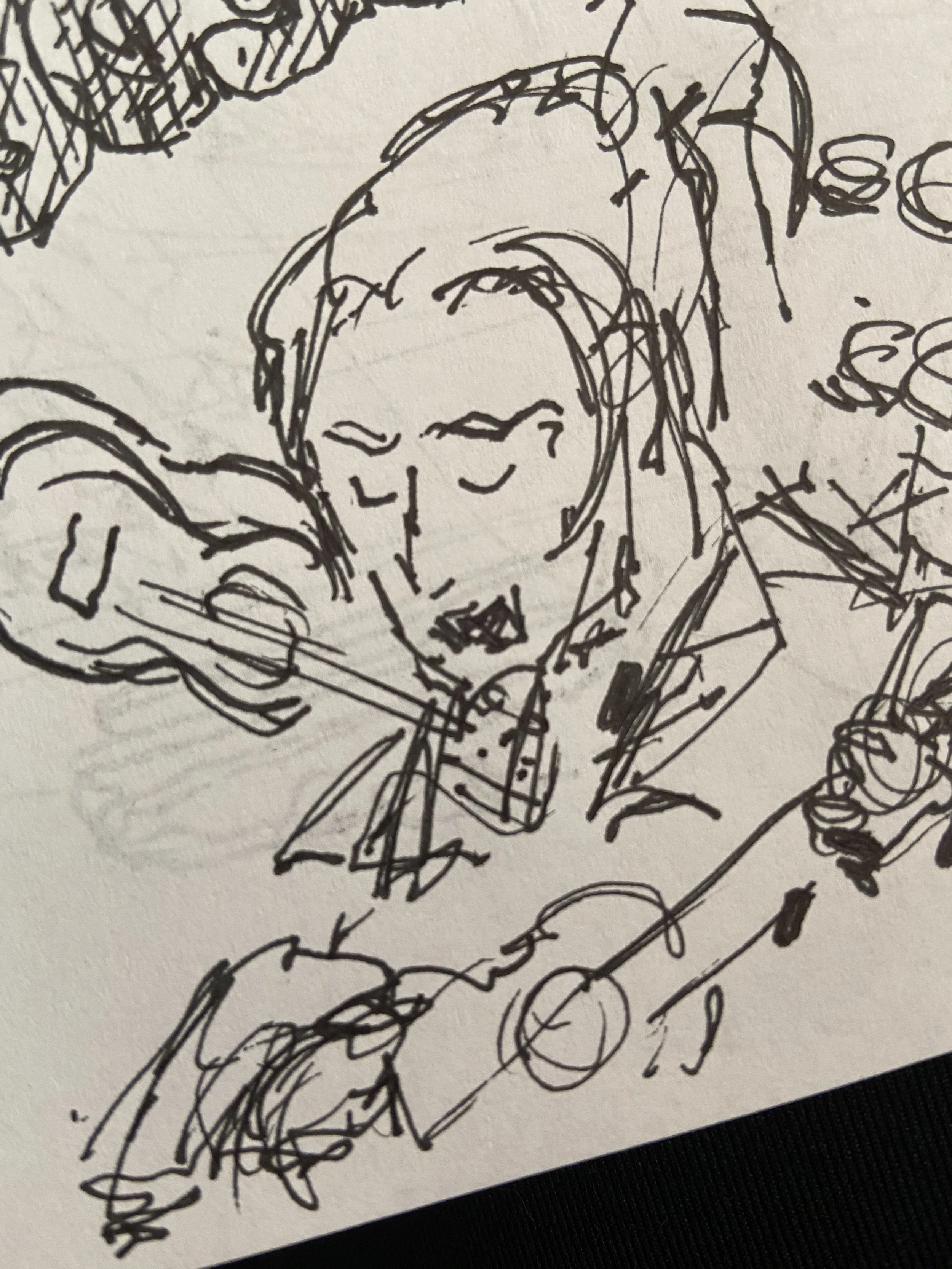
Self Portrait in Ink
December 27, 2020. Another private drawing of me, created two days after the contemplative portrait. My hat and facial features remain recognizable despite the rapid and overlapping ink lines.
Two days later, I appear again.
The medium changes.
The lines become faster, darker, and less controlled. The figure, the instrument, and the surrounding marks begin to collapse into one another.
Still, I recognize myself.
The hat remains.
The face remains.
The repetition matters.
These were not isolated similarities. He returned to my image again and again, creating versions of me inside pages I would not discover until much later.
He was making a private record.
I was living the life outside it.
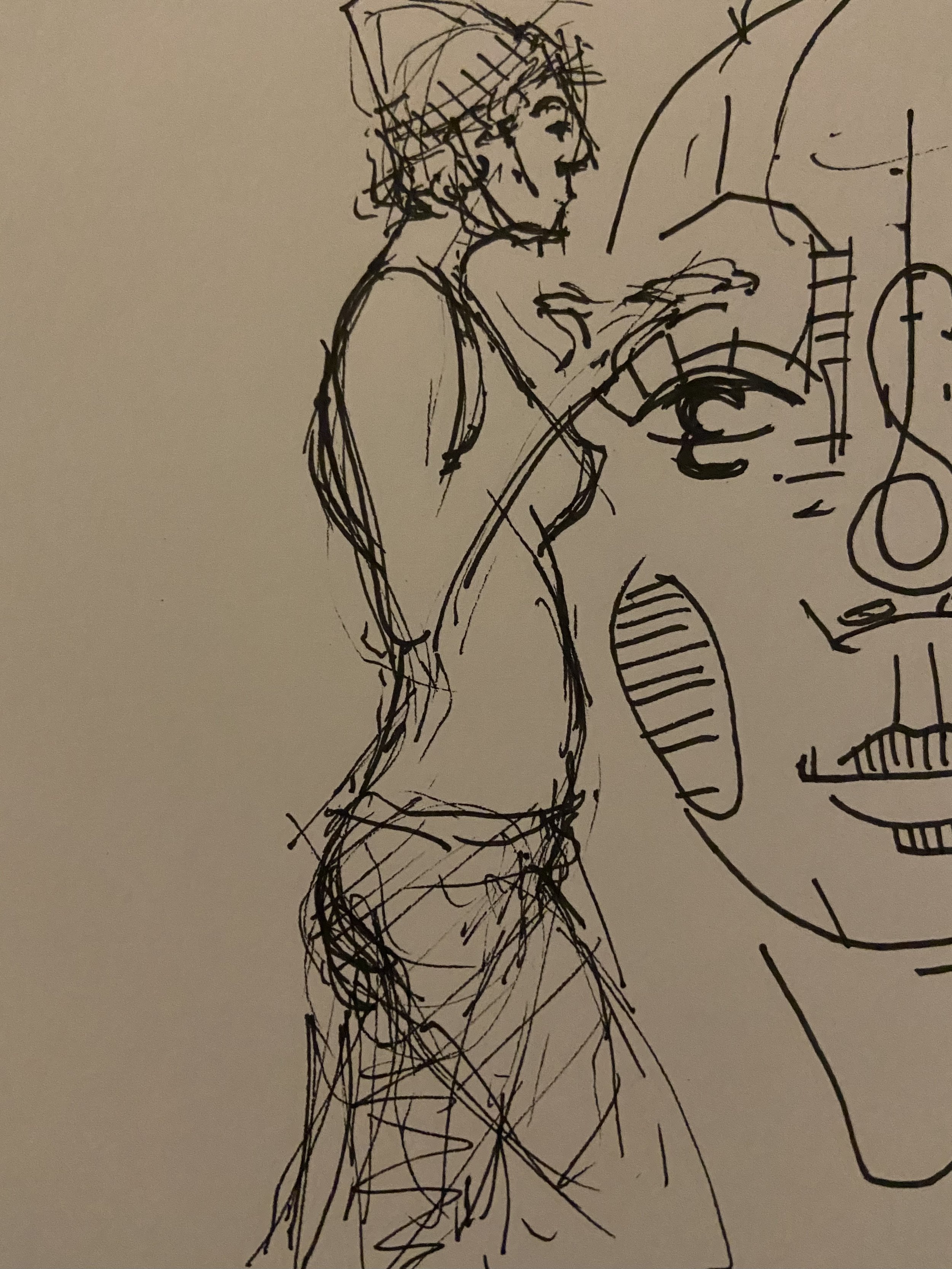
Standing Self Study
February 24, 2021. A standing study of me beside an oversized abstract face. My hat, profile, clothing, and body identify the figure. I found the drawing later inside his private sketchbook.
By February, the portraits had expanded beyond my face.
Here I appear in profile beside an enormous abstract head.
My figure is small in relation to the face surrounding me. I appear nearly absorbed into the larger image, placed beside something more monumental, more symbolic, and more complete.
I cannot know exactly what he intended.
I cannot enter his mind and translate every line.
But I can identify myself.
I can identify what I wore.
I can document that he repeatedly drew my face and body without ever showing me the work.
And I can describe the experience of discovering that I existed inside someone else’s private symbolic world while my actual life with that person was becoming increasingly unstable.
There is something deeply unsettling about finding your own body in a hidden archive.
You recognize yourself.
You do not recognize the story being told about you.
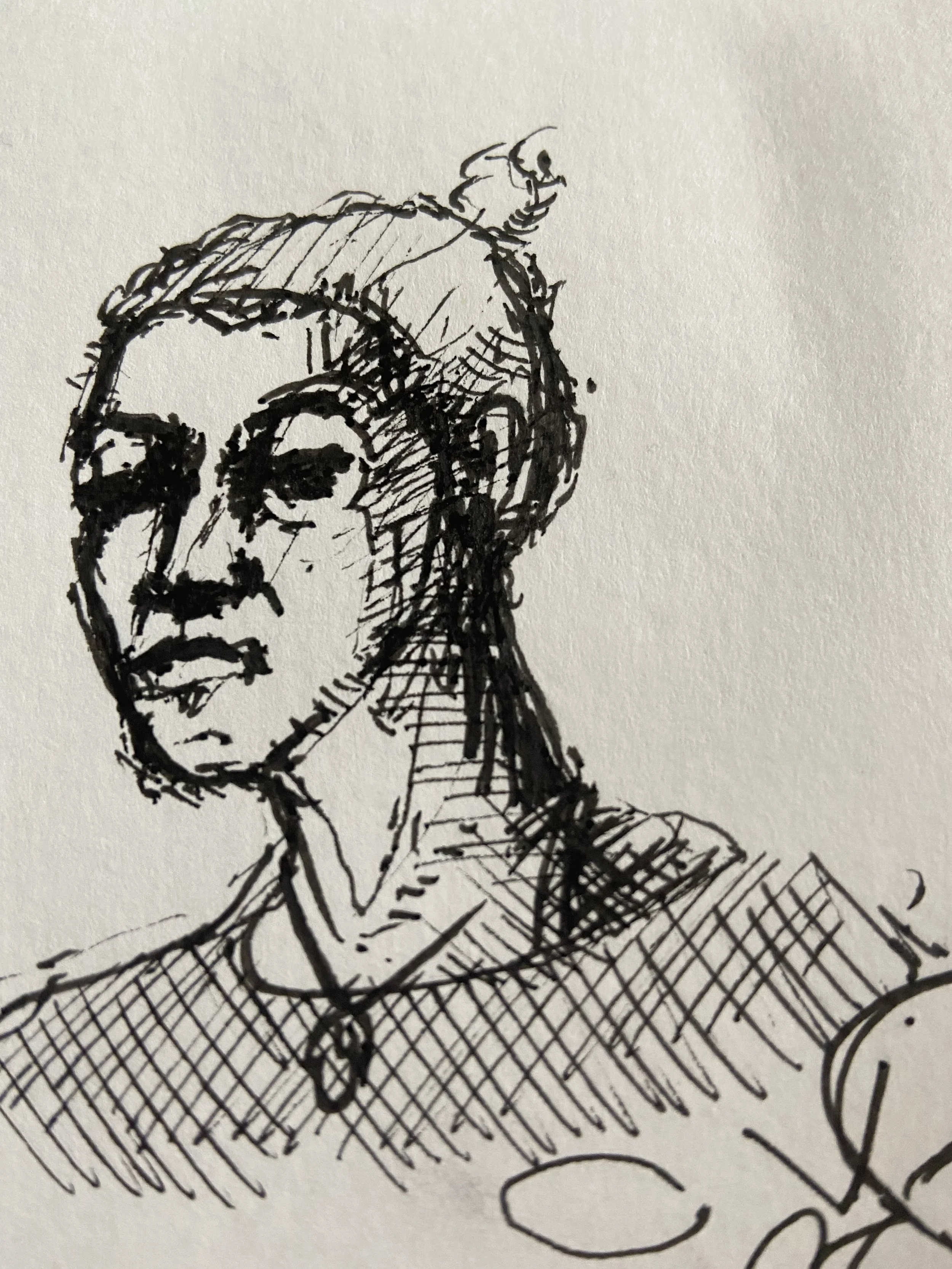
Self Portrait I
March 28, 2021. An ink portrait of me wearing my pendant necklace. The pendant, facial features, and hairstyle identify the subject.
This portrait is also me.
The pendant at my throat is mine.
The hairstyle is mine.
The facial structure is mine.
The lines are darker now. The eyes are heavily marked. One side of the face is built from dense crosshatching and shadow.
The portrait feels divided between exposure and concealment.
Part of the face is open.
Part of it is buried beneath ink.
Viewed alone, it is an expressive study.
Viewed beside the others, it becomes another entry in a private chronology of my image.
He kept drawing me.
He did not keep seeing me.
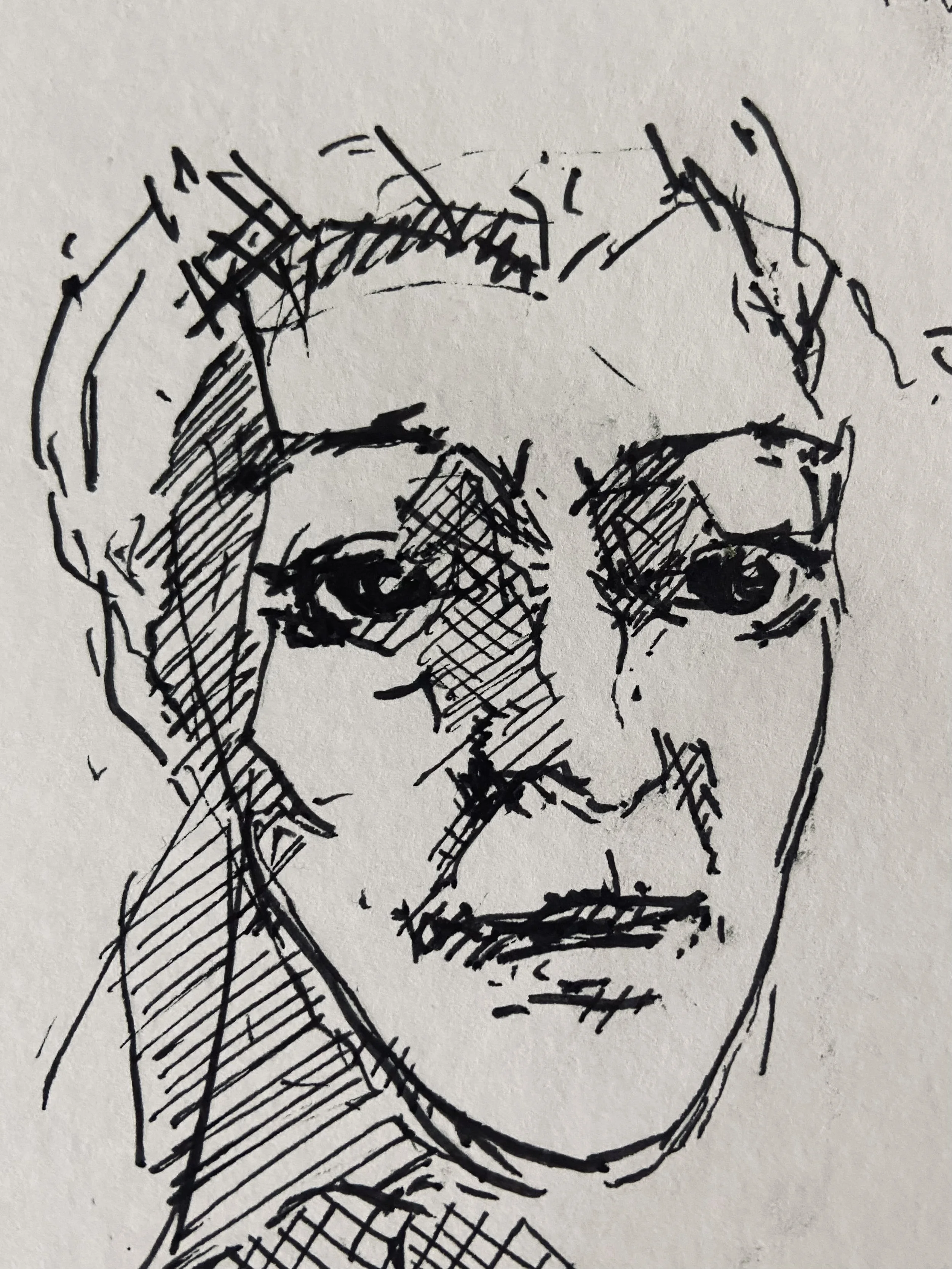
Self Portrait II
March 28, 2021. A second portrait of me from the same date, rendered with a direct gaze and heavy ink shading.
The same day, he drew me again.
This version is closer.
The face fills the page. The eyes look outward. The mouth is closed. The shading cuts across the forehead, nose, cheeks, and neck.
She appears watchful.
She also appears trapped inside the marks used to construct her.
These portraits were not made for me.
I did not receive them as gestures of love.
I did not know that my face was being preserved in this form.
I encountered them later as recovered objects, after the relationship had ended and after the meaning of everything surrounding them had changed.
That is why I call them artifacts.
An artwork is something we are invited to view.
An artifact is something that survives a history.
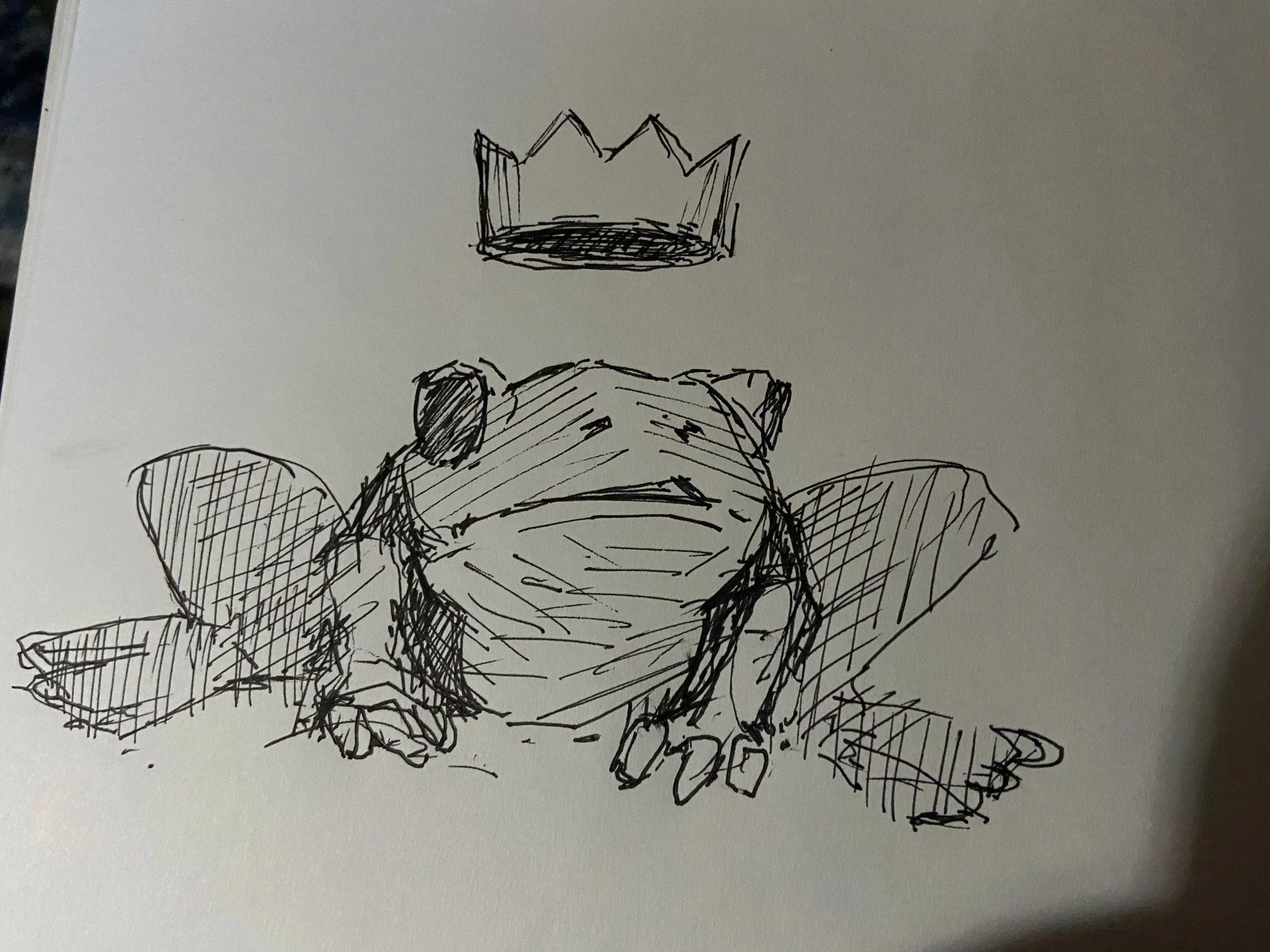
The Frog After My Mother’s Death
March 28, 2021. One day after my mother died. My mother loved frogs. He created this drawing the following day and never showed it to me. I found it later while documenting his sketchbooks.
Then there is the frog.
My mother loved frogs.
He drew this one day after she died.
He never showed it to me.
I discovered it later among the other sketches.
I cannot prove why he drew it. I will not assign him an intention he never expressed.
But the chronology is real.
My mother’s love of frogs is real.
Her death is real.
The date of the drawing is real.
The fact that he created it and kept it private while I was grieving is also real.
That absence belongs to the artifact.
A drawing that might have felt like recognition, tenderness, or shared mourning was never offered to me.
It did not comfort me when I needed comfort.
It did not acknowledge my mother while I was trying to survive her death.
I encountered it much later as evidence of something noticed but never given.
He recorded the symbol.
I lived the loss.
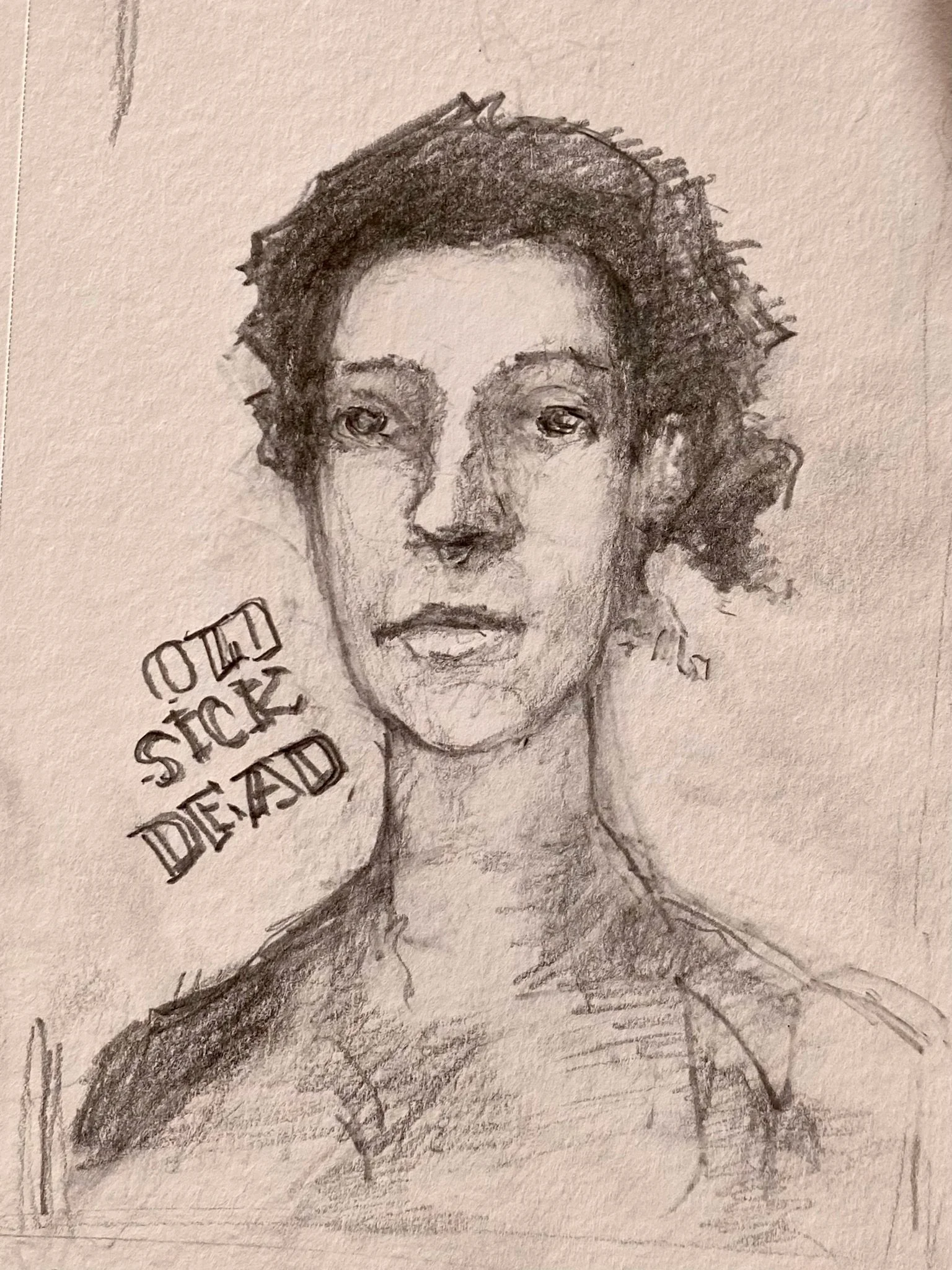
Old Sick Dead Self Portrait
September 3, 2021. A portrait of me with the words “Old Sick Dead” written beside my image. I found the drawing inside his private sketchbook. It was never presented or explained to me.
The final portrait is also me.
The face is mine.
The body is mine.
Beside my image, he wrote:
OLD SICK DEAD
Those words later became part of the identity he presented publicly.
Here, they appear beside my portrait.
I cannot claim to know every private association he attached to the phrase.
I can document what exists on the page.
My image and those words occupy the same artifact.
That matters because public identities do not appear from nowhere.
They are rehearsed.
They are assembled.
They develop first inside private lives.
They appear in notebooks beside faces, bodies, skulls, spiritual teachers, personal symbols, and recurring subjects before they emerge as finished personas for an audience.
The public sees the identity after it has been curated.
The sketchbook preserves the construction site.
What the Sketchbooks Preserve
These drawings do not prove every private intention.
They cannot tell me exactly what he believed, wanted, feared, or meant.
They prove something simpler.
They existed.
They document what he repeatedly drew.
They document when he drew it.
They document which details of my body and belongings he used.
They document what symbols and words he placed beside my image.
They also document what he withheld.
He did not give me the portraits.
He did not explain them.
He did not sit beside me and say, “I made this because I saw you.”
He kept them private.
I found them later.
That is the central fact of this collection.
The portraits depict me, but they were not made with me.
My face became material.
My clothing became reference.
My jewelry became symbolism.
My grief became chronology.
My body appeared in one drawing after another while my actual experience inside the relationship remained unseen, denied, or distorted.
Then the double portrait makes the private structure visible.
The woman he wanted is above me.
I am beneath her.
She is composed.
I am melting.
She is complete.
I am disappearing.
Her image is treated as an object of idealization.
Mine carries the consequence.
That is why these drawings belong in Recovered Work.
I am not presenting them as proof of thoughts I cannot verify.
I am presenting them as a visual record of a life I recognize because it is my own face, my own body, my own clothing, my own jewelry, my own grief, and my own history on the page.
The sketchbooks were private.
The consequences were not.
He drew the image.
I survived the context.
Now I am creating the record.